A Survey on Archetypal Analysis
Archetypal analysis (AA) was originally proposed in 1994 by Adele Cutler and Leo Breiman as a computational procedure for extracting distinct aspects, so-called archetypes, from observations, with each observational record approximated as a mixture (i.e., convex combination) of these archetypes. AA thereby provides straightforward, interpretable, and explainable representations for feature extraction and dimensionality reduction, facilitating the understanding of the structure of high-dimensional data and enabling wide applications across the sciences. However, AA also faces challenges, particularly as the associated optimization problem is non-convex. This is the first survey that provides researchers and data mining practitioners with an overview of the methodologies and opportunities that AA offers, surveying the many applications of AA across disparate fields of science, as well as best practices for modeling data with AA and its limitations. The survey concludes by explaining crucial future research directions concerning AA.
💡 Research Summary
This survey provides the first comprehensive overview of Archetypal Analysis (AA), a method originally introduced by Cutler and Breiman in 1994 for extracting extreme “archetypes” from high‑dimensional data and representing each observation as a convex combination of these archetypes. The authors begin by positioning AA within the broader landscape of unsupervised learning, contrasting it with PCA, ICA, NMF, and clustering. While PCA seeks orthogonal directions that capture variance, and NMF imposes non‑negativity, AA is grounded in convex geometry: archetypes themselves lie on the boundary of the data’s convex hull, guaranteeing that they are feasible, physically plausible mixtures of actual observations.
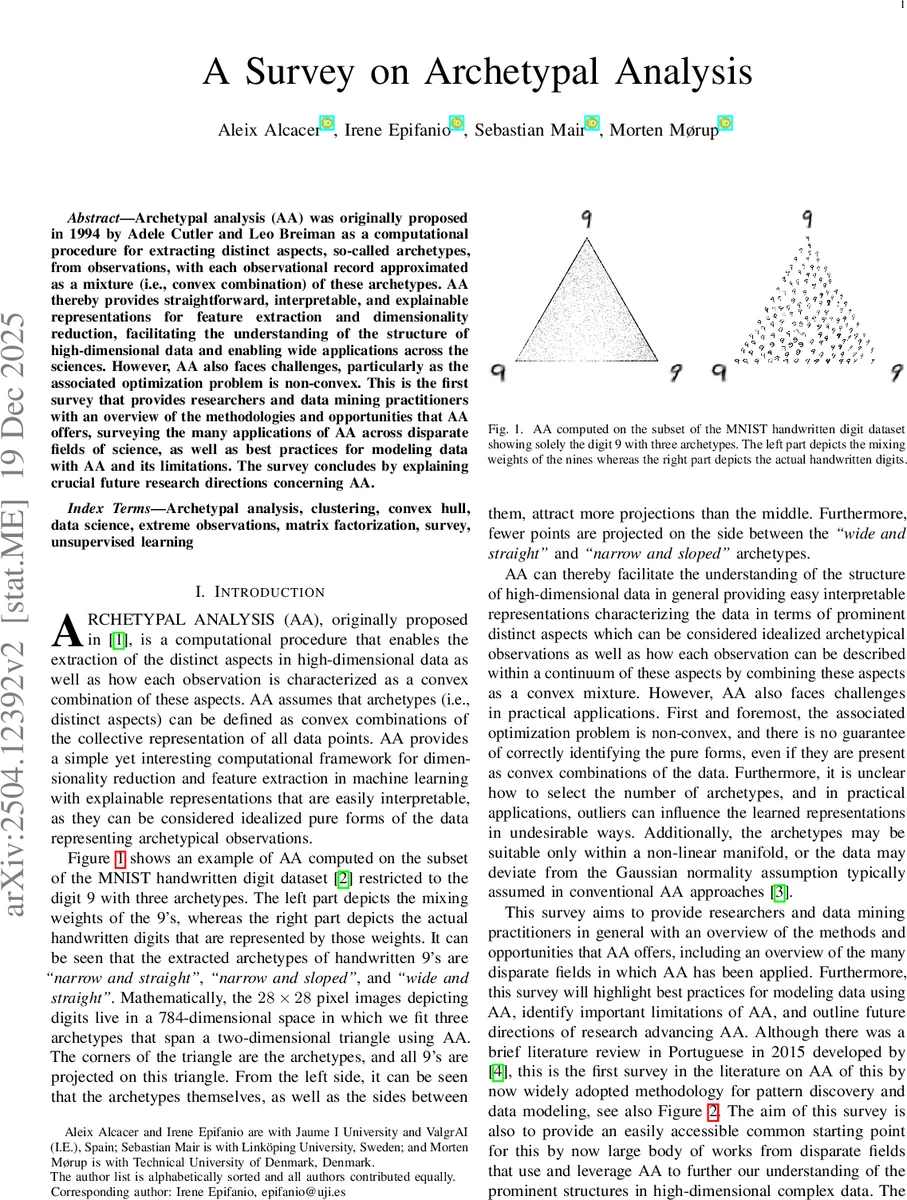
The paper traces the historical roots of the term “archetype” from philosophy and Jungian psychology to the 1990s need for interpretable factor models in atmospheric chemistry. It then enumerates a wide range of scientific domains where AA has been applied—evolutionary biology (Pareto optimality), chemistry (spectral end‑member extraction), remote sensing (hyperspectral unmixing), medicine (patient phenotyping), and social sciences (cultural pattern analysis). A concrete illustration on the MNIST digit‑9 subset shows how three archetypes (“narrow‑straight”, “narrow‑sloped”, “wide‑straight”) emerge and how each digit’s mixing weights are visualized.
Mathematically, AA seeks matrices S (N × K) and C (K × N) such that X ≈ S C X, where rows of S and C belong to the probability simplex. The objective is to minimize the residual sum of squares (RSS). The overall problem is non‑convex, but it is convex in S when C is fixed and vice‑versa, leading to the standard alternating optimization algorithm (Algorithm 1). The authors present key theoretical results: (i) archetypes always lie on the convex hull boundary for K > 1 (Theorem 1), (ii) the solution is invariant to affine transformations and scaling (Lemma 1), and (iii) there is no rotational ambiguity (Theorem 2). These properties underpin AA’s interpretability and robustness to preprocessing.
Recognizing the limitations of the vanilla model, the survey reviews a suite of extensions. Kernel AA maps data into a reproducing‑kernel Hilbert space to capture non‑linear structures; probabilistic AA embeds the factorization in a Bayesian framework, providing uncertainty quantification; functional AA handles continuous-time or spatial data; and deep AA integrates neural networks to learn archetypes end‑to‑end, scaling the method to massive datasets. Each extension is discussed in terms of its motivation, mathematical formulation, and representative software implementations.
The software landscape is summarized, highlighting R’s “archetypes” package, Python’s “pyarchetype”, and MATLAB toolboxes. The authors note differences in initialization strategies (e.g., random, k‑means‑based, convex‑hull seeding), convergence criteria, and visualization utilities (simplex plots, barycentric coordinates). They stress the importance of careful hyper‑parameter selection—particularly the number of archetypes K—and suggest cross‑validation, elbow methods, or domain‑specific criteria as practical guides.
A substantial portion of the paper catalogs applications across disciplines, illustrating AA’s versatility. In biology, AA reveals trade‑offs among life‑history traits; in chemistry, it isolates pure component spectra; in remote sensing, it extracts end‑members for land‑cover classification; in healthcare, it identifies extreme patient phenotypes that inform risk stratification; and in economics, it uncovers extreme market regimes. The authors argue that AA’s ability to surface boundary structures makes it uniquely suited for exploratory data analysis, hypothesis generation, and communication of results to non‑technical audiences.
The survey does not shy away from AA’s challenges. The non‑convex optimization can trap the algorithm in local minima, making results sensitive to initialization. Selecting K remains largely heuristic, and outliers can disproportionately pull archetypes toward the data periphery, potentially distorting interpretations. Computational cost grows with data size and dimensionality, especially for kernel or deep variants. The authors therefore outline future research directions: development of global optimization schemes (e.g., stochastic annealing, convex relaxations), automated model‑selection criteria for K, robust formulations that down‑weight outliers, scalable algorithms for massive high‑dimensional data, and tighter integration with downstream predictive models while preserving interpretability.
In conclusion, the authors position AA as a powerful, interpretable tool that complements existing unsupervised techniques. By focusing on extreme points of the data distribution, AA provides geometric insight, reveals trade‑offs, and yields compact representations that are readily visualized and communicated. Continued methodological advances and broader adoption across scientific domains are expected to cement AA’s role in the data‑science toolbox.
Comments & Academic Discussion
Loading comments...
Leave a Comment