A dual approach to proving electoral fraud using statistics and forensic evidence (Dvojnoe dokazatel'stvo falsifikazij na vyborah statistikoj i kriminalistikoj)
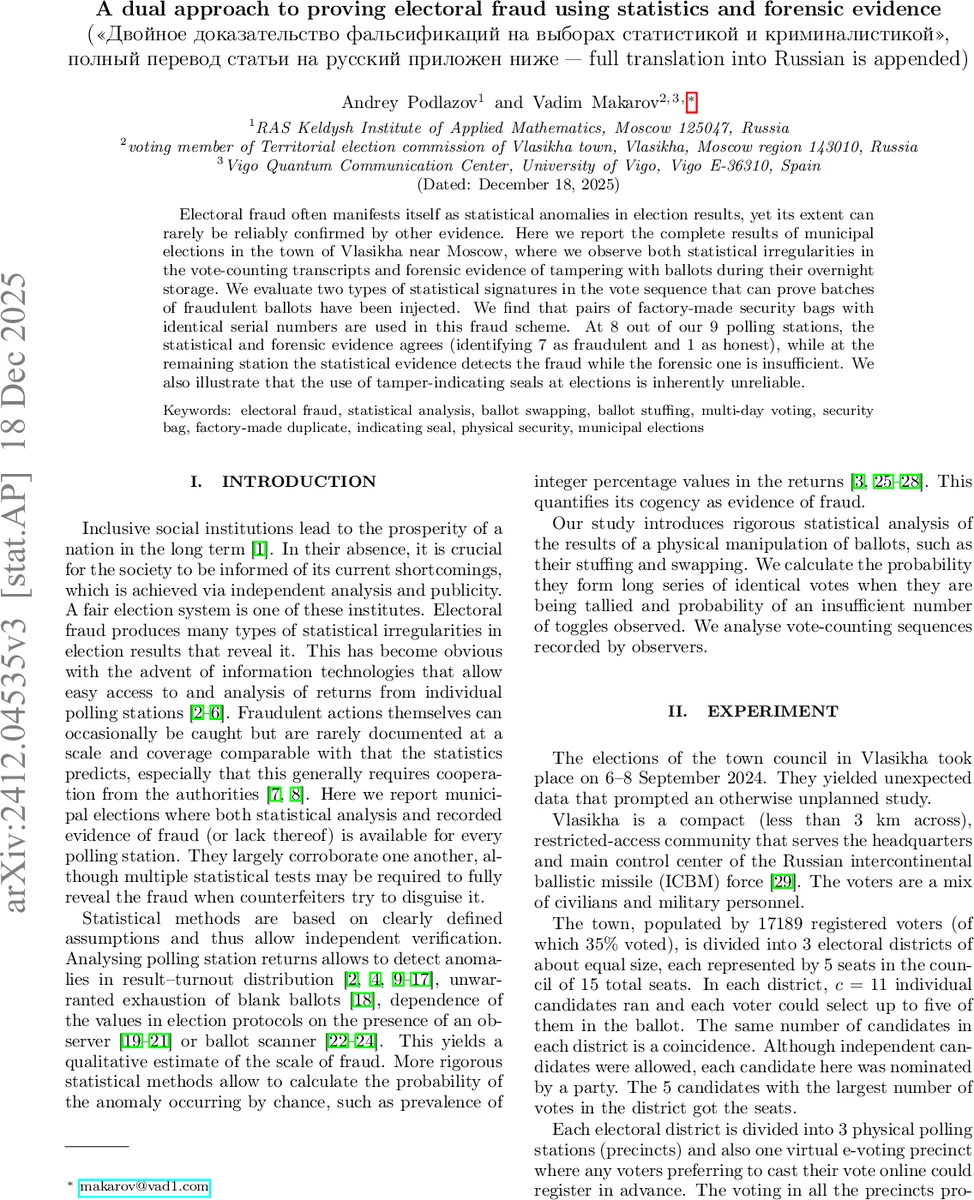
Electoral fraud often manifests itself as statistical anomalies in election results, yet its extent can rarely be reliably confirmed by other evidence. Here we report the complete results of municipal elections in the town of Vlasikha near Moscow, where we observe both statistical irregularities in the vote-counting transcripts and forensic evidence of tampering with ballots during their overnight storage. We evaluate two types of statistical signatures in the vote sequence that can prove batches of fraudulent ballots have been injected. We find that pairs of factory-made security bags with identical serial numbers are used in this fraud scheme. At 8 out of our 9 polling stations, the statistical and forensic evidence agrees (identifying 7 as fraudulent and 1 as honest), while at the remaining station the statistical evidence detects the fraud while the forensic one is insufficient. We also illustrate that the use of tamper-indicating seals at elections is inherently unreliable.
💡 Research Summary
The paper presents a comprehensive case study of the municipal elections held in September 2024 in the town of Vlasikha, Russia, examining all nine polling stations with both statistical analysis of vote‑counting transcripts and forensic examination of the physical security measures used to store ballots. The authors develop two statistical signatures designed to detect the injection of batches of identical ballots. The first signature calculates the probability (α₁ for the longest continuous run of votes for a candidate, α₀ for the longest run of non‑votes) that such a run could arise by chance under the assumption of independent voting. The minimum of these two probabilities (α_min) is taken as the candidate‑level indicator of possible ballot stuffing. The second signature evaluates the probability (˜α) that the observed number of continuous runs for all candidates does not exceed what would be expected naturally, and applies a multiplicity correction (˜α′ ≈ c·˜α_min, where c is the number of candidates). Probabilities are expressed as p‑values in log‑scale (p = ‑log₁₀α) to make the magnitude of evidence intuitive; values above 9 correspond to α < 10⁻⁹, i.e., less than one‑in‑a‑billion chance of occurring naturally.
Statistical assumptions are deliberately conservative: (1) every voter’s ballot is genuine and independent, and (2) the random mixing of ballots when they are dropped into a transparent box and later extracted preserves independence. In practice, ballots cast on each of the three voting days were sealed in tamper‑evident security bags, each bearing a unique serial number, and stored overnight. The authors obtained video and photographic records of the storage rooms and identified clear signs of tampering at seven stations: altered sealing tape, mismatched serial numbers, and in one case (precinct 219) a pair of factory‑produced duplicate bags with identical serial numbers, complete with forged pen signatures.
The forensic findings are cross‑checked with the statistical results. Eight of the nine stations exhibit statistically significant anomalies; seven of these (precincts 212, 213, 217, 218, 219, 220, 221) also show physical evidence of bag replacement or tape manipulation, confirming fraud. Precinct 220 displays an extreme run of 129 identical ballots for pro‑administration candidates, yielding a p‑value > 9, yet no visual tampering was captured, leaving the forensic evidence inconclusive. Precinct 215 shows neither statistical irregularities nor any forensic signs, indicating a clean process. The remaining stations (212, 213, 217) have lower p‑values but the authors attribute this to intentional mixing of ballots by election officials, which can break long runs and reduce statistical power.
A key contribution of the paper is the demonstration that tamper‑evident seals, while useful, are insufficient when adversaries can obtain factory‑made duplicate bags with the same serial numbers. The authors detail five methods of compromising the bags, including removal of the original tape, solvent cleaning, and re‑sealing with a duplicate bag. They argue that detection of such manipulation requires high‑resolution imaging and trained observers, resources that are rarely available in typical election settings.
Overall, the study provides a dual‑method framework for election fraud detection: rigorous statistical testing of vote sequences combined with systematic forensic inspection of ballot storage. By quantifying the probability of observed anomalies and documenting concrete physical tampering, the authors show that both lines of evidence can corroborate each other, reducing the risk of false accusations while increasing detection sensitivity. The methodology, especially the use of longest‑run statistics and multiplicity‑adjusted p‑values, offers a scalable tool for election monitors worldwide and highlights the need for stronger physical security measures beyond simple tamper‑evident seals.
Comments & Academic Discussion
Loading comments...
Leave a Comment