Local Well-posedenss of the Bartnik Static Extension Problem near Schwarzschild spheres
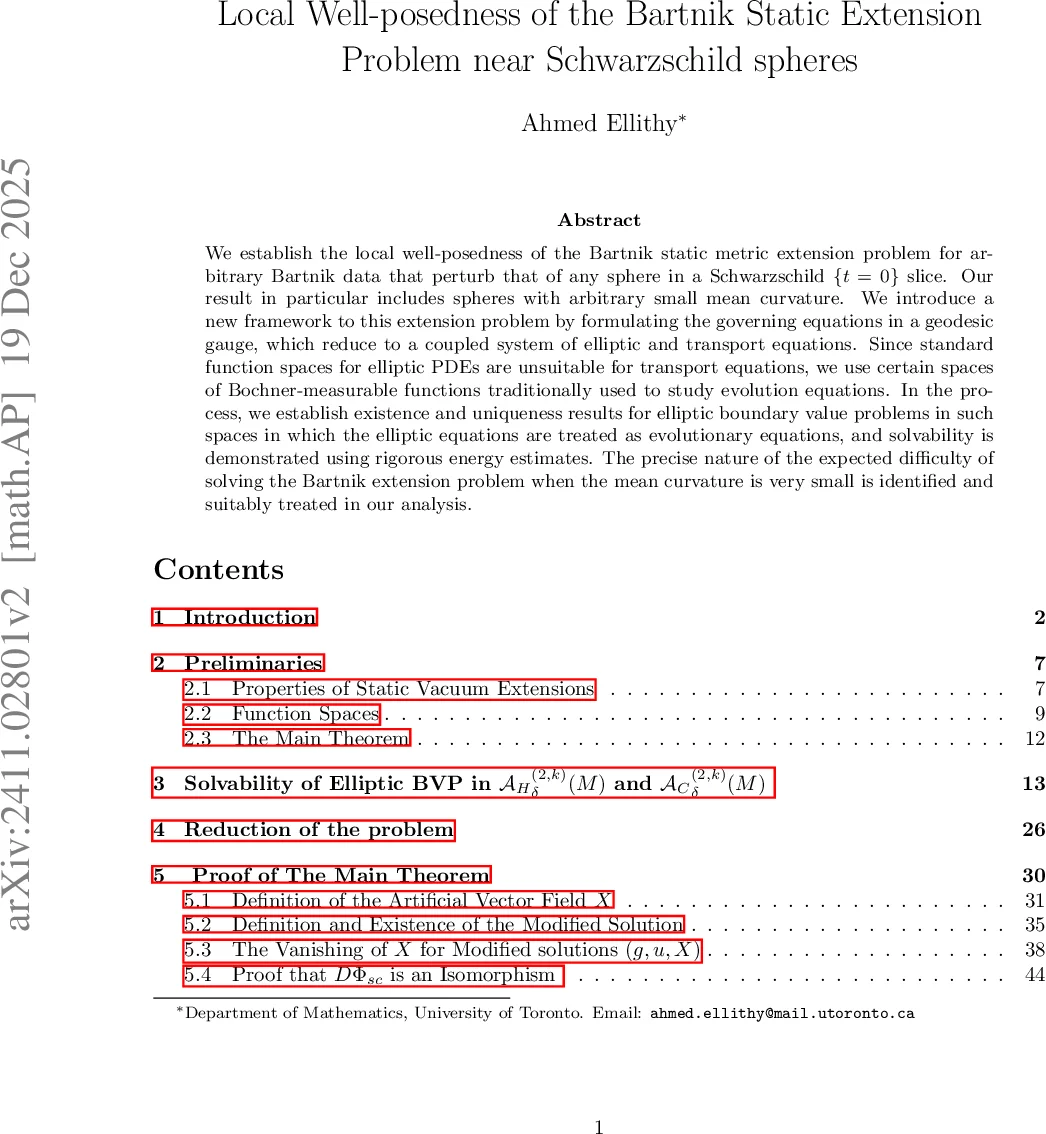
We establish the local well-posedness of the Bartnik static metric extension problem for arbitrary Bartnik data that perturb that of any sphere in a Schwarzschild ${t=0}$ slice. Our result in particular includes spheres with arbitrary small mean curvature. We introduce a new framework to this extension problem by formulating the governing equations in a geodesic gauge, which reduce to a coupled system of elliptic and transport equations. Since standard function spaces for elliptic PDEs are unsuitable for transport equations, we use certain spaces of Bochner-measurable functions traditionally used to study evolution equations. In the process, we establish existence and uniqueness results for elliptic boundary value problems in such spaces in which the elliptic equations are treated as evolutionary equations, and solvability is demonstrated using rigorous energy estimates. The precise nature of the expected difficulty of solving the Bartnik extension problem when the mean curvature is very small is identified and suitably treated in our analysis.
💡 Research Summary
The paper addresses the Bartnik static metric extension problem, which asks whether a given pair consisting of a Riemannian metric γ on a 2‑sphere and a prescribed mean curvature function H can be realized as the boundary data of an asymptotically flat static vacuum extension (g,f) on the exterior of a ball in ℝ³. Such extensions satisfy the static vacuum equations
Δ_g f = 0, Ric_g = f⁻¹ Hess_g f,
together with the boundary conditions g|_{∂M}=γ and the exterior mean curvature H_ext equals the prescribed H. The problem is motivated by Bartnik’s definition of quasi‑local mass, where the ADM mass of an admissible extension is minimized.
Previous work established local well‑posedness only under symmetry assumptions (Miao) or under the “static regularity” condition, which requires the linearized operator at a known solution to have trivial kernel (Huang‑An). However, static regularity is a condition on data that already lie inside a static vacuum solution and does not guarantee genericity in the space of Bartnik data.
The author introduces a completely new framework based on a geodesic gauge. By writing the unknown metric as g = f² ĝ and setting u = ln f, the static equations become
Ric_{ĝ}=2 ∇u⊗∇u,
so that in three dimensions the Ricci tensor determines the full Riemann curvature. The problem then splits into an elliptic equation for u coupled with a Riccati‑type transport system for the second fundamental form k of the equidistant foliation defined by the geodesic gauge. The transport equations evolve in the radial direction r, which plays the role of a “time” variable.
Because of this transport structure, the usual weighted Sobolev or Hölder spaces are unsuitable. Instead the author works in Bochner‑measurable function spaces traditionally used for evolution equations:
- (A H(2,k)_\delta(M)): L²‑based spaces with weighted norms controlling u, ∂_r u, and ∂²_r u.
- (A C(2,k)_\delta(M)): C⁰‑based analogues with the same weighted decay at infinity (δ∈(−1,−½)).
A central technical achievement is proving that the elliptic operator
Q : u ↦ (Δ_{ĝ} u, u|_{∂M})
is an isomorphism between these spaces and the corresponding boundary data spaces (Theorem 3.1). The proof relies on careful energy estimates, a Hardy‑type inequality (Appendix A.2), and a detailed analysis of the weighted norms. This result is non‑trivial because standard elliptic theory does not apply in the mixed Hölder–Sobolev spaces used here.
With the isomorphism in hand, the linearization of the full coupled system at a Schwarzschild solution is shown to be an isomorphism on the Banach manifolds built from the above function spaces. The author introduces an artificial vector field X to define a “modified solution” (g,u,X) and proves that X must vanish for genuine solutions, thereby eliminating the artificial constraint used in earlier works.
The Implicit Function Theorem on Banach manifolds then yields the main theorem: for any Schwarzschild sphere of radius r>2m (including radii arbitrarily close to the horizon where the mean curvature is very small), any Bartnik data (γ,H) that is a sufficiently small perturbation of the Schwarzschild data admits a unique static vacuum extension. Proposition 5.20 shows that the kernel of the linearized operator is trivial for every r>2m, so the “static regularity” condition holds automatically without any extra assumptions.
The paper also discusses the difficulty of the problem when the mean curvature tends to zero. Black‑hole uniqueness theorems imply that for zero mean curvature only round spheres admit extensions, so the admissible perturbation space shrinks as r→2m⁺. The analysis captures this subtlety and still proves solvability.
Compared with the Bianci‑harmonic gauge approach of Huang‑An, the geodesic gauge has several advantages:
- In three dimensions the Weyl tensor vanishes, turning the Ricci‑Hessian equation into a transport system that is easier to handle.
- The linearized problem reduces to a novel non‑local elliptic system (eq. 5.105), offering a new perspective for global existence questions.
- The framework is flexible and could be adapted to other foliations (e.g., inverse‑mean‑curvature flow) or to stationary (non‑static) extensions.
- The analysis of elliptic boundary value problems in the Bochner‑measurable spaces may have independent interest for other coupled elliptic‑hyperbolic systems.
A limitation is that the method relies heavily on the three‑dimensional identity Ricci = Riemann, so it does not directly extend to higher dimensions, where the Weyl tensor obstructs the simplification. Nonetheless, for the physically most relevant case of three‑dimensional initial data sets, the result provides a complete local well‑posedness theory for perturbations of any Schwarzschild sphere, removing symmetry or static‑regularity hypotheses.
In summary, the author establishes a robust, gauge‑theoretic, functional‑analytic framework that proves the existence and uniqueness of static vacuum extensions for arbitrary small perturbations of Schwarzschild boundary data, even when the mean curvature is arbitrarily small. This advances the understanding of Bartnik’s quasi‑local mass problem and opens new avenues for studying global extensions and related geometric PDE systems.
Comments & Academic Discussion
Loading comments...
Leave a Comment