Weak Independence and Coupled Parallelism in Biological Petri Nets
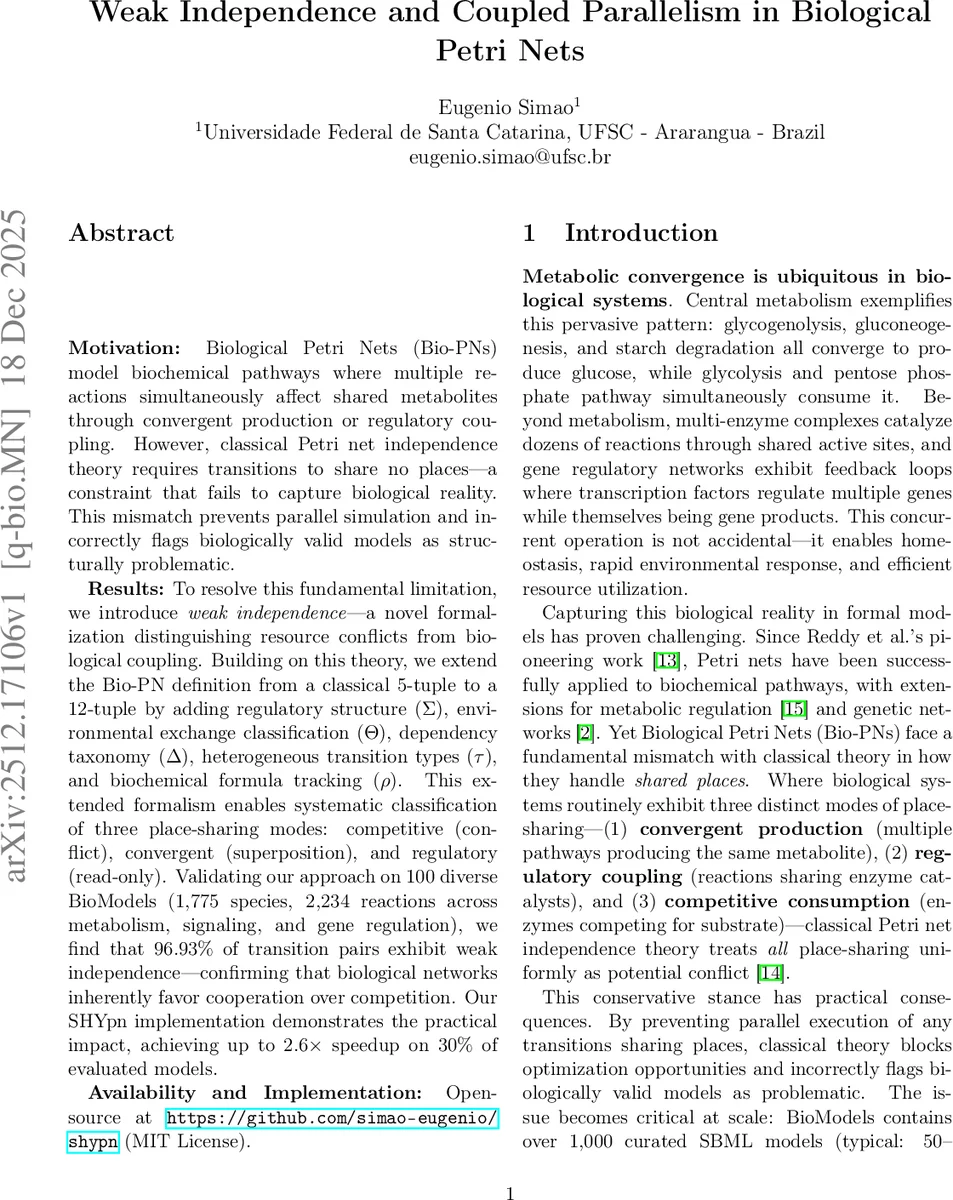
Motivation: Biological Petri Nets (Bio-PNs) model biochemical pathways where multiple reactions simultaneously affect shared metabolites through convergent production or regulatory coupling. However, classical Petri net independence theory requires transitions to share no places – a constraint that fails to capture biological reality. This mismatch prevents parallel simulation and incorrectly flags biologically valid models as structurally problematic. Results: To resolve this fundamental limitation, we introduce weak independence – a novel formalization distinguishing resource conflicts from biological coupling. Building on this theory, we extend the Bio-PN definition from a classical 5-tuple to a 12-tuple by adding regulatory structure, environmental exchange classification, dependency taxonomy, heterogeneous transition types, and biochemical formula tracking. This extended formalism enables systematic classification of three place-sharing modes: competitive (conflict), convergent (superposition), and regulatory (read-only). Validating our approach on 100 diverse BioModels (1,775 species, 2,234 reactions across metabolism, signaling, and gene regulation), we find that 96.93% of transition pairs exhibit weak independence – confirming that biological networks inherently favor cooperation over competition. Our SHYpn implementation demonstrates the practical impact, achieving up to 2.6x speedup on 30% of evaluated models. Availability and Implementation: Open-source at https://github.com/simao-eugenio/shypn (MIT License).
💡 Research Summary
The paper addresses a fundamental mismatch between classical Petri net independence theory and the realities of biological systems modeled with Biological Petri Nets (Bio‑PNs). Traditional independence requires that two transitions share no places (neither inputs, outputs, nor test arcs), which forces all place‑sharing transitions to be treated as conflicts. In real biochemical networks, however, multiple reactions often share the same product (convergent production), share catalysts or regulators without consuming them (regulatory coupling), or compete for the same substrate (competitive consumption). Treating all sharing as conflict blocks parallel simulation and incorrectly flags many biologically valid models as structurally problematic.
To resolve this, the authors introduce weak independence, a two‑tier independence hierarchy that distinguishes true resource conflicts from benign biological coupling. Weak independence permits parallel execution when transitions share output places (convergent mode) or share regulatory arcs (regulatory mode), while still prohibiting parallelism when they compete for the same input places (competitive mode). The authors formalize this with a new definition (Equation 5) and prove a correctness theorem showing that, under convergent or regulatory coupling, the combined ODE dynamics are equivalent to any sequential interleaving.
The paper also extends the classical 5‑tuple Petri net definition to a 12‑tuple Bio‑PN:
- P (places), T (transitions), F (flow relation), W (arc weights), M₀ (initial marking)
- K (place capacities), Φ (kinetic rate functions), Σ (regulatory/test arcs), Θ (environmental exchange classification), Δ (pairwise dependency classification), τ (transition semantics), ρ (chemical formula mapping).
These additions enable systematic representation of heterogeneous dynamics (continuous, stochastic, timed, immediate), environmental interactions (internal, source, sink, exchange), and mass‑balance verification via formula tracking.
A dependency classification algorithm (Algorithm 1) computes Δ for every pair of transitions by comparing their input, output, and regulatory arc sets. The algorithm runs in O(|T|²·|P|) time and modest space, making it feasible for genome‑scale models.
The authors implemented the theory in an open‑source tool called SHYpn. SHYpn parses SBML models, converts them into the 12‑tuple Bio‑PN, runs the classification algorithm, and schedules parallel simulation steps for transitions identified as weakly independent.
Empirical validation used 100 diverse SBML models from the BioModels repository (1,775 species, 2,234 reactions). Conversion fidelity was 100 %. Across 102,960 transition pairs, 96.93 % satisfied weak independence: 93.06 % were strongly independent (no shared places), 3.48 % were convergent, 0.38 % regulatory, and only 3.07 % competitive. Thus, true conflicts constitute a tiny fraction of all possible interactions, confirming that biological networks are inherently cooperative.
Performance experiments showed that SHYpn achieved an average speed‑up of 0.89× across all models (parallel overhead dominates for simple models) but reached up to 2.6× for complex cases (e.g., model BIOMD0000000415). Approximately 30 % of models obtained a speed‑up greater than 1×, with larger models benefiting more from parallelism.
In discussion, the authors argue that weak independence provides a biologically faithful notion of parallelism, enabling scalable simulation of large‑scale metabolic, signaling, and gene‑regulatory networks. The 12‑tuple formalism unifies continuous, stochastic, and timed dynamics while supporting mass‑balance checks via chemical formulas. The dependency classification algorithm offers automated structural analysis, and SHYpn demonstrates practical gains in simulation speed.
Overall, the paper makes a significant contribution by reconciling Petri net theory with biological reality, introducing a robust theoretical framework, extending the formal model, providing efficient analysis tools, and showing tangible performance improvements on real-world biological models. This work opens the door for more efficient, parallelizable simulations in systems biology and related fields.
Comments & Academic Discussion
Loading comments...
Leave a Comment