The accretion of quasars at the epoch of reionisation: $JWST$ catches the primeval monsters slowly feasting
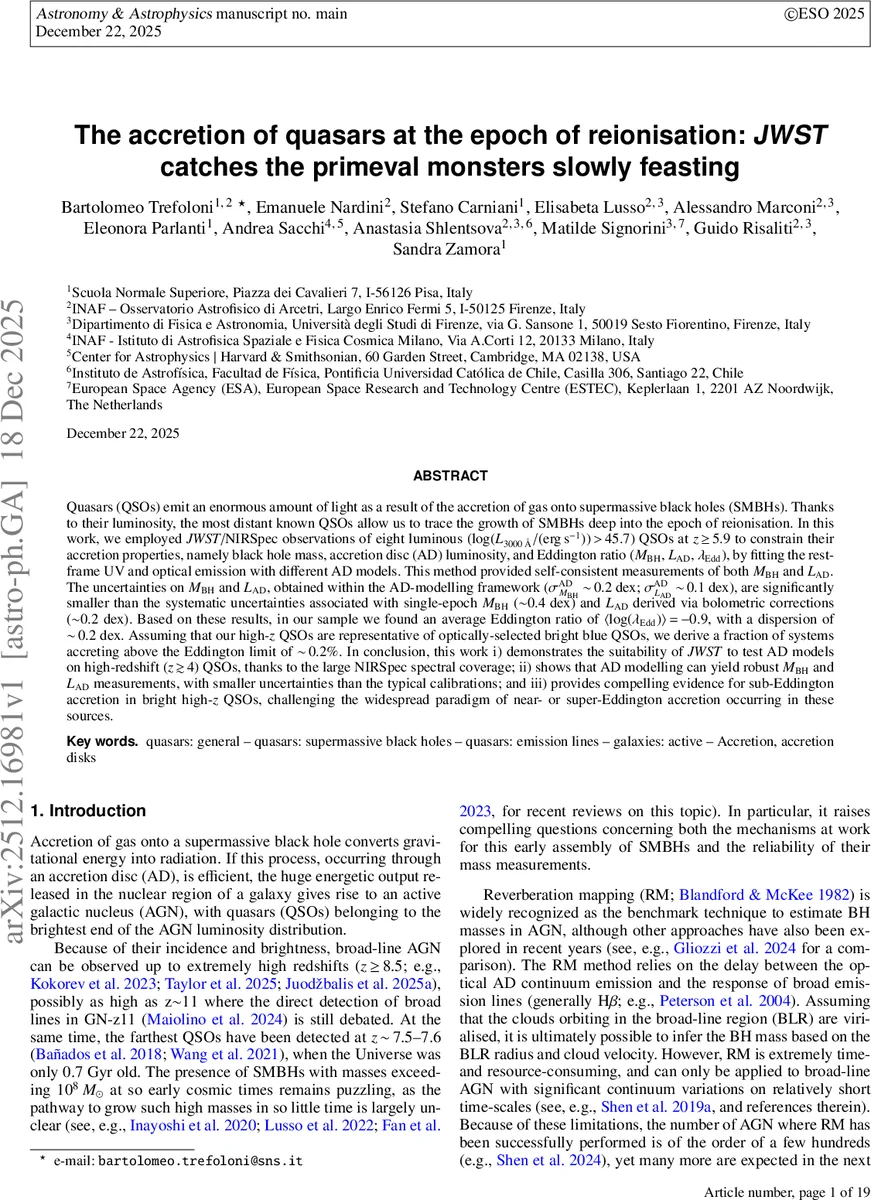
Quasars (QSOs) emit an enormous amount of light as a result of the accretion of gas onto supermassive black holes (SMBHs). Thanks to their luminosity, the most distant known QSOs allow us to trace the growth of SMBHs deep into the epoch of reionisation. In this work, we employed $JWST$/NIRSpec observations of eight luminous (log$(L_{3000,A^{\circ}}/(erg , s^{-1}))>$45.7) QSOs at $z\geq$5.9 to constrain their accretion properties, namely black hole mass, accretion disc (AD) luminosity, and Eddington ratio ($M_{BH}$, $L_{AD}$, $λ_{Edd}$), by fitting the rest-frame UV and optical emission with different AD models. This method provided self-consistent measurements of both $M_{BH}$ and $L_{AD}$. The uncertainties on $M_{BH}$ and $L_{AD}$, obtained within the AD-modelling framework ($σ^{AD}{M{BH}}\sim$0.2 dex; $σ^{AD}{L{AD}}\sim$0.1 dex), are significantly smaller than the systematic uncertainties associated with single-epoch $M_{BH}$ ($\sim$0.4 dex) and $L_{AD}$ derived via bolometric corrections ($\sim$0.2 dex). Based on these results, in our sample we found an average Eddington ratio of $\langle \log(λ_{Edd}) \rangle=-0.9$, with a dispersion of $\sim$0.2 dex. Assuming that our high-z QSOs are representative of optically-selected bright blue QSOs, we derive a fraction of systems accreting above the Eddington limit of $\sim$0.2%. In conclusion, this work i) demonstrates the suitability of $JWST$ to test AD models on high-redshift ($z\gtrsim$4) QSOs, thanks to the large NIRSpec spectral coverage; ii) shows that AD modelling can yield robust $M_{\rm BH}$ and $L_{\rm AD}$ measurements, with smaller uncertainties than the typical calibrations; and iii) provides compelling evidence for sub-Eddington accretion in bright high-$z$ QSOs, challenging the widespread paradigm of near- or super-Eddington accretion occurring in these sources.
💡 Research Summary
This paper presents a detailed study of eight luminous quasars at redshifts z ≥ 5.9 using JWST/NIRSpec low‑resolution PRISM/CLEAR observations that cover the rest‑frame wavelength range from roughly 1,200 Å to 6,700 Å. The authors aim to overcome the large systematic uncertainties inherent in traditional single‑epoch (SE) virial black‑hole mass estimators by fitting the full ultraviolet‑optical spectral energy distribution (SED) with physically motivated accretion‑disc (AD) models.
First, the spectra are carefully decomposed to isolate the broad components of the Mg II, H β, and H α emission lines. A custom Python pipeline, built on the MPFIT Levenberg‑Marquardt optimizer, models each line with a combination of Gaussians, Lorentzians, or broken power‑law profiles, while simultaneously fitting Fe II blends and narrow lines such as
Comments & Academic Discussion
Loading comments...
Leave a Comment