Theory of exciton polarons in 2D Wigner crystals
Monolayer transition-metal dichalcogenides (TMDs) provide a platform for realizing Wigner crystals and enable their detection via exciton spectroscopy. We develop a microscopic theoretical model for excitons interacting with the localized electrons of the Wigner crystal, including their vibrational motion. In addition to the previously observed exciton-Umklapp feature, the theory reproduces and explains the higher-band attractive-polaron resonances recently reported experimentally. Our model further uncovers that the appearance of two equal-strength and parallel attractive polarons, as commonly observed in WSe$_2$ and WS$_2$, is a signature of strong correlations in the electronic system. Altogether, our results demonstrate that accounting for electronic interactions is essential to reproduce and interpret the exciton-polaron spectra of TMDs.
💡 Research Summary
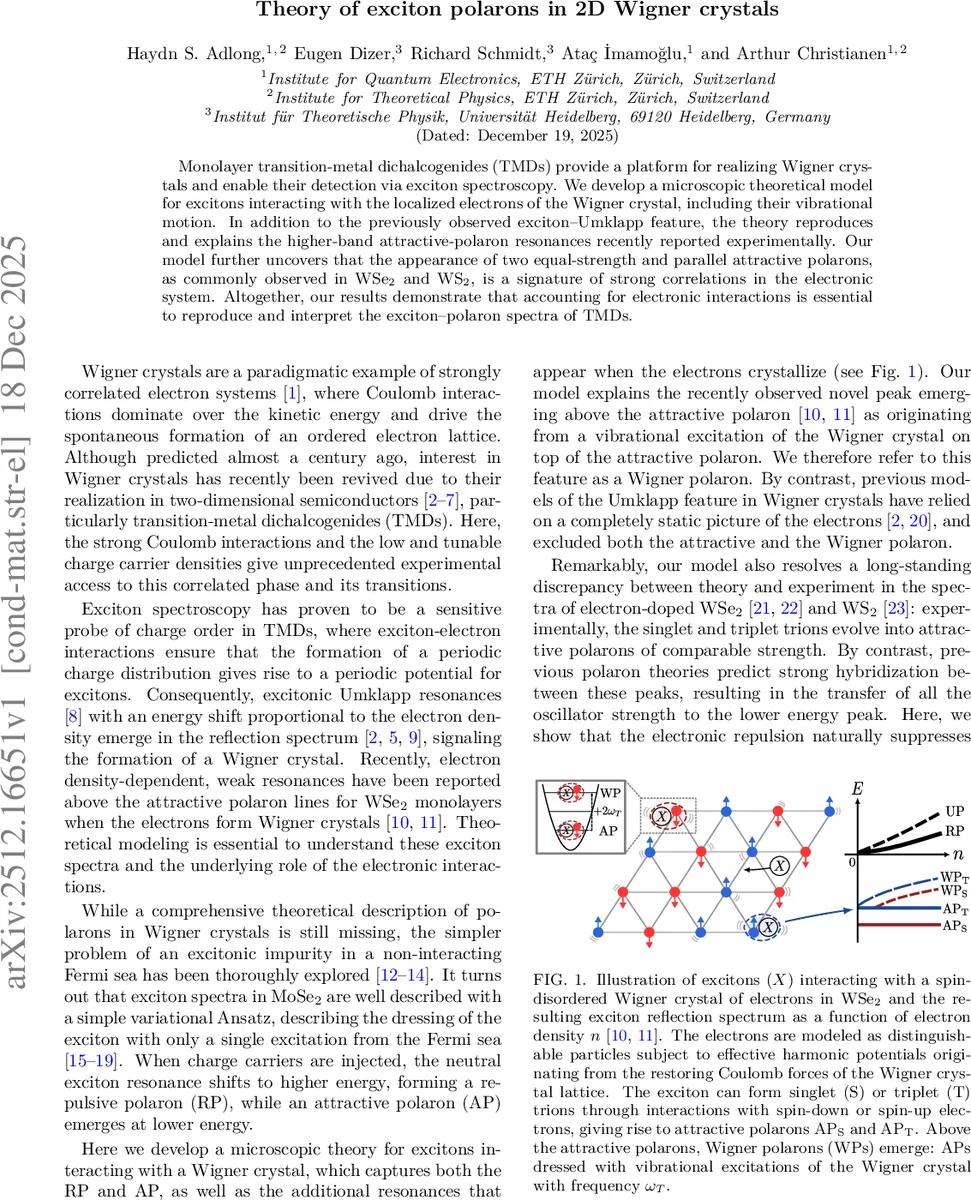
This paper presents a comprehensive microscopic theory of exciton polarons in monolayer transition‑metal dichalcogenides (TMDs) when the charge carriers form a two‑dimensional Wigner crystal. The authors start from the observation that, at low electron densities, Coulomb repulsion dominates kinetic energy and forces electrons into an ordered lattice. In this regime the electrons are spatially well separated, allowing them to be treated as distinguishable particles each confined by a harmonic potential generated by the mean‑field Hartree potential of all other electrons. The harmonic frequency ωₑ is derived analytically and scales as n³⁄⁴ with the electron density n, reflecting the long‑range nature of the Coulomb interaction.
The exciton is modeled as a point‑like particle of mass mₓ≈0.81 m₀ that interacts with the electrons via a contact interaction g δ(Rₑ−Rₓ). The coupling constant g depends on the electron spin/valley index, which distinguishes the formation of a singlet trion (attractive polaron AP_S) and a triplet trion (AP_T). The Hamiltonian is split into two subspaces using a projector P onto the electronic ground‑state manifold and a coupling operator V that excites a single electron to its first harmonic level. This “single‑excitation” approximation is directly analogous to the Chevy ansatz used for Fermi‑polaron problems and reduces the many‑body self‑energy Σ(ω) to a sum over independent lattice sites, making the calculation tractable for arbitrary spin configurations.
Two distinct physical situations are examined. In a fully spin‑polarized crystal (e.g., under a strong magnetic field) the calculated spectral function shows four characteristic peaks: (i) the low‑energy attractive polaron (AP), (ii) the high‑energy repulsive polaron (RP), (iii) an Umklapp polaron (UP) that appears above RP due to the periodic potential of the crystal, and (iv) a new “Wigner polaron” (WP) located roughly 2 ω_T above the AP, where ω_T is the vibrational frequency of the trion (a combination of the exciton and electron masses). The WP carries about 10 % of the oscillator strength of the AP and its AP‑WP splitting follows the same n³⁄⁴ scaling as ωₑ, in contrast to the linear‑n scaling of the UP‑RP separation. This demonstrates that the crystal’s vibrational dynamics directly dress the exciton‑trion complex.
In the spin‑disordered case (no external magnetic field) the electrons are assigned random up/down spins in a large supercell. The theory predicts two parallel, equal‑strength attractive‑polaron branches (AP_S and AP_T) each accompanied by its own WP (WP_S, WP_T). Crucially, the two AP branches do not hybridize, unlike the situation in a non‑interacting Fermi sea where strong hybridization transfers all oscillator strength to the lower‑energy branch. The lack of hybridization is traced to the spatial localization of each AP wavefunction on a specific spin sublattice; the overlap between singlet‑ and triplet‑type electronic components is negligible when the spins are spatially separated and the kinetic cost of delocalizing exceeds the trion binding‑energy difference. This provides a clear signature that the observed double‑AP structure in WSe₂ and WS₂ originates from strong electronic correlations rather than simple band‑filling effects.
The authors also discuss the role of phonons beyond the local harmonic approximation. By replacing a single electron with a trion in a finite‑size crystal they compute a realistic phonon spectrum and find that the WP resonance persists but acquires a finite linewidth and a modest energy shift. Disorder further broadens the line inhomogeneously, suggesting that experimental WP linewidths contain contributions from both localized phonon decay and sample inhomogeneity.
Comparison with recent experiments on electron‑doped WSe₂ shows excellent agreement: the same set of AP, RP, UP, and WP features appear, and the disappearance of one AP/WP pair under optical or magnetic spin‑polarization is naturally explained. The theory slightly overestimates the red‑shift of the AP with increasing density, a discrepancy attributed to missing band‑gap renormalization and exciton‑binding‑energy reduction effects, which are known to partially cancel the density‑induced shift. Nonetheless, the energy separation between AP and RP is reproduced accurately.
In summary, the paper delivers a unified microscopic framework that captures all salient exciton‑polaron features observed in TMDs with Wigner‑crystallized electrons. It highlights that (1) the presence of two equal‑strength, parallel attractive polarons is a hallmark of strong electron‑electron correlations, (2) the newly identified Wigner polaron arises from trion vibrational excitations, and (3) realistic phonon dynamics modestly modify but do not destroy the WP signature. These insights pave the way for using exciton spectroscopy as a sensitive probe of electronic ordering and correlations in low‑dimensional materials, and they suggest future extensions that incorporate full electron‑electron correlations and dynamic screening for even more quantitative agreement.
Comments & Academic Discussion
Loading comments...
Leave a Comment