Lie symmetry classification and exact solutions of a diffusive Lotka-Volterra system with convection
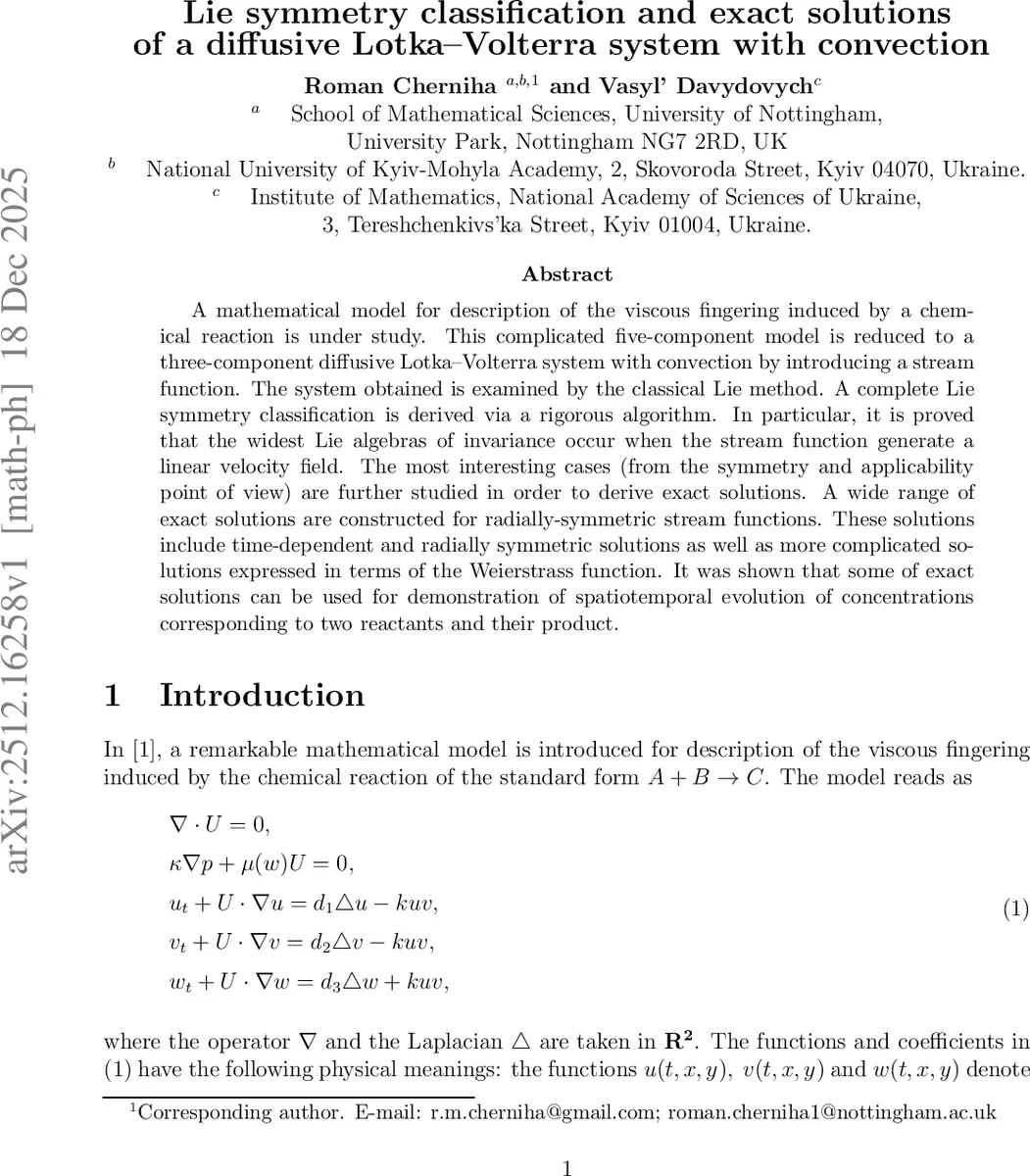
A mathematical model for description of the viscous fingering induced by a chemical reaction is under study. This complicated five-component model is reduced to a three-component diffusive Lotka-Volterra system with convection by introducing a stream function. The system obtained is examined by the classical Lie method. A complete Lie symmetry classification is derived via a rigorous algorithm. In particular, it is proved that the widest Lie algebras of invariance occur when the stream function generate a linear velocity field. The most interesting cases (from the symmetry and applicability point of view) are further studied in order to derive exact solutions. A wide range of exact solutions are constructed for radially-symmetric stream functions. These solutions include time-dependent and radially symmetric solutions as well as more complicated solutions expressed in terms of the Weierstrass function. It was shown that some of exact solutions can be used for demonstration of spatiotemporal evolution of concentrations corresponding to two reactants and their product.
💡 Research Summary
The paper addresses the mathematical description of viscous fingering that arises when a chemical reaction of the type A + B → C takes place in a porous medium. The original formulation consists of a five‑component system: incompressibility (∇·U = 0), Darcy’s law for the pressure gradient, and three convection‑diffusion‑reaction equations for the concentrations of the two reactants (u, v) and the product (w). By introducing a stream function Ψ(x, y) such that the two‑dimensional velocity field is given by U₁ = ∂Ψ/∂y, U₂ = −∂Ψ/∂x, the continuity equation is automatically satisfied and the pressure equation decouples. Assuming that Ψ does not depend on time, the model collapses to a three‑component diffusive Lotka‑Volterra system with convection:
u_t + Ψ_y u_x − Ψ_x u_y = d₁Δu − k uv,
v_t + Ψ_y v_x − Ψ_x v_y = d₂Δv − k uv,
w_t + Ψ_y w_x − Ψ_x w_y = d₃Δw + k uv.
Here d₁, d₂, d₃ > 0 are diffusion coefficients, k > 0 is the reaction rate, and Ψ(x, y) is an arbitrary spatial stream function. The authors apply the classical Lie symmetry method to this system. First, they determine the full group of equivalence transformations (ETs) that map the system onto itself while possibly changing Ψ, the diffusion coefficients, and the reaction rate. These ETs consist of time scaling, planar rotations, translations, and a linear superposition term acting on w, reflecting the linearity of the third equation.
With the ETs in hand, the authors compute the principal Lie algebra, i.e., the symmetry algebra that exists for an arbitrary Ψ. It contains only the time translation ∂ₜ and an infinite‑dimensional family H(t, x, y)∂_w, where H satisfies the linear convection‑diffusion equation associated with w. Additional symmetries appear when the diffusion coefficients satisfy d₁ = d₃, d₂ = d₃, or d₁ = d₂ = d₃, giving rise to operators (u + w)∂_w, (v + w)∂_w, and two further generators, respectively.
The core of the classification is the solution of the determining equations for Ψ. By integrating these equations, the authors find that only eleven distinct functional forms of Ψ lead to an enlargement of the symmetry algebra. These forms include radial functions F(r²) with possible arctangent terms, linear combinations α₁x + α₂y, logarithmic expressions, exponential factors, and quadratic polynomials. Each case is listed in Table 1 together with the extra symmetry generators (e.g., rotations y∂ₓ − x∂ᵧ, scalings 2t∂ₜ + x∂ₓ + y∂ᵧ, or more exotic combinations). The most symmetric situation occurs when Ψ = x² + y², which corresponds to a linear velocity field and yields the full eleven‑generator algebra.
Having identified the symmetry‑rich cases, the authors proceed to construct exact solutions. Using the admitted symmetries they perform similarity reductions, converting the PDE system into ordinary differential equations (ODEs). For the radially symmetric stream function Ψ = x² + y², they obtain families of solutions that are either self‑similar (power‑law in time) or stationary radial profiles. In a particularly interesting subcase, the reduced ODEs lead to the Weierstrass ℘‑function, providing elliptic‑function solutions that exhibit periodic spatial structures. These solutions are not merely mathematical curiosities; they describe nontrivial spatiotemporal patterns of the reactant and product concentrations, such as expanding concentration fronts or oscillatory fingering patterns.
The paper includes graphical illustrations of several solution families, showing how the concentrations u, v, and w evolve from an initially localized perturbation. The plots demonstrate that the analytical solutions capture key qualitative features observed in experiments on viscous fingering, such as the formation of finger‑like protrusions and the subsequent merging or splitting of concentration zones.
In conclusion, the work delivers a complete Lie symmetry classification for a convection‑diffusion‑reaction system derived from a realistic viscous fingering model, identifies all stream functions that enlarge the symmetry group, and exploits these symmetries to obtain a rich set of exact solutions, including novel elliptic‑function expressions. The methodology showcases how symmetry analysis can turn a highly nonlinear, multi‑component PDE system into a tractable problem, providing insight into the underlying physics and offering benchmark solutions for future numerical and experimental studies.
Comments & Academic Discussion
Loading comments...
Leave a Comment