Unified Semantic Transformer for 3D Scene Understanding
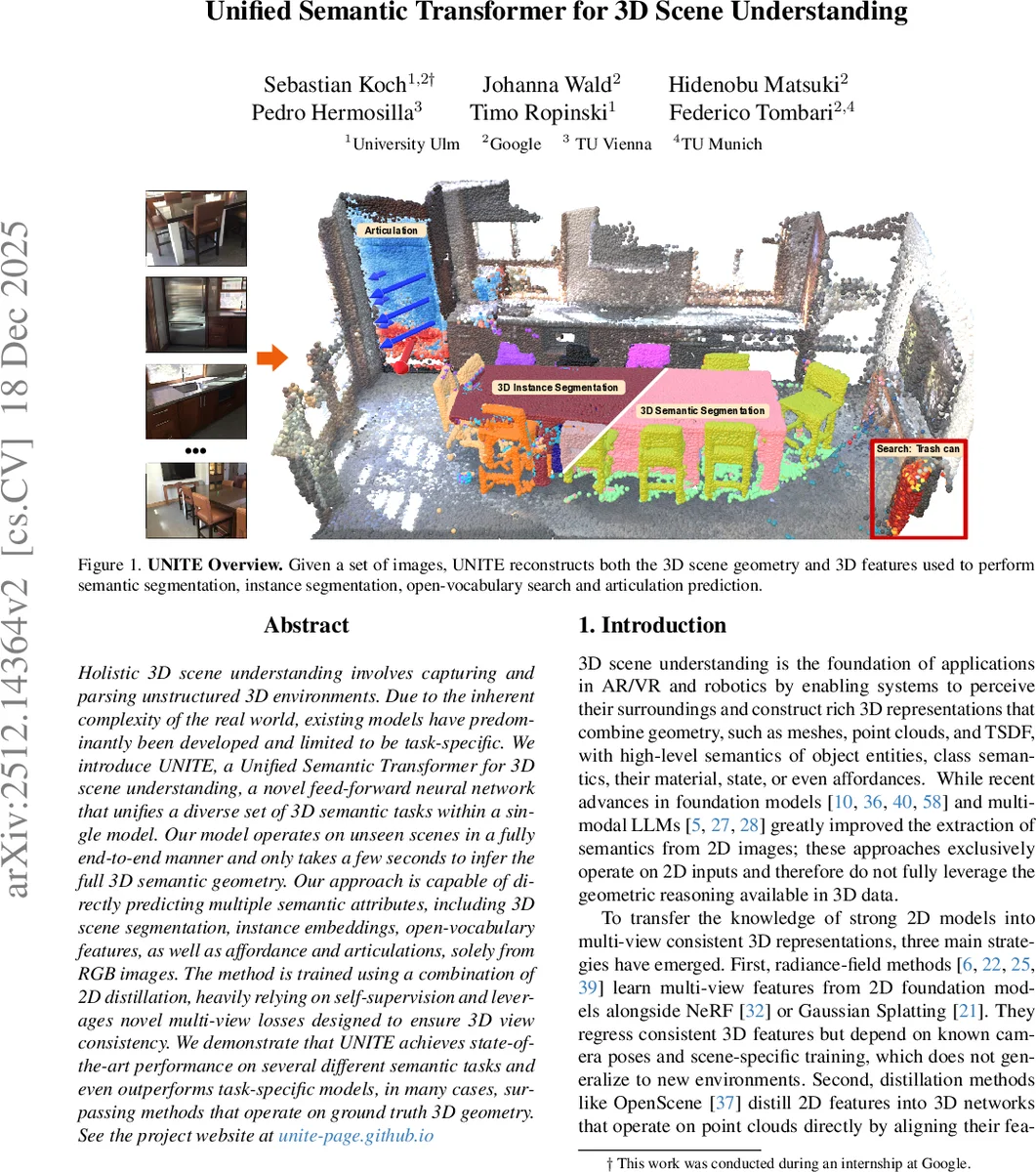
Holistic 3D scene understanding involves capturing and parsing unstructured 3D environments. Due to the inherent complexity of the real world, existing models have predominantly been developed and limited to be task-specific. We introduce UNITE, a Unified Semantic Transformer for 3D scene understanding, a novel feed-forward neural network that unifies a diverse set of 3D semantic tasks within a single model. Our model operates on unseen scenes in a fully end-to-end manner and only takes a few seconds to infer the full 3D semantic geometry. Our approach is capable of directly predicting multiple semantic attributes, including 3D scene segmentation, instance embeddings, open-vocabulary features, as well as affordance and articulations, solely from RGB images. The method is trained using a combination of 2D distillation, heavily relying on self-supervision and leverages novel multi-view losses designed to ensure 3D view consistency. We demonstrate that UNITE achieves state-of-the-art performance on several different semantic tasks and even outperforms task-specific models, in many cases, surpassing methods that operate on ground truth 3D geometry. See the project website at unite-page.github.io
💡 Research Summary
The paper introduces UNITE (Unified Semantic Transformer), a novel feed‑forward transformer architecture that simultaneously reconstructs 3D geometry and predicts a rich set of semantic attributes from a collection of RGB images taken from arbitrary viewpoints. Unlike prior pipelines that treat geometry reconstruction and semantic reasoning as separate stages—or that rely on task‑specific networks—UNITE integrates everything into a single end‑to‑end model that runs in a few seconds per scene.
Core Architecture
UNITE builds on a pre‑trained geometric backbone (VGGT) that processes multi‑view image tokens through alternating frame‑wise and global self‑attention layers. This backbone jointly predicts camera intrinsics/poses, depth maps, and a dense point cloud (point map) without any external Structure‑from‑Motion or Multi‑View Stereo modules. On top of the shared multi‑view encoder, the authors attach several Dense Prediction Transformer (DPT) heads, each dedicated to a different semantic task: (i) open‑vocabulary semantic features aligned with CLIP space, (ii) class‑agnostic instance embeddings, (iii) affordance and open‑vocab queries, and (iv) per‑pixel articulation parameters (translation and rotation approximated as linear displacements).
Training Strategy
The model is trained using a combination of 2D distillation and novel multi‑view consistency losses. For semantic distillation, SAM (Segment Anything Model) first generates instance‑agnostic masks; each mask is encoded with CLIP to obtain dense vision‑language features. A cosine‑similarity loss forces the DPT‑semantic head to reproduce these features. However, CLIP features are view‑dependent, leading to contradictory signals across views. To resolve this, the authors introduce a multi‑view consistency loss: for every 3D point p, they collect all visible pixel predictions across views, compute a confidence‑weighted average feature ¯f_p, and penalize the cosine distance between each view‑specific feature and ¯f_p (stop‑gradient applied to ¯f_p). This encourages view‑invariant embeddings while allowing the network to learn which views are more reliable.
Instance embeddings are trained similarly but with a contrastive loss: pixels belonging to the same SAM mask are pulled together, while those from different masks are pushed apart by a margin. The same multi‑view consistency aggregation is reused for instance features, ensuring that the same physical object receives consistent embeddings from all viewpoints.
Articulation prediction uses ground‑truth 3D articulation annotations (translation vectors and rotation axes). Rotational motion is linearized by rotating surface points 90° around the axis and using the resulting displacement as a proxy linear vector, enabling a simple regression loss.
Overall loss = λ_2D_sem·L_2D_sem + λ_cons·L_cons (semantic) + λ_group·L_group + λ_cons·L_inst_cons (instance) + articulation loss, jointly optimized end‑to‑end.
Results
UNITE is evaluated on several indoor datasets (ScanNet, 3RScan, MultiScan). It achieves state‑of‑the‑art performance on 3D semantic segmentation (higher mIoU than dedicated 3D networks), instance segmentation (higher AP), open‑vocabulary text‑to‑3D retrieval (outperforming CLIP‑based baselines), and affordance/ articulation prediction (better accuracy on drawers, doors, etc.). Remarkably, UNITE often surpasses methods that assume access to ground‑truth 3D geometry, demonstrating the benefit of jointly learning geometry and semantics.
Strengths and Limitations
Strengths include: (1) a truly unified model handling geometry, semantics, instances, affordances, and articulations; (2) no reliance on depth sensors or external reconstruction pipelines; (3) scalability to many views and large‑scale self‑supervised training via 2D foundation models; (4) strong multi‑view consistency enforced by explicit loss terms. Limitations are: (2) dependence on sufficient view coverage for accurate geometry; (3) linear approximation of rotations may not capture complex articulated objects; (4) performance inherits biases of the underlying 2D models (CLIP, SAM).
Conclusion and Future Work
UNITE demonstrates that a feed‑forward transformer, equipped with multi‑view attention and self‑supervised 2D distillation, can serve as a universal 3D scene understanding engine. Future directions suggested include improving robustness to sparse view sets, extending articulation modeling to non‑linear joints, and integrating physics‑based reasoning or large‑scale language models for richer scene interaction. The work paves the way for real‑time, multi‑task 3D perception in robotics, AR/VR, and digital twin applications.
Comments & Academic Discussion
Loading comments...
Leave a Comment