The Coarse Nash Bargaining Solutions
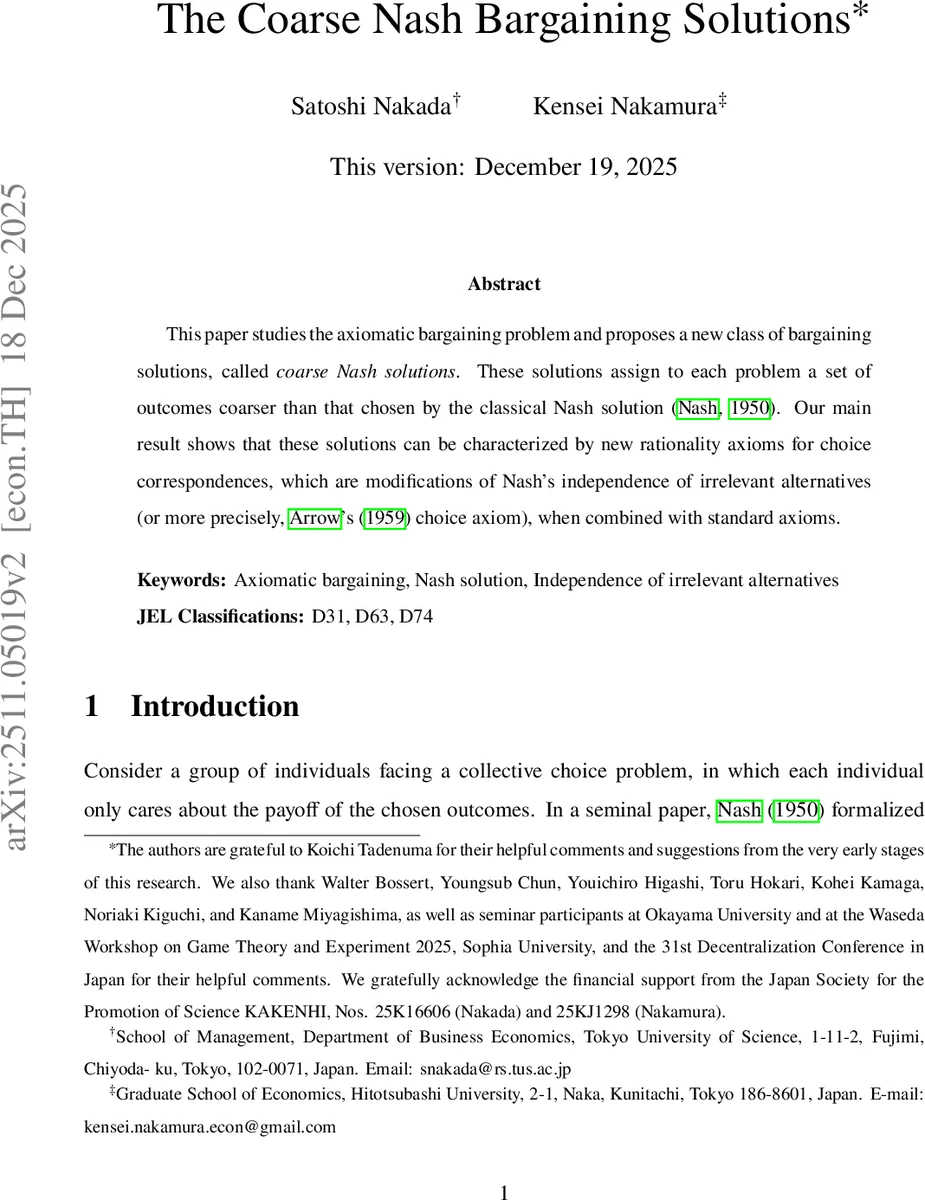
This paper studies the axiomatic bargaining problem and proposes a new class of bargaining solutions, called coarse Nash solutions. These solutions assign to each problem a set of outcomes coarser than that chosen by the classical Nash solution (Nash, 1950). Our main result shows that these solutions can be characterized by new rationality axioms for choice correspondences, which are modifications of Nash’s independence of irrelevant alternatives (or more precisely, Arrow’s (1959) choice axiom), when combined with standard axioms.
💡 Research Summary
The paper revisits the classic Nash bargaining framework and asks what kind of collective choice rules can be justified when the strong independence‑of‑irrelevant‑alternatives (IIA) condition—formalized as Arrow’s choice axiom—is relaxed. After recalling the standard setting (a finite set of players, a compact, comprehensive feasible utility set S ⊂ ℝⁿ₊₊, and the Nash solution that maximizes the product of utilities), the authors decompose Arrow’s axiom into two components: the Chernoff axiom (the “α‑condition”) and the dual Chernoff axiom (the “β‑condition”). While much of the literature has criticized the α‑condition, the authors argue that the β‑condition is also overly restrictive in realistic bargaining situations.
To address this, they introduce two new axioms. The first, called the Weak Arrow axiom, retains the Chernoff condition but replaces the dual Chernoff condition with a weaker requirement: any outcome that is chosen in both of two problems must also be chosen in their union, and conversely any outcome chosen in the union and feasible in both sub‑problems must be chosen in each sub‑problem. The second axiom, Independence of Irrelevant Expansions (IIE), states that if an expansion of the feasible set does not introduce any new chosen outcomes (i.e., every outcome selected after the expansion already belongs to the original set), then the original chosen set must be retained after the expansion.
These two axioms are examined together with the standard axioms of efficiency, symmetry, scale invariance, and continuity. Lemma 1 shows that under efficiency and continuity, the classic Arrow axiom is equivalent to full rationalizability (existence of a complete, transitive, monotone, continuous binary relation that selects the maximal elements). In contrast, the Weak Arrow axiom together with IIE is equivalent to weak rationalizability, where the underlying binary relation needs only be quasi‑transitive, monotone, and continuous. This relaxation permits choice correspondences that are not single‑valued and that can reflect genuine indecisiveness or “buffer” regions in the feasible set.
The core technical contribution is a representation theorem for all solutions satisfying the weak axioms plus the standard ones. The authors define an improving set A ⊂ ℝⁿ, an open set that (i) contains every strictly positive vector and (ii) is closed under addition (if x, y ∈ A then x + y ∈ A). Using a log‑transformation, they construct a binary relation ≻ₐ on utility vectors: x ≻ₐ y iff log x – log y ∈ A. This relation is quasi‑transitive, monotone, and continuous. A coarse Nash solution F_A selects, from any feasible set S, all points that are not strictly dominated according to ≻ₐ:
F_A(S) = { x ∈ S | ∄ y ∈ S such that y ≻ₐ x }.
When A is the whole positive orthant, ≻ₐ reduces to the usual Nash product ordering and F_A coincides with the classical Nash solution. If A is a convex cone generated by a weight vector w, ≻ₐ corresponds to the weighted Nash ordering, and F_A reproduces the weighted Nash solution. At the opposite extreme, if A is very large (e.g., containing all non‑negative vectors), F_A becomes the set of all Pareto‑optimal outcomes. Thus, the class of coarse Nash solutions nests the weighted Nash solutions, the weakly Pareto‑optimal solutions, and the full Pareto frontier as special cases.
A key inclusion result proves that every coarse Nash solution strictly contains some weighted Nash solution: for any improving set A there exists a weight vector w such that F_w(S) ⊆ F_A(S) for all feasible S. Consequently, coarse Nash solutions are “coarser” (i.e., less decisive) than at least one weighted Nash solution, yet they retain the essential product‑based structure of Nash’s original idea.
The paper situates its contribution within the broader literature on bargaining solutions (Kalai‑Smorodinsky, weighted Nash, etc.) and on social choice theory (Sen’s α, β, γ, δ axioms). By weakening Arrow’s axiom in a principled way, the authors provide a unified theoretical framework that captures a spectrum of bargaining outcomes ranging from highly decisive (classical Nash) to highly permissive (full Pareto set).
Finally, the authors outline several avenues for future work: extending the analysis to dynamic bargaining where the improving set A may evolve over time, empirically testing whether real‑world negotiators behave in line with the weak axioms, and exploring algorithmic methods for constructing appropriate improving sets that reflect multiple normative criteria such as efficiency, equity, and stability. In sum, the study offers a rigorous, axiomatic foundation for “coarse” bargaining solutions that broaden the applicability of Nash‑type reasoning while preserving its core economic intuition.
Comments & Academic Discussion
Loading comments...
Leave a Comment