On effective mean-values of arithmetic functions
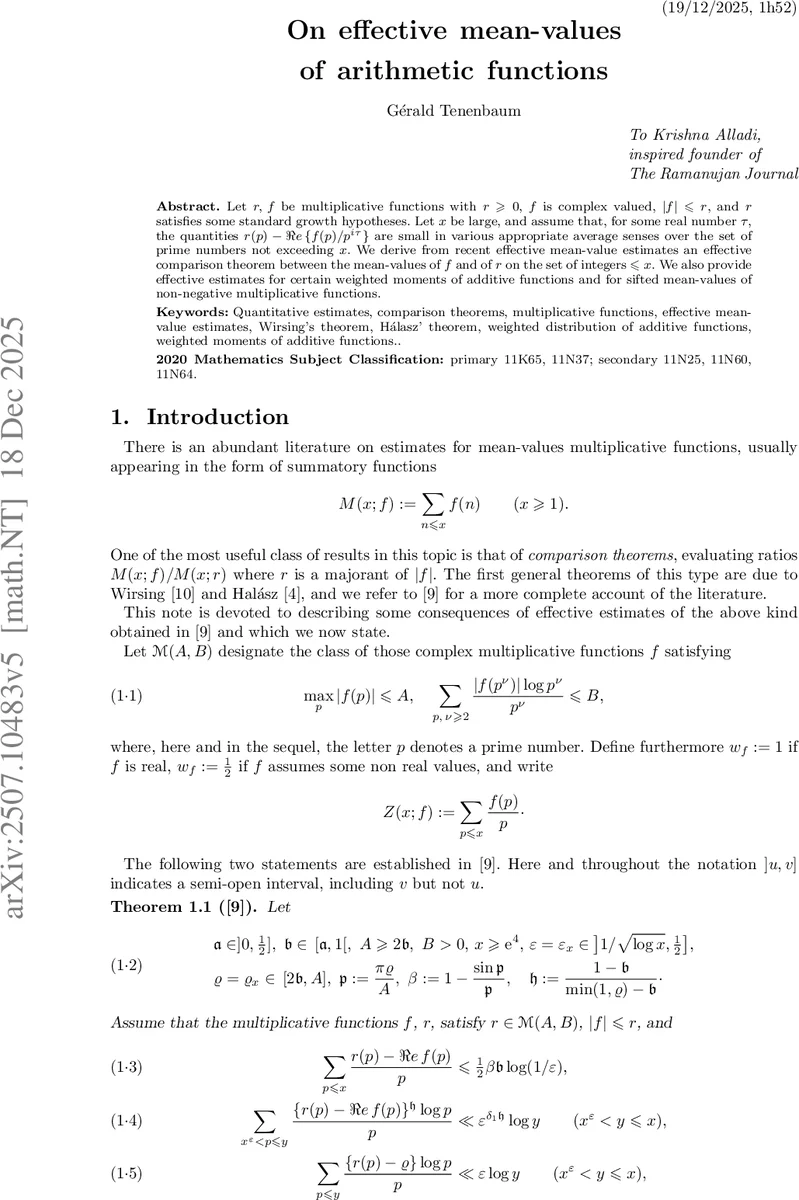
Let $r,,f$ be multiplicative functions with $r\geqslant 0$, $f$ is complex valued, $|f|\leqslant r$, and $r$ satisfies some standard growth hypotheses. Let $x$ be large, and assume that, for some real number $τ$, the quantities $r(p)-\Re{f(p)/p^{iτ}}$ are small in various appropriate average senses over the set of prime numbers not exceeding $x$. We derive from recent effective mean-value estimates an effective comparison theorem between the mean-values of $f$ and of $r$ on the set of integers $\leqslant x$. We also provide effective estimates for certain weighted moments of additive functions and for sifted mean-values of non-negative multiplicative functions.
💡 Research Summary
The paper investigates the mean values of multiplicative functions in a fully quantitative, “effective’’ setting. Let r be a non‑negative multiplicative function belonging to the class M(A,B) (i.e. maxₚ|r(p)|≤A and ∑{p,ν>2}|r(p^ν)| log p^ν / p^ν≤B) and let f be a complex‑valued multiplicative function satisfying |f|≤r. The central hypothesis is that for some real τ the quantities r(p)−Re{f(p)/p^{iτ} } are small on average over the primes p≤x; more precisely the paper assumes bounds of the form (1.3)–(1.5) involving a small parameter ε and a logarithmic factor. Under these hypotheses the authors prove an effective comparison theorem (Theorem 1.1) which expresses M(x;f)=∑{n≤x}f(n) as a product of the main term for r and a controlled error term O(ε δ Z(x;f)). Here Z(x;f)=∑{p≤x}f(p)/p, δ = w_f δ₁ with δ₁∈(0,2/3 β b] and w_f = 1 or ½ according to whether f is real‑valued or not. The main term contains the familiar factor e^{−γ %} x Γ(% ) log x ∏{p^ν≤x} f(p^ν)/p^{ν}, where % is a parameter defined in (1.2). This result refines the classical Wirsing–Halász comparison theorems by providing explicit constants and an error term that depends only on the prescribed small parameters.
Theorem 1.2 treats the case where r can be written as a convolution r₁∗r₂ with non‑negative components and where the twist τ is allowed to be non‑zero. Under an additional mild growth condition (1.12) the authors obtain a similar formula for M(x;f) with an extra factor (1−c Z(x;|f|−f) log x) in the error term, where c=b/A. This theorem shows that the comparison holds uniformly for any complex twist τ, extending the classical results which were essentially limited to τ=0.
Section 2 presents Theorem 2.1, a fully effective version of Wirsing’s theorem with a complex twist. By replacing f with f_τ(n)=f(n)/n^{iτ} the authors prove M(x;f)=x^{iτ} M(x;r) (1+iτ)^{−1} ∏_{p^ν≤x} \frac{f(p^ν)}{p^{ν}} \big/ \frac{r(p^ν)}{p^{ν}} + O(ε δ M(x;r)). The proof combines the effective comparison theorem with a delicate analysis of the contribution of small prime factors and uses a refined version of Rankin’s method to control the error. This result is new even in the untwisted case because it supplies an explicit dependence on ε and δ.
In Section 3 the authors turn to weighted moments of additive functions. For a non‑negative multiplicative weight r∈M(A,B) and a real additive function h, they define the weighted distribution function F_x(z;h,r)=\frac{1}{M(x;r)}\sum_{n≤x}1_{h(n)≤z} r(n), with mean E_h(x;r)=∑{p≤x}r(p)h(p)/p and variance D_h(x;r)^2=∑{p≤x}r(p)h(p)^2/p. Assuming (i)–(iv) (essentially a lower bound on r(p) and a growth condition on h), Theorem 3.1 shows that F_x(E_h+z D_h)=Φ(z)+O(θ_x), where Φ is the standard normal distribution function and θ_x=μ_x+1/D_h with μ_x=max_{p≤x}|h(p)|/D_h. This yields a quantitative central limit theorem with an explicit error term. Theorem 3.2 then derives asymptotics for the weighted moments G_m(x;r,h)=\frac{1}{M(x;r)}\sum_{n≤x}r(n)(h(n)−E_h)^m, showing that G_m=ν_m+O(θ_x (log 1/θ_x)^{m/2}) where ν_m is the m‑th moment of the normal law. The proofs rely on exponential moment bounds (Shiu’s inequality) and the effective central limit theorem from Theorem 3.1.
Section 4 deals with sifted mean values. For a non‑negative exponentially multiplicative function r satisfying uniform bounds supₚ r(p)≤A, ∑{w<p≤v} (r(p)−b)/p ≤ c₁, the authors consider the sifted function f_D(n)=1{(n,D)=1} f(n). Using the effective comparison theorem they obtain an explicit formula (Theorem 4.2): M(x;r_D)=M(x;r) (1+W_r(D)) + O\big((\log 2 D)^{1+A}(\log x)^{-c}\big), where W_r(D)=∏_{p|D}(1−r(p)/p)^{-1} and c=b^3/(b^2+3456 A^2). This improves earlier results of Elliott and Kish by providing concrete constants β and δ derived from Theorem 1.2.
Overall, the paper delivers a suite of effective results that sharpen classical mean‑value theorems for multiplicative functions. By quantifying the dependence on the small parameters ε and δ, the authors make the theorems directly applicable to explicit calculations, to the study of twisted Dirichlet series, and to probabilistic models of additive functions. The work bridges the gap between asymptotic theory and explicit analytic number theory, offering tools that can be employed in computational investigations and in further theoretical developments where precise error bounds are essential.
Comments & Academic Discussion
Loading comments...
Leave a Comment