The Stochastic Occupation Kernel (SOCK) Method for Learning Stochastic Differential Equations
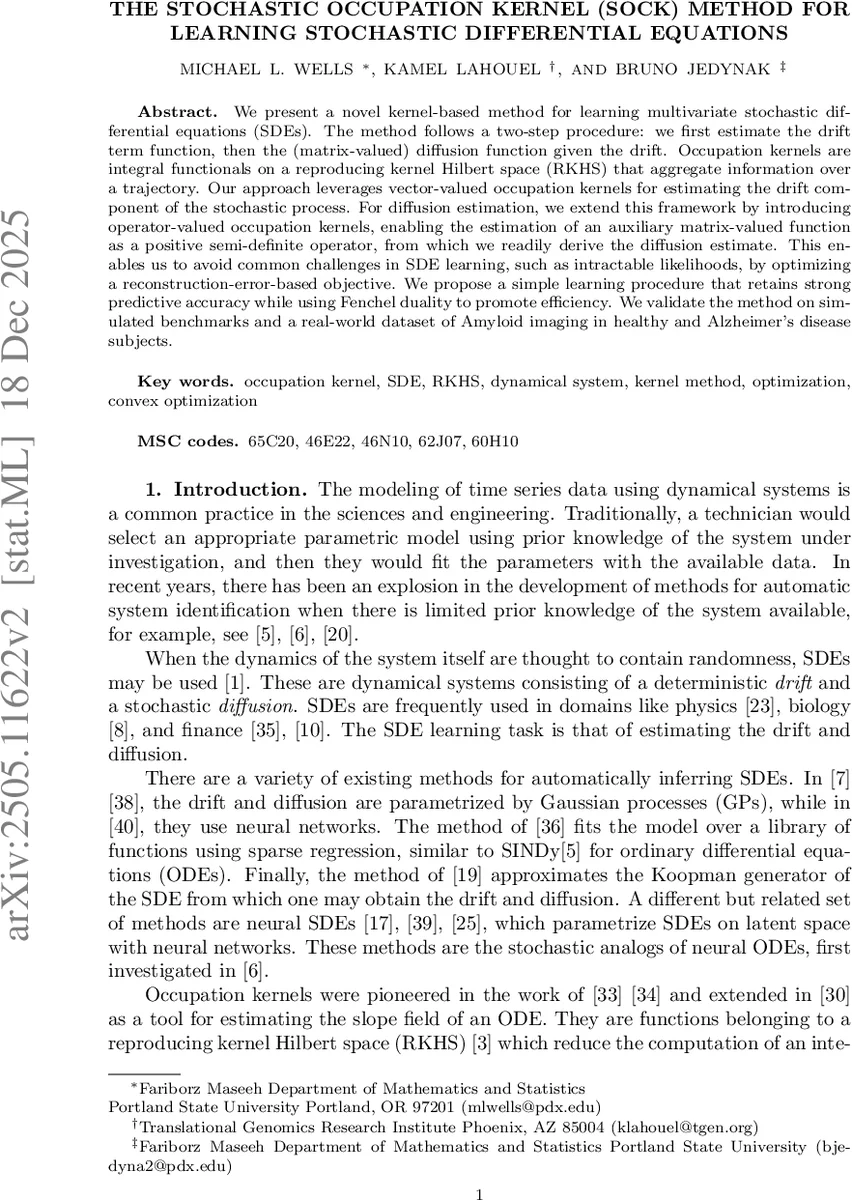
We present a novel kernel-based method for learning multivariate stochastic differential equations (SDEs). The method follows a two-step procedure: we first estimate the drift term function, then the (matrix-valued) diffusion function given the drift. Occupation kernels are integral functionals on a reproducing kernel Hilbert space (RKHS) that aggregate information over a trajectory. Our approach leverages vector-valued occupation kernels for estimating the drift component of the stochastic process. For diffusion estimation, we extend this framework by introducing operator-valued occupation kernels, enabling the estimation of an auxiliary matrix-valued function as a positive semi-definite operator, from which we readily derive the diffusion estimate. This enables us to avoid common challenges in SDE learning, such as intractable likelihoods, by optimizing a reconstruction-error-based objective. We propose a simple learning procedure that retains strong predictive accuracy while using Fenchel duality to promote efficiency. We validate the method on simulated benchmarks and a real-world dataset of Amyloid imaging in healthy and Alzheimer’s disease subjects.
💡 Research Summary
The paper introduces the Stochastic Occupation Kernel (SOCK) method, a novel kernel‑based framework for learning multivariate stochastic differential equations (SDEs) without resorting to intractable likelihoods. The authors treat the drift and diffusion components separately in a two‑step procedure.
In the drift‑learning stage, they start from the integral form of an Itô SDE and take conditional expectations, which eliminates the stochastic integral term. This yields a reconstruction‑error objective that measures the discrepancy between the empirical increments of observed trajectories and the expected integral of a candidate drift function. By placing the drift in a reproducing kernel Hilbert space (RKHS) with a matrix‑valued kernel K, they derive a representer theorem (Theorem 3.1) showing that the optimal drift is a finite linear combination of vector‑valued occupation kernels L*ᵢ(x)=E
Comments & Academic Discussion
Loading comments...
Leave a Comment