📝 Original Info
- Title: Introducing ORKG ASK: an AI-driven Scholarly Literature Search and Exploration System Taking a Neuro-Symbolic Approach
- ArXiv ID: 2512.16425
- Date: 2025-12-18
- Authors: Researchers from original ArXiv paper
📝 Abstract
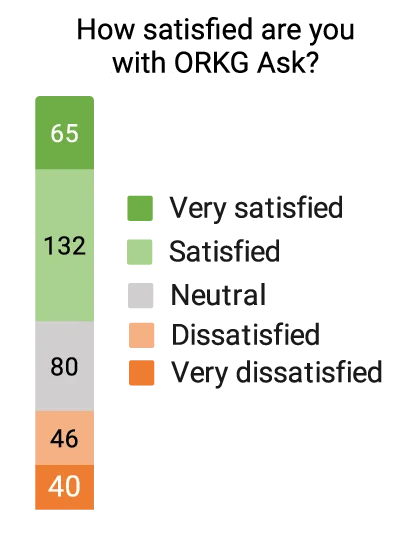
As the volume of published scholarly literature continues to grow, finding relevant literature becomes increasingly difficult. With the rise of generative Artificial Intelligence (AI), and particularly Large Language Models (LLMs), new possibilities emerge to find and explore literature. We introduce ASK (Assistant for Scientific Knowledge), an AI-driven scholarly literature search and exploration system that follows a neuro-symbolic approach. ASK aims to provide active support to researchers in finding relevant scholarly literature by leveraging vector search, LLMs, and knowledge graphs. The system allows users to input research questions in natural language and retrieve relevant articles. ASK automatically extracts key information and generates answers to research questions using a Retrieval-Augmented Generation (RAG) approach. We present an evaluation of ASK, assessing the system's usability and usefulness. Findings indicate that the system is user-friendly and users are generally satisfied while using the system.
💡 Deep Analysis
Deep Dive into Introducing ORKG ASK: an AI-driven Scholarly Literature Search and Exploration System Taking a Neuro-Symbolic Approach.
As the volume of published scholarly literature continues to grow, finding relevant literature becomes increasingly difficult. With the rise of generative Artificial Intelligence (AI), and particularly Large Language Models (LLMs), new possibilities emerge to find and explore literature. We introduce ASK (Assistant for Scientific Knowledge), an AI-driven scholarly literature search and exploration system that follows a neuro-symbolic approach. ASK aims to provide active support to researchers in finding relevant scholarly literature by leveraging vector search, LLMs, and knowledge graphs. The system allows users to input research questions in natural language and retrieve relevant articles. ASK automatically extracts key information and generates answers to research questions using a Retrieval-Augmented Generation (RAG) approach. We present an evaluation of ASK, assessing the system’s usability and usefulness. Findings indicate that the system is user-friendly and users are generally s
📄 Full Content
Introducing ORKG ASK: an AI-driven Scholarly
Literature Search and Exploration System Taking
a Neuro-Symbolic Approach
Allard Oelen1[0000−0001−9924−9153], Mohamad Yaser
Jaradeh2[0000−0001−8777−2780], and Sören Auer1,2[0000−0002−0698−2864]
1 TIB – Leibniz Information Centre for Science and Technology, Hannover, Germany
{allard.oelen,auer}@tib.eu
2 L3S Research Center, Leibniz University of Hannover, Hannover, Germany
jaradeh@l3s.de
Abstract. As the volume of published scholarly literature continues
to grow, finding relevant literature becomes increasingly difficult. With
the rise of generative Artificial Intelligence (AI), and particularly Large
Language Models (LLMs), new possibilities emerge to find and explore
literature. We introduce ASK (Assistant for Scientific Knowledge), an
AI-driven scholarly literature search and exploration system that fol-
lows a neuro-symbolic approach. ASK aims to provide active support
to researchers in finding relevant scholarly literature by leveraging vec-
tor search, LLMs, and knowledge graphs. The system allows users to
input research questions in natural language and retrieve relevant arti-
cles. ASK automatically extracts key information and generates answers
to research questions using a Retrieval-Augmented Generation (RAG)
approach. We present an evaluation of ASK, assessing the system’s us-
ability and usefulness. Findings indicate that the system is user-friendly
and users are generally satisfied while using the system.
Keywords: AI-Supported Digital Library · Intelligent User Interface ·
Large Language Models · Scholarly Search System
1
Introduction
Analyzing scholarly literature is a key aspect of research. However, due to the
ever-increasing body of scholarly publications, finding scholarly literature be-
comes increasingly difficult [12]. Consequently, finding literature consumes a
substantial portion of researchers’ time [15]. Because of the recent developments
in generative Artificial Intelligence (AI), and specifically Large Language Mod-
els (LLMs), new possibilities arise to extract knowledge from scholarly articles,
helping researchers to find relevant literature in the flood of publications.
In this article, we present ORKG ASK (Assistant for Scientific Knowledge),
hereafter referred to as ASK, a next-generation scholarly search and exploration
system. ASK aims to provide support to researchers in finding relevant schol-
arly literature. ASK takes a Neuro-Symbolic approach which consists of three
arXiv:2512.16425v1 [cs.IR] 18 Dec 2025
2
Oelen et al.
Q: Why are some...
A: Literature shows...
Enter research question
Generate
embeddings
Retrieval of top n
relevant documents
Generate answer
Vector database
...
...
1
2
n
LLM
Literature corpus
Relevant documents
Research question
Find research you are looking for
Answer question
from context
Prepared prompt
Prompt
LLM as generator
brain
~76M articles
Abstracts and
optionally full-text
Q: Why are some...
Search
Augment prompts with
n document context
Fig. 1. Explainer depicting our RAG (Retrieval-Augmented Generation) approach for
scholarly search. The Retrieval step ranks articles by their relevance to the question.
The Augmented step injects the previously retrieved context in the prompt. The Gen-
eration step prompts the LLM and displays the answer.
key components, namely Vector Search and LLMs for the neural aspect and
Knowledge Graphs (KGs) for the symbolic part. We build upon our previously
presented work where we demonstrated the basic ASK infrastructure [16]. In
this paper, we expand on our previous work by providing an in-depth explana-
tion of the approach, technical details of the implementation, and a extensive
evaluation. In brief, ASK functions as follows: a user of ASK formulates their
information needs as a research question. Afterward, a list of relevant articles
is displayed. For each article, an automatically extracted answer for the previ-
ously asked question is displayed to the user. Finally, the symbolic aspect ensures
users are able to narrow down the search space by providing semantic filters. This
provides both the precision of symbolic approach and the flexibility of a neural
approach. ASK is running as a publicly available production service online.3
The system takes a Retrieval-Augmented Generation (RAG) approach to
support the previously described workflow. RAG [14] is commonly used to inter-
twine LLM extractions with information retrieval systems, as depicted in Fig-
ure 1. Firstly, the Vector Search component ranks documents based on their
relevance (Retrieval) for a research question. Secondly, relevant context is col-
lected (i.e., the paper abstract and, if available, full-text) from the previous step
(Augmented). Finally, the LLM generates answers and displays this to the user
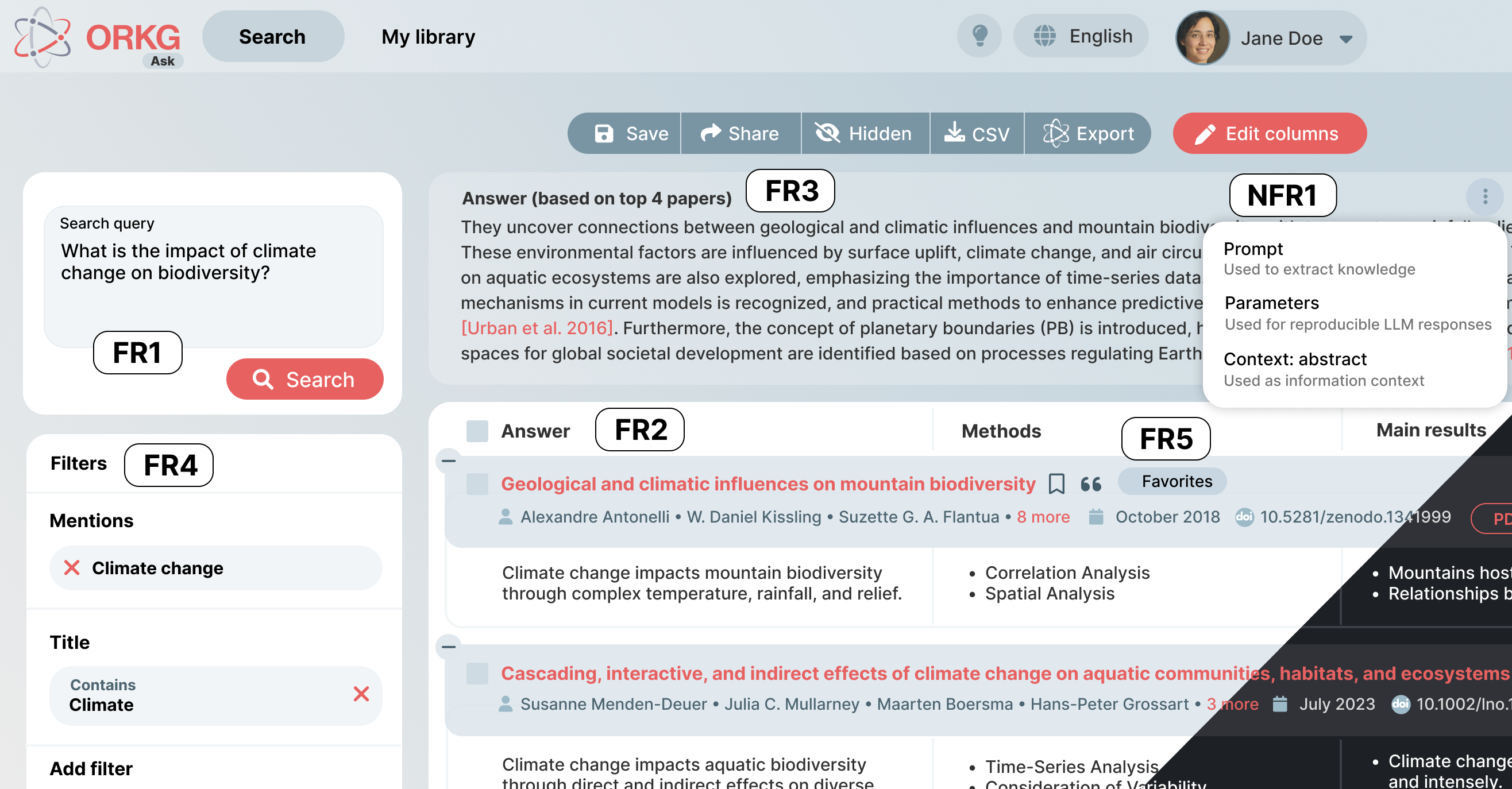
(Generation). A screenshot showing the ranked articles, search query, and gen-
erated LLM responses is displayed in Figure 2. This work introduces the follow-
ing contributions: i) presents an LL
…(Full text truncated)…
📸 Image Gallery
Reference
This content is AI-processed based on ArXiv data.