Generalized Gregorian quadrature, including end-corrected weights for the midpoint rule
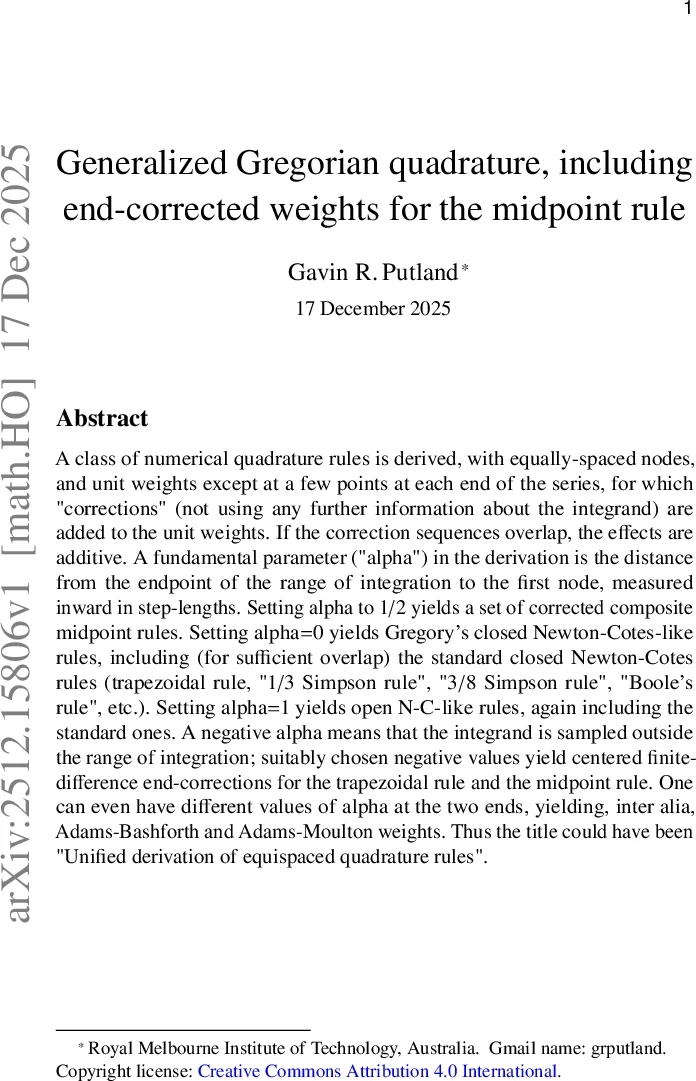
A class of numerical quadrature rules is derived, with equally-spaced nodes, and unit weights except at a few points at each end of the series, for which “corrections” (not using any further information about the integrand) are added to the unit weights. If the correction sequences overlap, the effects are additive. A fundamental parameter (“alpha”) in the derivation is the distance from the endpoint of the range of integration to the first node, measured inward in step-lengths. Setting alpha to 1/2 yields a set of corrected composite midpoint rules. Setting alpha=0 yields Gregory’s closed Newton-Cotes-like rules, including (for sufficient overlap) the standard closed Newton-Cotes rules (trapezoidal rule, “1/3 Simpson rule”, “3/8 Simpson rule”, “Boole’s rule”, etc.). Setting alpha=1 yields open N-C-like rules, again including the standard ones. A negative alpha means that the integrand is sampled outside the range of integration; suitably chosen negative values yield centered finite-difference end-corrections for the trapezoidal rule and the midpoint rule. One can even have different values of alpha at the two ends, yielding, inter alia, Adams-Bashforth and Adams-Moulton weights. Thus the title could have been “Unified derivation of equispaced quadrature rules”.
💡 Research Summary
The paper introduces a unified framework for constructing numerical quadrature formulas on equally‑spaced nodes that consist of unit weights everywhere except for a small number of “correction” weights applied at the two ends of the interval. The key idea is to parameterize the distance between the integration limits and the nearest node by a scalar α (and β at the opposite end), measured in units of the step size h. By varying α, the author recovers a wide family of classical rules and also generates new, higher‑order corrected versions.
The derivation starts from a generic quadrature expression (1) that splits the integral into three parts: a left tail, a central sum over the interior nodes, and a right tail. The left and right tails are expanded using Taylor series about the endpoints, while the central part is expressed via the Euler–Maclaurin formula. This yields two sets of correction coefficients, c_i (depending only on α) and d_i (depending only on β). The author shows that if the rule is exact for all polynomials up to degree m, the error is O(h^{m+2}).
To determine the coefficients explicitly, the paper examines the limit n → ∞, which reduces the problem to matching a geometric series generated by the test function f(t)=e^{‑st/h}. By substituting this function into the infinite‑limit form of the rule, the author obtains a relation involving the logarithm and the binomial expansion of (1+x)^{‑α}. Equating coefficients of powers of x leads to a lower‑triangular linear system (32) for the difference‑based coefficients b_k. These b_k are then transformed back to the original correction weights c_i via an upper‑triangular system (1‑5). The resulting formulas are explicit: b_k are linear combinations of binomial coefficients (‑α choose j), and c_i are rational numbers that depend only on α and the chosen order m.
Special cases illustrate the power of the framework:
- α=β=0 reproduces Gregory’s closed Newton–Cotes rules (trapezoidal, Simpson 1/3, Simpson 3/8, Boole, etc.).
- α=β=1 yields the open Newton–Cotes family.
- α=β=½ gives a corrected composite midpoint rule: interior nodes have weight 1, while the first and last m+1 nodes receive the computed corrections. This rule attains O(h^{m+2}) accuracy without requiring derivative information.
- Negative α allows sampling outside the integration interval, providing centered finite‑difference corrections for both the trapezoidal and midpoint rules.
- Different α and β at the two ends generate the coefficients of Adams‑Bashforth (explicit) and Adams‑Moulton (implicit) multistep methods.
When the correction sequences from the two ends overlap (i.e., when the total number of nodes n ≤ 2m+2), the corrections simply add, giving a “merged” correction that still satisfies the polynomial exactness conditions. This overlapping case also explains why the same correction sequence applied to a unit‑weight rule of length m+1 reproduces the standard closed Newton–Cotes rule of that order.
The author emphasizes practical implementation: the triangular systems can be solved efficiently in a spreadsheet, MATLAB, or Mathematica. By pre‑computing the correction tables for a chosen m and α, one obtains a rule that requires only function evaluations at equally spaced points, with the interior weights all equal to 1. This eliminates cyclic weight patterns that could resonate with oscillatory integrands, and it avoids the need for the number of steps to be a multiple of any particular cycle length.
Error analysis shows that for polynomial integrands of degree ≤ m the rule is exact, and for general smooth functions the error behaves like C h^{m+2}. When α=β, the rule is symmetric about the midpoint, which makes it automatically exact for odd powers of (t‑nh/2) and raises the degree of exactness by one for even‑degree polynomials, although the leading error constant may still be non‑zero for arbitrary analytic functions.
The paper concludes that the “unit‑weight plus end‑corrections” paradigm provides a compact, flexible, and theoretically sound way to generate a broad spectrum of quadrature formulas—including all classical Newton–Cotes rules, corrected midpoint/trapezoidal rules, and multistep integration coefficients—without requiring additional derivative information. The method is especially attractive when data are available only at equally spaced points, as it delivers high‑order accuracy with minimal bookkeeping and without introducing periodic weight patterns.
Comments & Academic Discussion
Loading comments...
Leave a Comment