Optimal bounds for sums of non-negative arithmetic functions
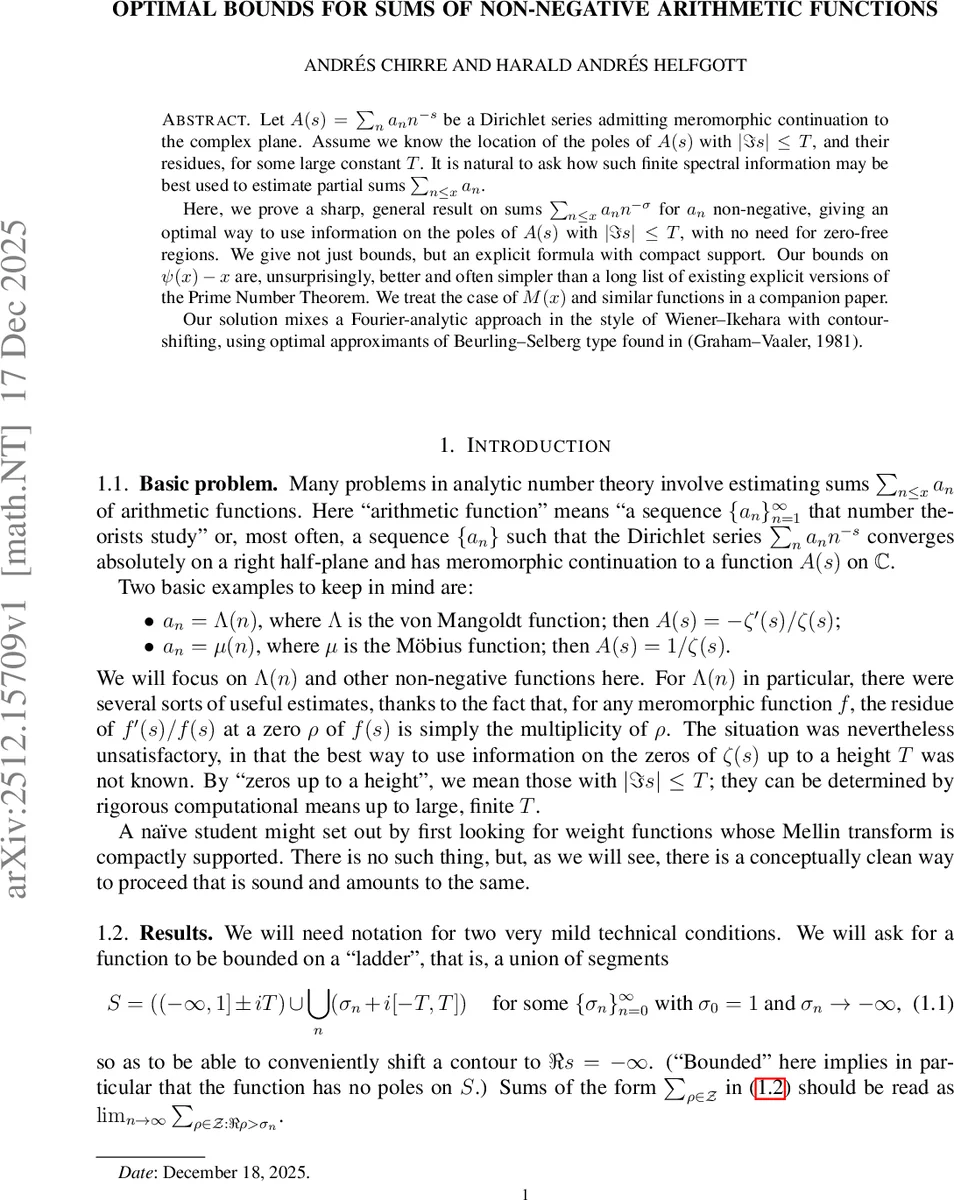
Let $A(s) = \sum_n a_n n^{-s}$ be a Dirichlet series admitting meromorphic continuation to the complex plane. Assume we know the location of the poles of $A(s)$ with $|\Im s| \leq T$, and their residues, for some large constant $T$. It is natural to ask how such finite spectral information may be best used to estimate partial sums $\sum_{n\leq x} a_n$. Here, we prove a sharp, general result on sums $\sum_{n\leq x} a_n n^{-σ}$ for $a_n$ non-negative, giving an optimal way to use information on the poles of $A(s)$ with $|\Im s|\leq T$, with no need for zero-free regions. We give not just bounds, but an explicit formula with compact support. Our bounds on $ψ(x)-x$ are, unsurprisingly, better and often simpler than a long list of existing explicit versions of the Prime Number Theorem. We treat the case of $M(x)$ and similar functions in a companion paper. Our solution mixes a Fourier-analytic approach in the style of Wiener–Ikehara with contour-shifting, using optimal approximants of Beurling–Selberg type found in (Graham–Vaaler, 1981).
💡 Research Summary
The paper “Optimal bounds for sums of non-negative arithmetic functions” addresses a fundamental problem in analytic number theory: how to accurately estimate the partial sums of the coefficients of a Dirichlet series using only a finite amount of spectral information. Specifically, the authors investigate the sum $S_\sigma(x) = \sum_{n \leq x} a_n n^{-\sigma}$ for non-negative arithmetic functions $a_n$, where the Dirichlet series $A(s) = \sum a_n n^{-s}$ is known to have a meromorphic continuation to the complex plane.
The central challenge in such estimations is that traditional methods, such as Perron’s formula, are highly sensitive to the distribution of zeros of $A(s)$. To obtain sharp bounds, one typically requires knowledge of a “zero-free region,” a notoriously difficult property to establish for many L-functions. This paper breaks new ground by demonstrating that it is possible to achieve optimal bounds using only the locations and residues of the poles of $A(s)$ within a bounded vertical strip $|\Im s| \leq T$.
To achieve this, the authors employ a sophisticated methodology that blends Fourier analysis in the style of the Wiener–Ikehara theorem with advanced approximation theory. Instead of the standard Perron formula, they introduce a weight function $\phi \in L^1(\mathbb{R})$ characterized by compact support. A crucial aspect of their design is ensuring that the Fourier transform $b_\phi$ is restricted to a specific frequency range. This allows for a controlled contour-shifting technique in the complex plane, where the integral along the vertical line $\Re s = \sigma$ can be effectively replaced by a sum of residues from the known poles, without needing to account for unknown zeros.
The mathematical “engine” of this approach is the use of Beurling–Selberg type optimal approximants, as developed by Graham and Vaaler (1981). These functions provide the tightest possible majorants and minorants for the characteristic function of an interval, thereby minimizing the error introduced by the smoothing process.
The results are remarkably powerful. The authors do not merely provide upper and lower bounds; they present an explicit formula with compact support. Notably, the bounds derived for $\psi(x) - x$ are shown to be both simpler and more precise than many existing explicit versions of the Prime Number Theorem. By eliminating the dependency on zero-free regions, this work provides a robust and computationally efficient framework for analyzing the distribution of arithmetic functions, making it an invaluable contribution to the field of analytic number theory.
Comments & Academic Discussion
Loading comments...
Leave a Comment