On right units of special inverse monoids
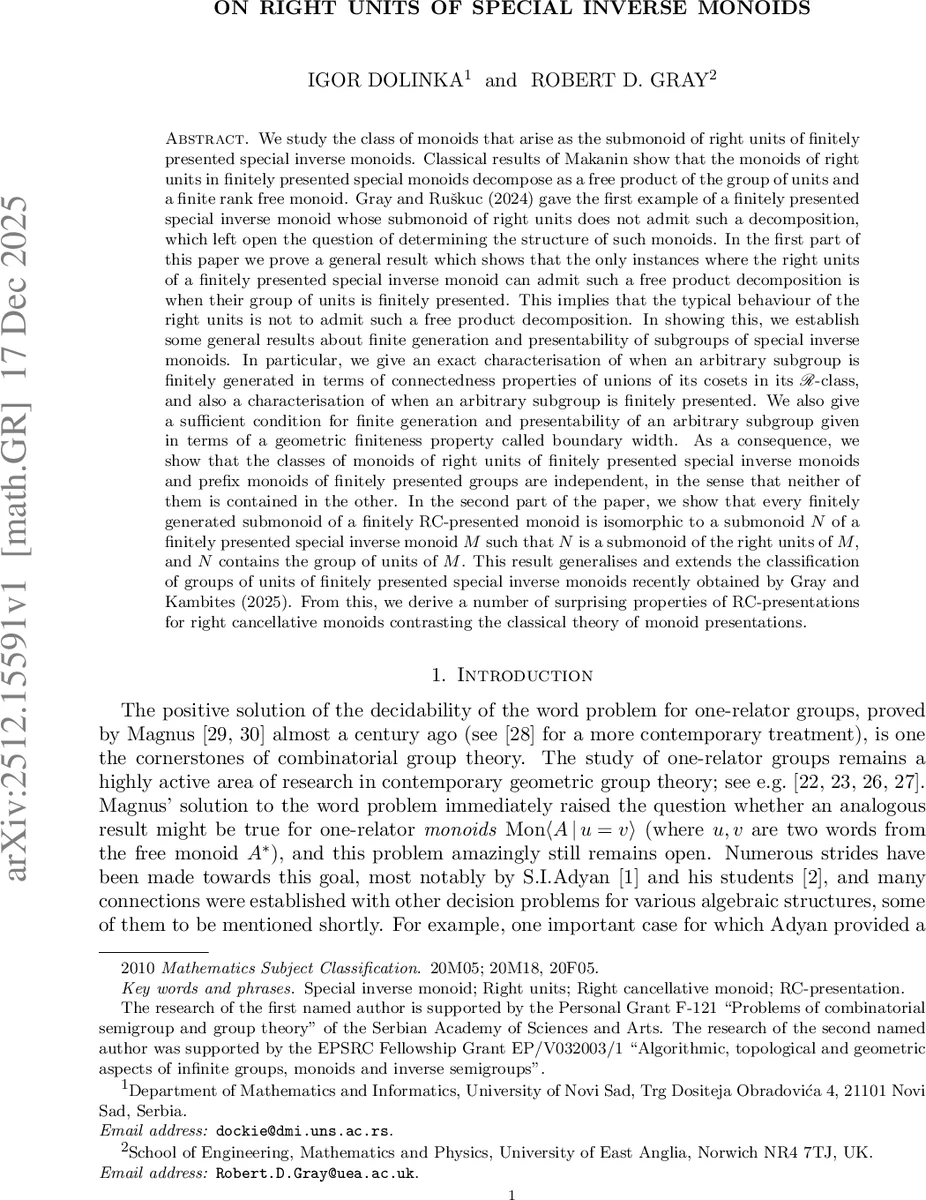
We study the class of monoids that arise as the submonoid of right units of finitely presented special inverse monoids (SIMs). Gray and Ruškuc (2024) gave the first example of a finitely presented SIM whose submonoid of right units does not admit a decomposition into a free product of the group of units and a finite rank free monoid. In the first part of this paper we prove a general result which shows that the only instances where the right units of a finitely presented SIM can admit such a free product decomposition is when their group of units is finitely presented. In showing this, we establish some general results about finite generation and presentability of subgroups of SIMs. In particular, we give an exact characterisation of when an arbitrary subgroup is finitely generated in terms of connectedness properties of unions of its cosets in its $\mathscr{R}$-class, and also a characterisation of when an arbitrary subgroup is finitely presented. We also give a sufficient condition for finite generation and presentability of an arbitrary subgroup given in terms of a geometric finiteness property called boundary width. As a consequence, we show that the classes of monoids of right units of finitely presented SIMs and prefix monoids of finitely presented groups are independent. In the second part of the paper, we show that every finitely generated submonoid of a finitely RC-presented monoid is isomorphic to a submonoid $N$ of a finitely presented SIM $M$ such that $N$ is a submonoid of the right units of $M$, and $N$ contains the group of units of $M$. This result generalises and extends the classification of groups of units of finitely presented SIMs recently obtained by Gray and Kambites (2025). From this, we derive a number of surprising properties of RC-presentations for right cancellative monoids contrasting the classical theory of monoid presentations.
💡 Research Summary
**
This paper investigates the structure of right‑unit submonoids that arise from finitely presented special inverse monoids (SIMs). The classical result of Makarin shows that for finitely presented special plain monoids the right‑unit submonoid decomposes as a free product of the group of units and a free monoid of finite rank. Gray and Ruškuc (2024) produced the first example of a finitely presented SIM whose right‑unit submonoid does not admit such a decomposition, opening the question of how right‑units behave in the inverse setting.
The authors first establish a general theorem (Theorem 4.1) stating that a right‑unit submonoid of a finitely presented SIM can be expressed as a free product (G * T) (where (G) is the group of units and (T) is a finitely generated monoid with trivial group of units, e.g. a free monoid) only if the group of units (G) itself is finitely presented. Consequently, the typical right‑unit monoid of a SIM does not admit a free‑product decomposition unless the unit group is already well‑behaved. This result dramatically narrows the possible “nice’’ cases and shows that the phenomenon observed by Gray‑Ruškuc is not isolated but rather generic.
To prove this, the paper develops a suite of new tools concerning finite generation and finite presentability of subgroups of SIMs. Section 3 provides an exact characterisation of when an arbitrary subgroup (H) of a SIM is finitely generated: this occurs precisely when the union of the (R)-class cosets of (H) forms a single connected component in the (R)-class graph. Moreover, the authors introduce a geometric finiteness invariant called boundary width. If a subgroup has finite boundary width, then it is not only finitely generated but also finitely presented (Theorem 3.5). These criteria are expressed in terms of Schützenberger graphs, linking algebraic properties to combinatorial connectivity.
Armed with these subgroup results, the authors prove the free‑product theorem by showing that any free‑product decomposition would force the unit group to satisfy the finite‑generation and finite‑presentability conditions derived earlier; the only way this can happen is when the unit group itself is finitely presented.
The second major part of the paper explores the relationship between right‑cancellative monoids presented by RC‑presentations and right‑unit submonoids of SIMs. An RC‑presentation is a presentation that guarantees right cancellativity of the presented monoid. The authors prove (Theorem 5.3) that every finitely generated submonoid of a finitely RC‑presented monoid can be embedded as a submonoid (N) of the right‑unit submonoid of some finitely presented SIM (M), with the additional property that (N) contains the entire group of units of (M). This extends the recent classification of groups of units of finitely presented SIMs by Gray and Kambites (2025) to a broader class of submonoids.
The paper also demonstrates that the classes of right‑unit monoids of finitely presented SIMs and prefix monoids of finitely presented groups are independent: neither class is contained in the other. This is shown by constructing explicit examples that lie in one class but not the other, using the subgroup‑generation criteria and the boundary‑width condition.
In Section 6 the authors provide concrete constructions illustrating the theory. One example revisits the Gray‑Ruškuc counterexample, confirming that its right‑unit monoid has infinite boundary width and therefore cannot be expressed as a free product. Another example builds a finitely RC‑presented monoid that is not finitely presented as a monoid, yet its right‑unit monoid arises from a finitely presented SIM, highlighting a sharp contrast between ordinary monoid presentations and RC‑presentations.
Overall, the paper makes several significant contributions:
- Free‑product restriction – It shows that a free‑product decomposition of a right‑unit monoid forces the unit group to be finitely presented.
- Geometric subgroup criteria – Finite generation and presentability of subgroups are characterised via connectivity of coset unions and the boundary‑width invariant.
- Embedding into SIM right‑units – Every finitely generated submonoid of a finitely RC‑presented monoid embeds into the right‑unit submonoid of a finitely presented SIM, preserving the unit group.
- Independence of classes – Right‑unit monoids of SIMs and prefix monoids of finitely presented groups are shown to be incomparable.
- Contrast between presentation styles – The work exhibits monoids that are right‑cancellative and RC‑presentable but not finitely presented, and vice versa, underscoring the nuanced landscape of monoid presentations.
These results deepen our understanding of the algebraic and combinatorial structure of special inverse monoids, provide new tools for analyzing subgroups within them, and open avenues for further research on decision problems (e.g., word problem, membership problem) in the inverse‑monoid setting.
Comments & Academic Discussion
Loading comments...
Leave a Comment