Energy Inference of Black-Box Quantum Computers Using Quantum Speed Limit
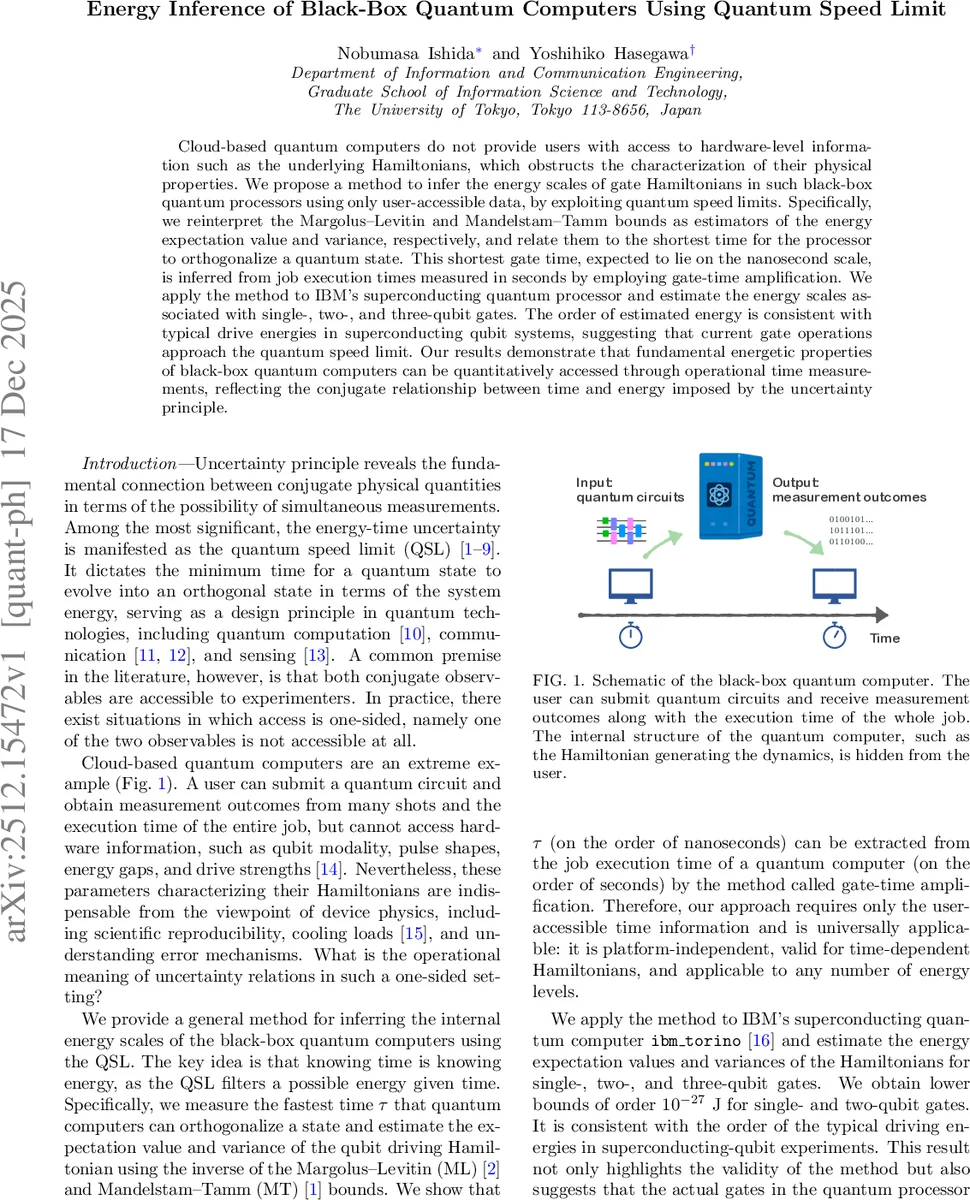
Cloud-based quantum computers do not provide users with access to hardware-level information such as the underlying Hamiltonians, which obstructs the characterization of their physical properties. We propose a method to infer the energy scales of gate Hamiltonians in such black-box quantum processors using only user-accessible data, by exploiting quantum speed limits. Specifically, we reinterpret the Margolus-Levitin and Mandelstam-Tamm bounds as estimators of the energy expectation value and variance, respectively, and relate them to the shortest time for the processor to orthogonalize a quantum state. This shortest gate time, expected to lie on the nanosecond scale, is inferred from job execution times measured in seconds by employing gate-time amplification. We apply the method to IBM’s superconducting quantum processor and estimate the energy scales associated with single-, two-, and three-qubit gates. The order of estimated energy is consistent with typical drive energies in superconducting qubit systems, suggesting that current gate operations approach the quantum speed limit. Our results demonstrate that fundamental energetic properties of black-box quantum computers can be quantitatively accessed through operational time measurements, reflecting the conjugate relationship between time and energy imposed by the uncertainty principle.
💡 Research Summary
The paper addresses a fundamental challenge in cloud‑based quantum computing: users have no access to the hardware‑level description of the device, such as the underlying Hamiltonians that generate the gate dynamics. Without this information it is impossible to directly characterize the energetic properties of the processor, which are crucial for understanding heat loads, error mechanisms, and the ultimate performance limits of quantum computers.
The authors turn the usual interpretation of quantum speed limits (QSLs) on its head. Traditionally, the Mandelstam‑Tamm (MT) and Margolus‑Levitin (ML) bounds constrain the minimum evolution time of a quantum state in terms of the energy variance ΔE and the mean energy E, respectively. Here, the authors ask the inverse question: if one can experimentally determine the shortest time τ required for a gate to evolve some initial state into an orthogonal state, what can be inferred about the underlying energy scales? By simply rearranging the MT and ML inequalities they obtain lower‑bound estimators
E_est = ΔE_est = πħ/(2τ).
Thus, measuring τ provides a direct, model‑independent estimate of the average driving energy and its fluctuations.
The main practical obstacle is that cloud quantum computers report execution times only with second‑scale resolution, while the gate times of interest lie in the nanosecond regime. To bridge this gap the authors introduce “gate‑time amplification”. They construct circuits that repeat a chosen gate N_gate times, keep the number of measurement shots N_shot fixed, and record the total job execution time T_exec. For sufficiently large N_gate (≥10⁵ in their experiments) the contribution of the gate operations dominates all other overheads, and T_exec scales linearly with N_gate. The slope of this linear relationship yields the physical gate duration T_gate, which is identified with τ for the purpose of the QSL‑based energy estimate.
The methodology is applied to IBM’s superconducting processor “ibm torino”. The authors examine a representative set of single‑qubit gates (X, Y, virtual Z), two‑qubit gates (CZ, CNOT, iSWAP) and three‑qubit gates (Toffoli, iToffoli, CCZ). By varying N_gate from 0 to 5×10⁵ and measuring T_exec for each case, they extract the following τ values: X ≈ 32 ns, CZ ≈ 70 ns, CNOT ≈ 140 ns, iSWAP ≈ 220 ns, Toffoli ≈ 1500 ns, iToffoli ≈ 500 ns, CCZ ≈ 1600 ns. The virtual Z gate shows an effectively zero τ, consistent with its implementation as a frame‑update without a physical pulse.
Plugging these τ’s into the estimator gives energy lower bounds of
- Single‑qubit gates: E_est ≈ 5.2 × 10⁻²⁷ J,
- Two‑qubit gates: E_est ≈ 2.4 × 10⁻²⁷ J,
- Three‑qubit gates: E_est ≈ 3 × 10⁻²⁸ J.
These magnitudes are comparable to the driving energies inferred from typical Rabi frequencies (10–100 MHz) in transmon qubits, which correspond to energies on the order of 10⁻²⁶ J. The close agreement suggests that the ibm torino processor operates near the quantum speed limit for the examined gates.
On the theoretical side, the authors discuss the relationship between the time‑dependent Hamiltonian H(t) that actually drives the gate and an effective time‑independent Hamiltonian H_eff defined by U = exp(−iτH_eff/ħ). Using the Magnus expansion for H_eff and the Dyson series for the unitary evolution, they show that the difference between the effective mean energy ⟨H_eff⟩ and the true time‑averaged energy ⟨H(t)⟩ appears only at second order in the commutator
Comments & Academic Discussion
Loading comments...
Leave a Comment