Can AI Generate more Comprehensive Test Scenarios? Review on Automated Driving Systems Test Scenario Generation Methods
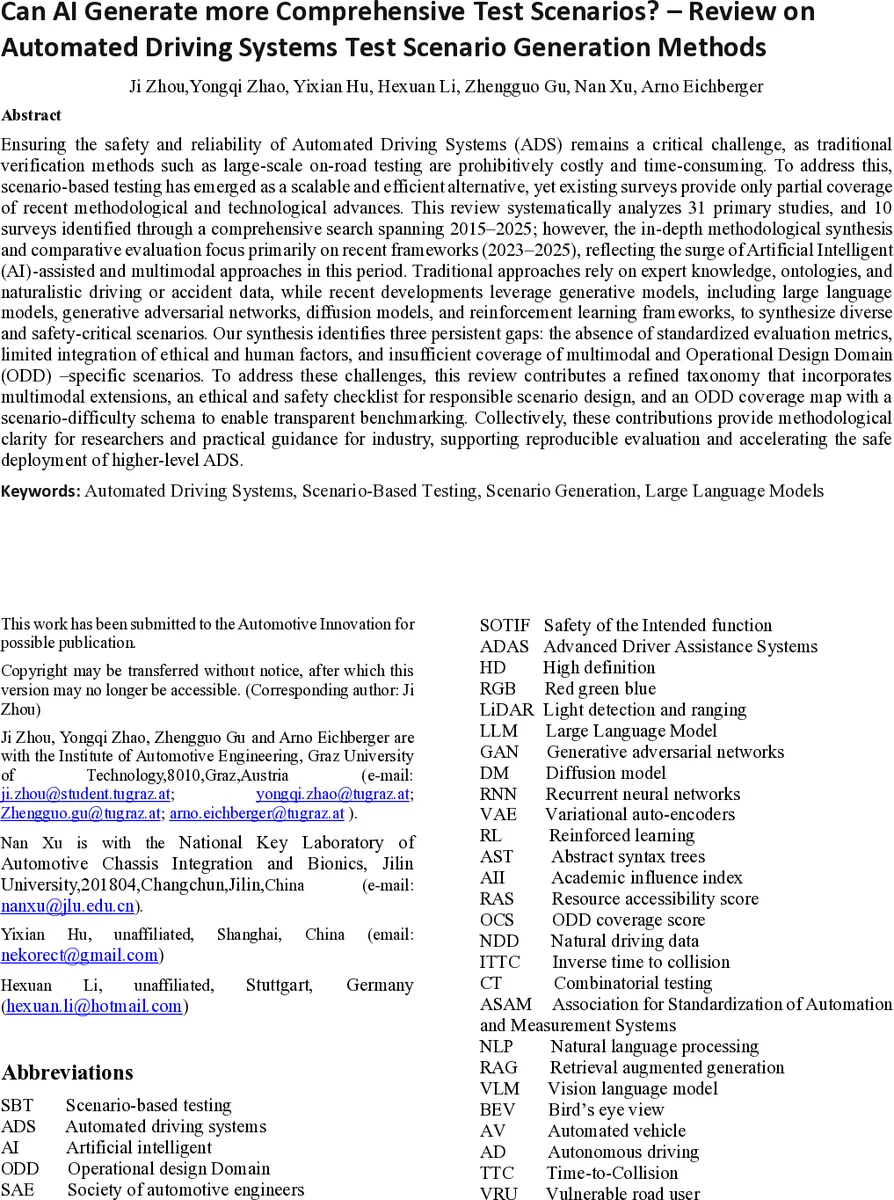
Ensuring the safety and reliability of Automated Driving Systems (ADS) remains a critical challenge, as traditional verification methods such as large-scale on-road testing are prohibitively costly and time-consuming.To address this,scenario-based testing has emerged as a scalable and efficient alternative,yet existing surveys provide only partial coverage of recent methodological and technological advances.This review systematically analyzes 31 primary studies,and 10 surveys identified through a comprehensive search spanning 20152025;however,the in-depth methodological synthesis and comparative evaluation focus primarily on recent frameworks(20232025),reflecting the surge of Artificial Intelligent(AI)-assisted and multimodal approaches in this period.Traditional approaches rely on expert knowledge,ontologies,and naturalistic driving or accident data,while recent developments leverage generative models,including large language models,generative adversarial networks,diffusion models,and reinforcement learning frameworks,to synthesize diverse and safety-critical scenarios.Our synthesis identifies three persistent gaps:the absence of standardized evaluation metrics,limited integration of ethical and human factors,and insufficient coverage of multimodal and Operational Design Domain (ODD)-specific scenarios.To address these challenges,this review contributes a refined taxonomy that incorporates multimodal extensions,an ethical and safety checklist for responsible scenario design,and an ODD coverage map with a scenario-difficulty schema to enable transparent benchmarking.Collectively,these contributions provide methodological clarity for researchers and practical guidance for industry,supporting reproducible evaluation and accelerating the safe deployment of higher-level ADS.
💡 Research Summary
This paper presents a comprehensive systematic review of scenario‑based testing (SBT) methods for Automated Driving Systems (ADS), focusing on the rapid evolution of AI‑assisted scenario generation between 2023 and 2025. The authors performed an extensive literature search across Google Scholar, Web of Science, Scopus, and IEEE Xplore covering the period 2015‑2025. After duplicate removal and rigorous inclusion/exclusion screening, 31 primary research articles and 10 prior surveys were selected for detailed analysis.
The review first outlines the historical context: traditional large‑scale on‑road testing is prohibitively expensive for SAE Level 3‑5 vehicles, prompting a shift toward SBT after the 2017 paradigm change. Early SBT relied on expert‑defined rule‑based approaches (ontologies, traffic regulations) and data‑driven extraction from naturalistic driving datasets (Waymo Open Motion, nuScenes, etc.). While these methods provide reproducibility and alignment with standards such as SOTIF and UN/ECE R157, they struggle to generate rare edge‑case events, to maintain cross‑modal consistency (RGB, LiDAR, HD maps), and to ensure sufficient scenario diversity.
The core contribution of the review is a taxonomy that separates traditional methods from four families of AI‑assisted generation that have emerged in the last three years:
- Large Language Model (LLM)‑driven generation – approaches such as Txt2Sce translate natural‑language specifications into abstract syntax trees or logical scenario descriptions, enabling human‑in‑the‑loop intent capture.
- Generative Adversarial Networks (GAN) and Variational Auto‑Encoders (VAE) – models like TrafficGen and GraphVAE learn probabilistic traffic participant behaviors and can synthesize diverse collision and avoidance situations.
- Diffusion and multimodal generative models – GAIA‑1, Genesis, and UMGen produce synchronized RGB video, LiDAR point clouds, and HD map updates from a single latent representation, achieving photorealistic, physically plausible scenarios.
- Reinforcement Learning (RL) frameworks – SEAL, SafeRL‑Scenario embed safety‑critical reward functions to actively search for high‑risk situations, offering a principled way to generate safety‑critical edge cases.
These AI‑driven techniques excel at scaling scenario creation, covering long‑tail events, and integrating multiple sensor modalities, but they suffer from a lack of standardized evaluation. To address this, the authors propose a three‑axis metric suite:
- AII (Academic Influence Index) – quantifies scholarly impact through citations, conference presentations, and patents.
- RAS (Reproducibility and Accessibility Score) – measures openness of code, data, and the ability to replicate experiments.
- OCS (ODD Coverage Score) – evaluates how well generated scenarios span the Operational Design Domain (road type, traffic density, weather, lighting, regulatory constraints) and assigns a difficulty level based on collision risk and interaction complexity.
The paper also introduces an ethical and safety checklist for scenario generation, covering bias mitigation, privacy protection, alignment with SOTIF/UN‑ECE standards, protection of vulnerable road users, and a multi‑stage validation pipeline (simulation, hardware‑in‑the‑loop, expert review).
Furthermore, an ODD coverage map and a scenario‑difficulty schema are presented. The map visualizes scenario distribution across five ODD dimensions (environment, traffic, weather, illumination, legal rules) while the difficulty schema classifies scenarios into Low, Medium, and High tiers based on quantitative risk metrics such as inverse time‑to‑collision and maneuvering complexity. This enables transparent benchmarking across different generation frameworks and facilitates regulatory reporting.
In the discussion, the authors compare their taxonomy with prior surveys, highlighting that earlier works either omitted multimodal integration or failed to incorporate foundation models, leading to static classifications that cannot keep pace with rapid AI advances. By integrating multimodal extensions, ethical safeguards, and a unified metric system, the review provides a forward‑looking foundation for reproducible, fair, and comprehensive scenario generation.
The paper concludes that the three identified gaps—absence of standardized evaluation metrics, limited ethical/human‑factor integration, and insufficient ODD‑specific coverage—must be addressed for ADS validation to scale safely. The proposed contributions (refined taxonomy, three‑axis metric suite, ethical checklist, ODD coverage map, and difficulty schema) collectively aim to standardize research practices, guide industry deployments, and accelerate the safe rollout of higher‑level autonomous vehicles.
Comments & Academic Discussion
Loading comments...
Leave a Comment