First implementation of AXUV-based analysis and macro-instability diagnostics on WHAM
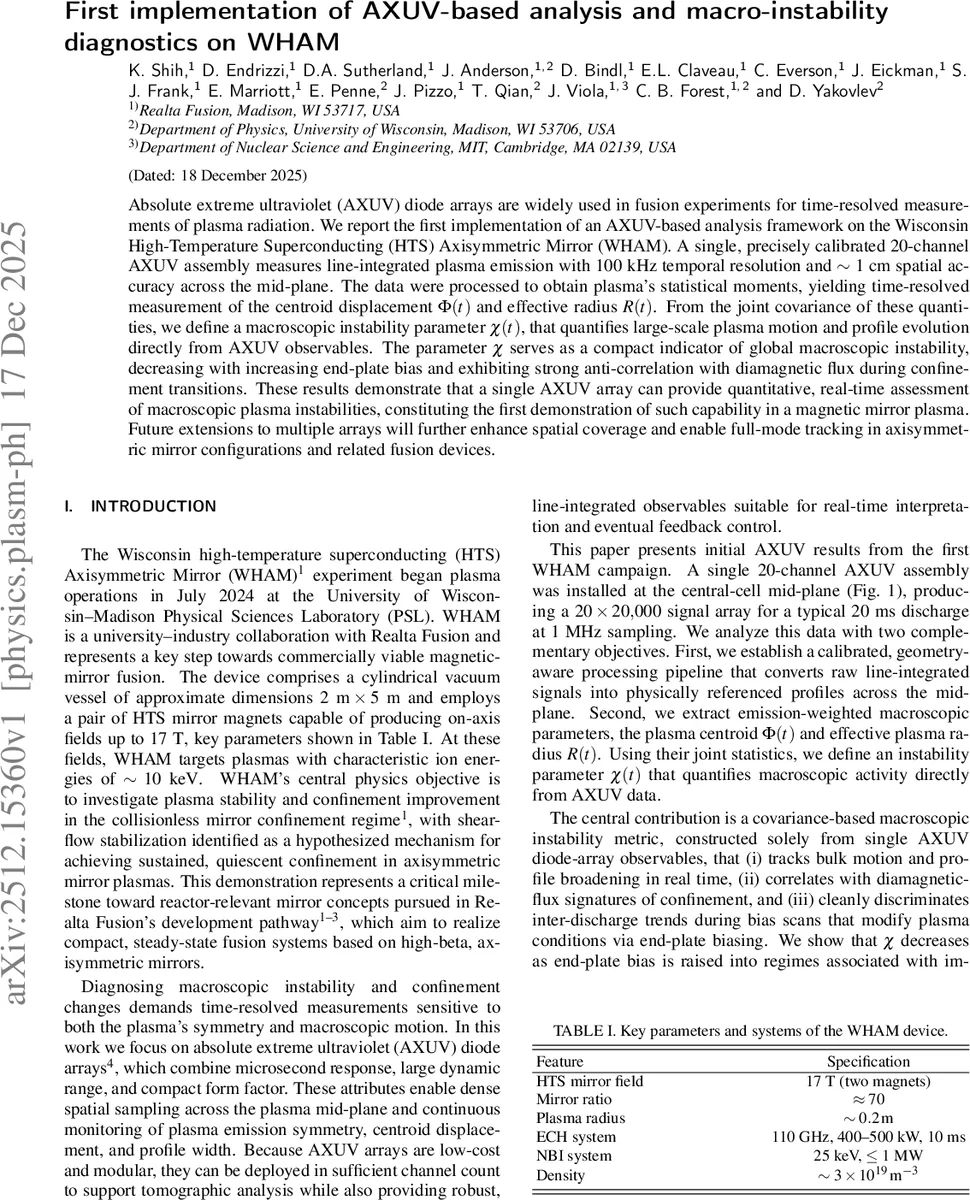
Absolute extreme ultraviolet (AXUV) diode arrays are widely used in fusion experiments for time-resolved measurements of plasma radiation. We report the first implementation of an AXUV-based analysis framework on the Wisconsin High-Temperature Superconducting (HTS) Axisymmetric Mirror (WHAM). A single, precisely calibrated 20-channel AXUV assembly measures line-integrated plasma emission with $ 100~\mathrm{kHz}$ temporal resolution and $\sim1~\mathrm{cm}$ spatial accuracy across the mid-plane. The data were processed to obtain plasma’s statistical moments, yielding time-resolved measurement of the centroid displacement $Φ(t)$ and effective radius $R(t)$. From the joint covariance of these quantities, we define a macroscopic instability parameter $χ(t)$, that quantifies large-scale plasma motion and profile evolution directly from AXUV observables. The parameter $χ$ serves as a compact indicator of global macroscopic instability, decreasing with increasing end-plate bias and exhibiting strong anti-correlation with diamagnetic flux during confinement transitions. These results demonstrate that a single AXUV array can provide quantitative, real-time assessment of macroscopic plasma instabilities, constituting the first demonstration of such capability in a magnetic mirror plasma. Future extensions to multiple arrays will further enhance spatial coverage and enable full-mode tracking in axisymmetric mirror configurations and related fusion devices.
💡 Research Summary
The paper reports the first implementation of an absolute extreme‑ultraviolet (AXUV) diode‑array diagnostic on the Wisconsin High‑Temperature Superconducting Axisymmetric Mirror (WHAM) experiment and demonstrates how a single 20‑channel assembly can provide a compact, real‑time metric of macroscopic plasma instability. WHAM is a 2 m × 5 m cylindrical magnetic‑mirror device employing two HTS magnets that generate up to 17 T on‑axis fields, targeting ~10 keV ion plasmas at densities of ~3 × 10¹⁹ m⁻³. The primary physics goal is to study shear‑flow stabilization in the collisionless mirror regime, which requires fast, symmetry‑sensitive diagnostics.
The AXUV system consists of twenty silicon photodiodes arranged behind a precision gold slit and a 250 nm aluminum filter, giving a line‑integrated soft‑X‑ray view of the plasma mid‑plane. Each channel’s viewing angle and relative sensitivity (C_i0) were calibrated using a laser‑based rotating‑and‑translating platform, achieving angular uncertainties <0.1° and gain variations <5 %. The calibrated signals I_i(t) were mapped to impact parameters b_i = –D sin φ_i, where D is the slit‑to‑axis distance and φ_i the measured angle. Edge effects were handled by extending the measured profile with Gaussian tails that smoothly reach zero at the limiter (R_L ≈ 25 cm). The resulting profile I(b,t) was interpolated onto a uniform b grid for further analysis.
Statistical moment analysis was applied to the time‑resolved profiles. The first moment yields the emission‑weighted centroid displacement Φ(t) = Σ I(b,t) b / Σ I(b,t), which quantifies m = 1 asymmetry (bulk shift). The second moment defines an effective radius R(t) = 2 √
Comments & Academic Discussion
Loading comments...
Leave a Comment