Expanding stellar horizons with polarized light
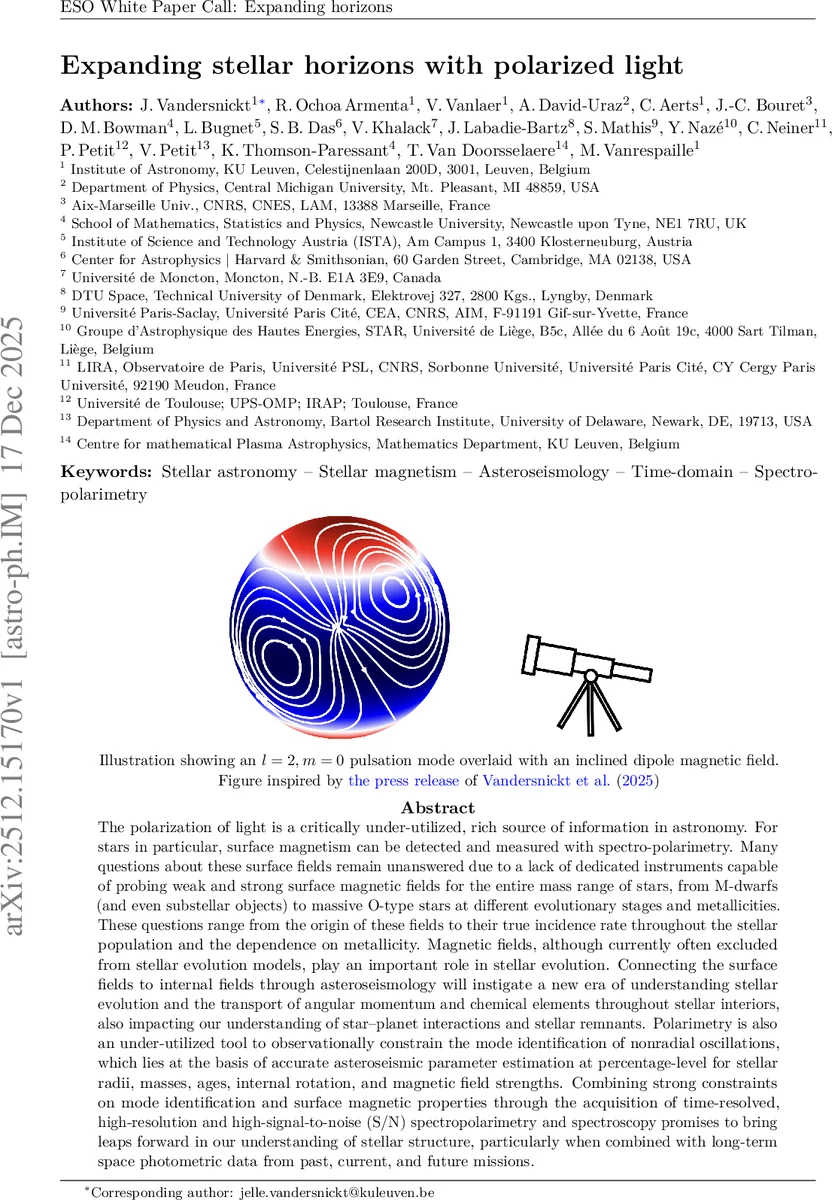
The polarization of light is a critically under-utilized, rich source of information in astronomy. For stars in particular, surface magnetism polarization that can be detected and measured with spectro-polarimetry. Many questions about these surface fields remain unanswered due to a lack of dedicated instruments capable of probing weak and strong surface magnetic fields for the entire mass range of stars, from M-dwarfs (and even substellar objects) to massive O-type stars at different evolutionary stages and metallicities. These questions range from the origin of these fields to their true incidence rate throughout the stellar population and the dependence on metallicity. Magnetic fields, although currently often excluded from stellar evolution models, play an important role in stellar evolution. Connecting the surface fields to internal fields through asteroseismology will instigate a new era of understanding stellar evolution and the transport of angular momentum and chemical elements throughout stellar interiors, also impacting our understanding of star-planet interactions and stellar remnants. Polarimetry is also an under-utilized tool to observationally constrain the mode identification of nonradial oscillations, which lies at the basis of accurate asteroseismic parameter estimation at percentage-level for stellar radii, masses, ages, internal rotation, and magnetic field strengths. Combining strong constraints on mode identification and surface magnetic properties through the acquisition of time-resolved, high-resolution and high-signal-to-noise (S/N) spectro-polarimetry and spectroscopy promises to bring leaps forward in our understanding of stellar structure, particularly when combined with long-term space photometric data from past, current, and future missions.
💡 Research Summary
**
The white paper “Expanding stellar horizons with polarized light” makes a compelling case for a next‑generation, high‑resolution spectropolarimetric facility that will transform our understanding of stellar magnetism across the entire Hertzsprung‑Russell diagram. The authors argue that current spectropolarimeters, typically mounted on ≤8 m telescopes, are limited to the brightest targets and cannot detect the weak, localized fields that dominate low‑mass stars or the faint magnetic signatures of distant massive stars and sub‑stellar objects. To overcome these limitations, they propose a dedicated instrument on a ≥10 m aperture telescope that covers the ultraviolet to near‑infrared (≈300 nm–2500 nm), delivers a spectral resolution of R ≥ 100 000, and achieves signal‑to‑noise ratios of >1000 in minute‑scale exposures for objects as faint as V≈12 mag.
Three scientific pillars drive the proposal. First, a systematic census of surface magnetic fields from M‑dwarfs and brown dwarfs up to O‑type stars, spanning a wide range of metallicities, will address the origin of magnetic fields in radiative envelopes, the incidence of strong large‑scale fields, and the hypothesized bistability mechanism that may link field strength to sub‑surface convection and differential rotation. Second, the combination of time‑resolved linear polarimetry with high‑resolution spectroscopy will enable robust mode identification (ℓ, m) for non‑radial pulsations, a prerequisite for precise asteroseismic inference. By measuring the phase‑resolved ratio of polarimetric to photometric amplitudes, the technique can determine both the spherical degree and the inclination of the pulsation axis, even for rapidly rotating stars where traditional echelle diagram methods fail. Third, the authors envision a synergistic program that couples these ground‑based magnetic diagnostics with long‑baseline space photometry from missions such as CoRoT, Kepler, TESS, PLATO and future surveys. This joint approach will deliver internal rotation profiles, magnetic field strengths, and chemical mixing rates with percent‑level precision, thereby calibrating angular‑momentum transport and magnetic braking prescriptions in stellar evolution codes.
The technical requirements are laid out in detail. A broadband, high‑efficiency optical design (including advanced coatings and fiber feeds) must preserve polarimetric fidelity at the 10⁻⁵ level. A stable wavelength reference (≤10 cm s⁻¹) and rapid readout detectors are needed to obtain continuous, minute‑cadence data. Multi‑object capability (single, binary, and multiple systems) is essential for efficient surveys. The instrument should be sited in the Southern Hemisphere—ideally at ESO’s Paranal or La Silla—to maximize overlap with the fields observed by current and upcoming space missions.
The anticipated scientific impact is far‑reaching. By delivering simultaneous surface and interior magnetic measurements, the facility will enable self‑consistent 3‑D magneto‑rotational stellar models, resolve the long‑standing discrepancy between observed and predicted internal rotation rates, and clarify the role of magnetic fields in stellar spin‑down, mass loss, and chemical mixing. In the low‑mass regime, precise magnetic diagnostics will improve gyrochronology, inform star‑planet interaction studies, and aid assessments of habitability around active M‑dwarfs. For massive stars, the data will test theories of fossil fields, merger‑induced magnetism, and metallicity‑dependent field generation. Ultimately, the authors argue that without such a dedicated spectropolarimetric capability, many of the “future scientific discovery” priorities identified in the AstroNet Roadmap (planet formation, reionization epoch, Solar System origins) will remain out of reach well into the 2040s. The paper concludes with a strong recommendation to fund the development of this instrument, positioning it as a cornerstone for the next generation of stellar astrophysics.
Comments & Academic Discussion
Loading comments...
Leave a Comment