Adaptive Weighted Genetic Algorithm-Optimized SVR for Robust Long-Term Forecasting of Global Stock Indices for investment decisions
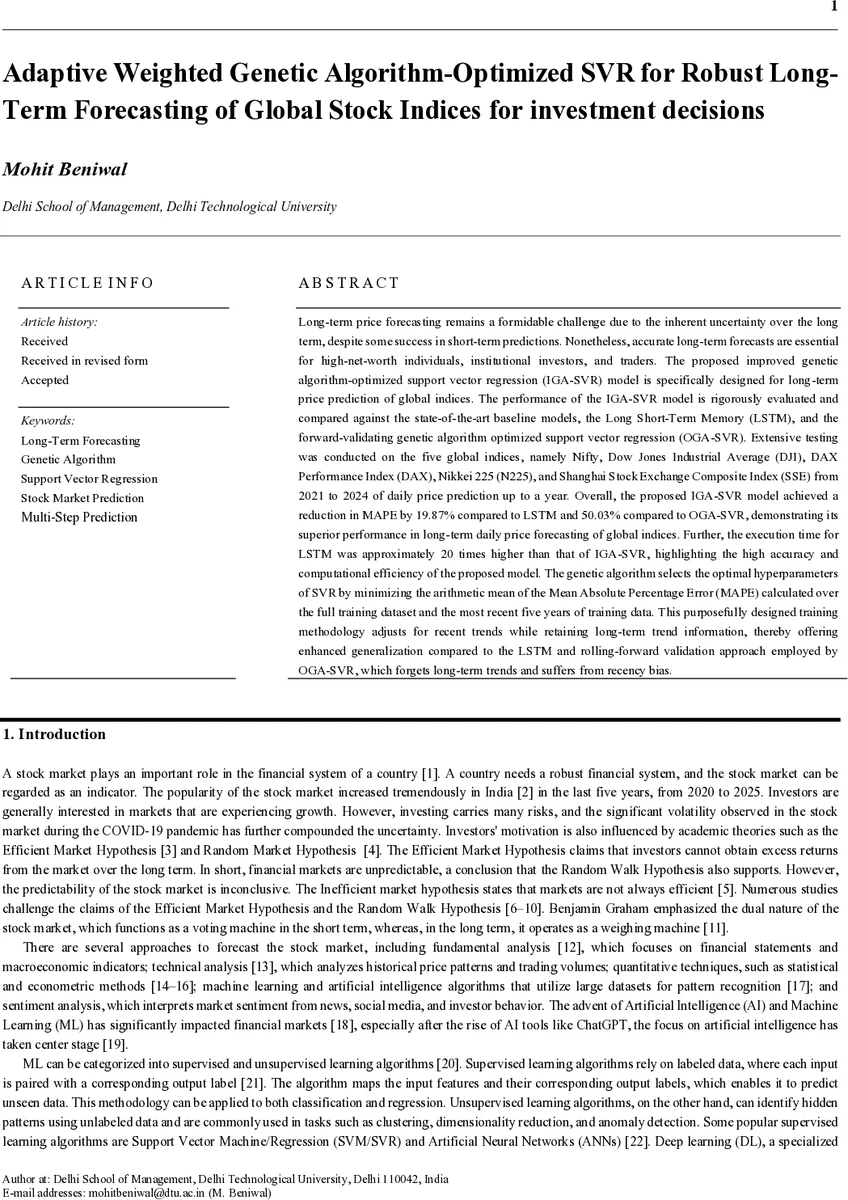
Long-term price forecasting remains a formidable challenge due to the inherent uncertainty over the long term, despite some success in short-term predictions. Nonetheless, accurate long-term forecasts are essential for high-net-worth individuals, institutional investors, and traders. The proposed improved genetic algorithm-optimized support vector regression (IGA-SVR) model is specifically designed for long-term price prediction of global indices. The performance of the IGA-SVR model is rigorously evaluated and compared against the state-of-the-art baseline models, the Long Short-Term Memory (LSTM), and the forward-validating genetic algorithm optimized support vector regression (OGA-SVR). Extensive testing was conducted on the five global indices, namely Nifty, Dow Jones Industrial Average (DJI), DAX Performance Index (DAX), Nikkei 225 (N225), and Shanghai Stock Exchange Composite Index (SSE) from 2021 to 2024 of daily price prediction up to a year. Overall, the proposed IGA-SVR model achieved a reduction in MAPE by 19.87% compared to LSTM and 50.03% compared to OGA-SVR, demonstrating its superior performance in long-term daily price forecasting of global indices. Further, the execution time for LSTM was approximately 20 times higher than that of IGA-SVR, highlighting the high accuracy and computational efficiency of the proposed model. The genetic algorithm selects the optimal hyperparameters of SVR by minimizing the arithmetic mean of the Mean Absolute Percentage Error (MAPE) calculated over the full training dataset and the most recent five years of training data. This purposefully designed training methodology adjusts for recent trends while retaining long-term trend information, thereby offering enhanced generalization compared to the LSTM and rolling-forward validation approach employed by OGA-SVR, which forgets long-term trends and suffers from recency bias.
💡 Research Summary
The paper proposes an “Improved Genetic Algorithm‑Optimized Support Vector Regression” (IGA‑SVR) model specifically designed for long‑term forecasting of global stock indices. Recognizing that most existing research focuses on short‑term predictions and that long‑term forecasts are crucial for high‑net‑worth individuals, institutional investors, and traders, the authors aim to fill this gap by developing a model that can reliably predict daily prices up to one year ahead.
The methodological contribution consists of three intertwined components. First, the authors employ a genetic algorithm (GA) to simultaneously optimize all three key hyper‑parameters of a radial‑basis‑function SVR: the regularization parameter C, the epsilon‑insensitive loss margin ε, and the kernel width γ. Prior work typically optimizes only C and ε, leaving γ at a default value; by optimizing γ as well, the model can better capture non‑linear relationships in financial time series.
Second, the GA’s fitness function is defined as the arithmetic mean of the Mean Absolute Percentage Error (MAPE) computed over (a) the entire historical training set and (b) the most recent five years of data. This dual‑window approach assigns higher weight to recent observations while preserving long‑term trend information, thereby mitigating the “recency bias” that plagues rolling‑forward validation schemes.
Third, unlike the rolling‑forward validation used in the baseline forward‑validating GA‑SVR (OGA‑SVR), IGA‑SVR trains on the full dataset, applying the weighted fitness function during hyper‑parameter search. This preserves long‑term structural patterns that might otherwise be forgotten when only recent windows are used for training.
Empirical evaluation is conducted on five major indices representing both developed and emerging economies: India’s Nifty, the United States’ Dow Jones Industrial Average (DJI), Germany’s DAX, Japan’s Nikkei 225 (N225), and China’s Shanghai Composite (SSE). Daily price data from 2021 to 2024 are used, and the models are tasked with forecasting up to a year ahead. Three models are compared: the proposed IGA‑SVR, a standard Long Short‑Term Memory (LSTM) neural network, and the previously published OGA‑SVR.
Results show that IGA‑SVR achieves a 19.87 % reduction in MAPE relative to LSTM and a 50.03 % reduction relative to OGA‑SVR across the five indices. In terms of computational efficiency, the LSTM’s training time is roughly twenty times longer than that of IGA‑SVR, highlighting the latter’s suitability for real‑time or near‑real‑time investment decision support. The performance gains are consistent across all indices, with particularly notable improvements on more volatile markets such as the SSE.
The authors discuss several implications. The superior accuracy and speed make IGA‑SVR a practical tool for long‑term portfolio allocation and risk management. The GA‑based hyper‑parameter optimization demonstrates that a relatively simple kernel‑based regression model can rival deep learning approaches when appropriately tuned and when the training objective balances long‑term and recent information.
Limitations are acknowledged. The study uses only price history as input, omitting macro‑economic indicators, sentiment data, or technical features that could further enhance predictive power. Sensitivity analysis of GA meta‑parameters (population size, crossover and mutation rates) is not presented, leaving open the question of robustness to GA configuration. Moreover, the forecasting horizon is limited to one year; extending the horizon to multiple years would test the model’s ability to capture even longer‑term dynamics.
Future research directions include (1) incorporating multi‑modal data (fundamentals, news sentiment, volatility indices), (2) comparing GA with other meta‑heuristics such as Particle Swarm Optimization or Differential Evolution for SVR tuning, and (3) integrating the forecasting engine into a live portfolio optimization framework to assess economic value in terms of returns and risk-adjusted performance.
In conclusion, the IGA‑SVR model delivers a compelling combination of high forecasting accuracy, computational efficiency, and methodological novelty, establishing it as a strong candidate for long‑term stock index prediction and supporting more informed investment decisions.
Comments & Academic Discussion
Loading comments...
Leave a Comment