Structural Analysis of Commutative S-Reduced Rings
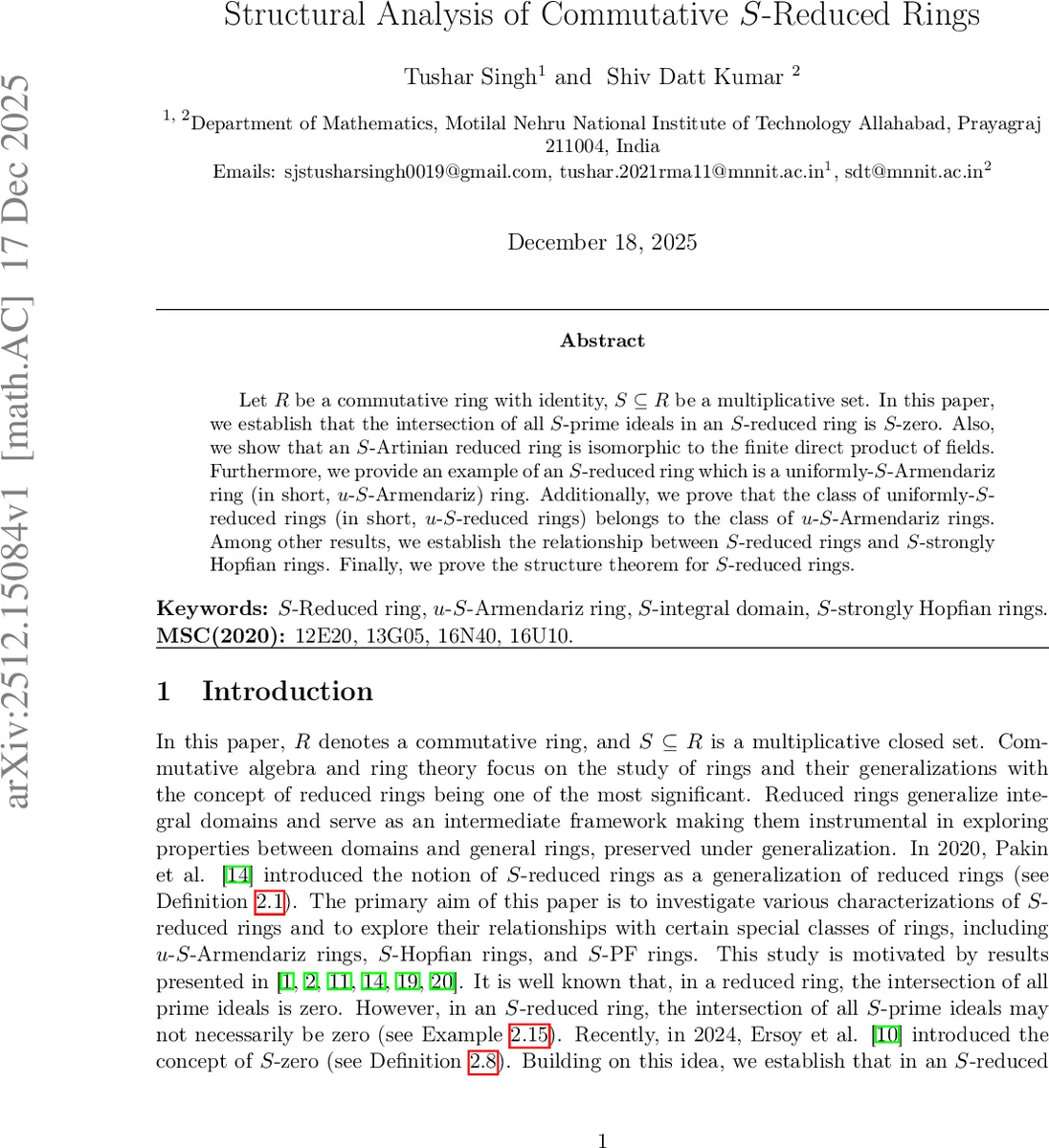
Let $R$ be a commutative ring with identity, $S \subseteq R$ be a multiplicative set. In this paper, we establish that the intersection of all $S$-prime ideals in an $S$-reduced ring is $S$-zero. Also, we show that an $S$-Artinian reduced ring is isomorphic to the finite direct product of fields. Furthermore, we provide an example of an $S$-reduced ring which is a uniformly-$S$-Armendariz ring (in short, $u$-$S$-Armendariz$)$ ring. Additionally, we prove that the class of uniformly-$S$-reduced rings (in short, $u$-$S$-reduced rings) belongs to the class of $u$-$S$-Armendariz rings. Among other results, we establish the relationship between $S$-reduced rings and $S$-strongly Hopfian rings. Finally, we prove the structure theorem for $S$-reduced rings.
💡 Research Summary
The paper investigates a class of commutative rings equipped with a multiplicative set S, called S‑reduced rings, and develops a systematic theory parallel to the classical theory of reduced rings. An S‑reduced ring R is defined by the condition that whenever an element r satisfies rⁿ = 0 for some n, there exists s ∈ S with sr = 0. This weakens the usual reduced condition and allows many non‑reduced examples (e.g., ℤ₍₂₄₎, infinite direct products) to become S‑reduced after a suitable choice of S.
The authors introduce several auxiliary notions: the S‑radical of an ideal, S‑zero (elements annihilated by some s ∈ S), and S‑nilpotent elements. They prove that in an S‑reduced ring the intersection of any two ideals is an S‑zero ideal if and only if their product is an S‑zero ideal, establishing a useful equivalence for later arguments.
A central result (Theorem 2.16) shows that in any S‑reduced ring the intersection of all S‑prime ideals is an S‑zero ideal. The proof uses Zorn’s Lemma to construct a maximal ideal disjoint from a certain set built from S‑zero elements, then shows this maximal ideal must be S‑prime, leading to a contradiction unless the intersection is S‑zero. This generalizes the classical fact that the nilradical equals the intersection of all prime ideals in a reduced ring.
The paper then studies S‑Artinian reduced rings. Under the hypothesis that R is S‑Noetherian, S‑reduced, and every non‑zero element of the localization S⁻¹R is either a zero‑divisor or a unit, the authors prove that S⁻¹R is Artinian. Consequently, an S‑Artinian reduced ring decomposes as a finite direct product of fields, mirroring the well‑known structure theorem for Artinian reduced rings but now in the S‑context.
Next, the authors turn to a generalized Armendariz property. A ring is called u‑S‑Armendariz if for polynomials f(x), g(x) with f g = 0, there exists s ∈ S such that s a_i b_j = 0 for all coefficients a_i, b_j. They exhibit a concrete example using 3×3 upper‑triangular matrices, establishing that non‑trivial u‑S‑Armendariz rings exist. Theorem 3.5 proves that every u‑S‑reduced ring is automatically u‑S‑Armendariz, by exploiting the S‑reduced condition to force each coefficient product into an S‑zero element.
The relationship with Hopfian properties is also explored. An S‑strongly Hopfian ring is one where every S‑linear endomorphism that is surjective is automatically injective. Proposition 3.9 shows that any S‑reduced ring is S‑strongly Hopfian, again using the fact that kernels of such maps become S‑zero and therefore must be trivial.
Further, the paper shows that the class of S‑PF rings (rings whose ideals are S‑pure) is contained in the class of S‑reduced rings, providing an example to illustrate the inclusion.
Finally, the authors present a structure theorem (Theorem 3.16) for S‑reduced rings: by localizing at S and examining the minimal S‑prime ideals, one can write any S‑reduced ring as a finite direct product of quotient rings R/P_i, each of which becomes a field after localization. Thus an S‑reduced ring is essentially a finite product of “S‑local fields,” and the intersection of all S‑prime ideals coincides with the S‑nilradical.
Overall, the paper successfully extends many classical results about reduced, Artinian, and Armendariz rings to the setting where a multiplicative set S is used to “twist’’ nilpotence and zero‑divisor behavior. The introduction of S‑zero, S‑prime, and u‑S‑Armendariz concepts creates a cohesive framework that connects reducedness, Artinian properties, Hopfian behavior, and polynomial annihilation in a unified manner, offering new tools for researchers studying localized or “relative’’ ring-theoretic properties.
Comments & Academic Discussion
Loading comments...
Leave a Comment