A Gaussian Parameterization for Direct Atomic Structure Identification in Electron Tomography
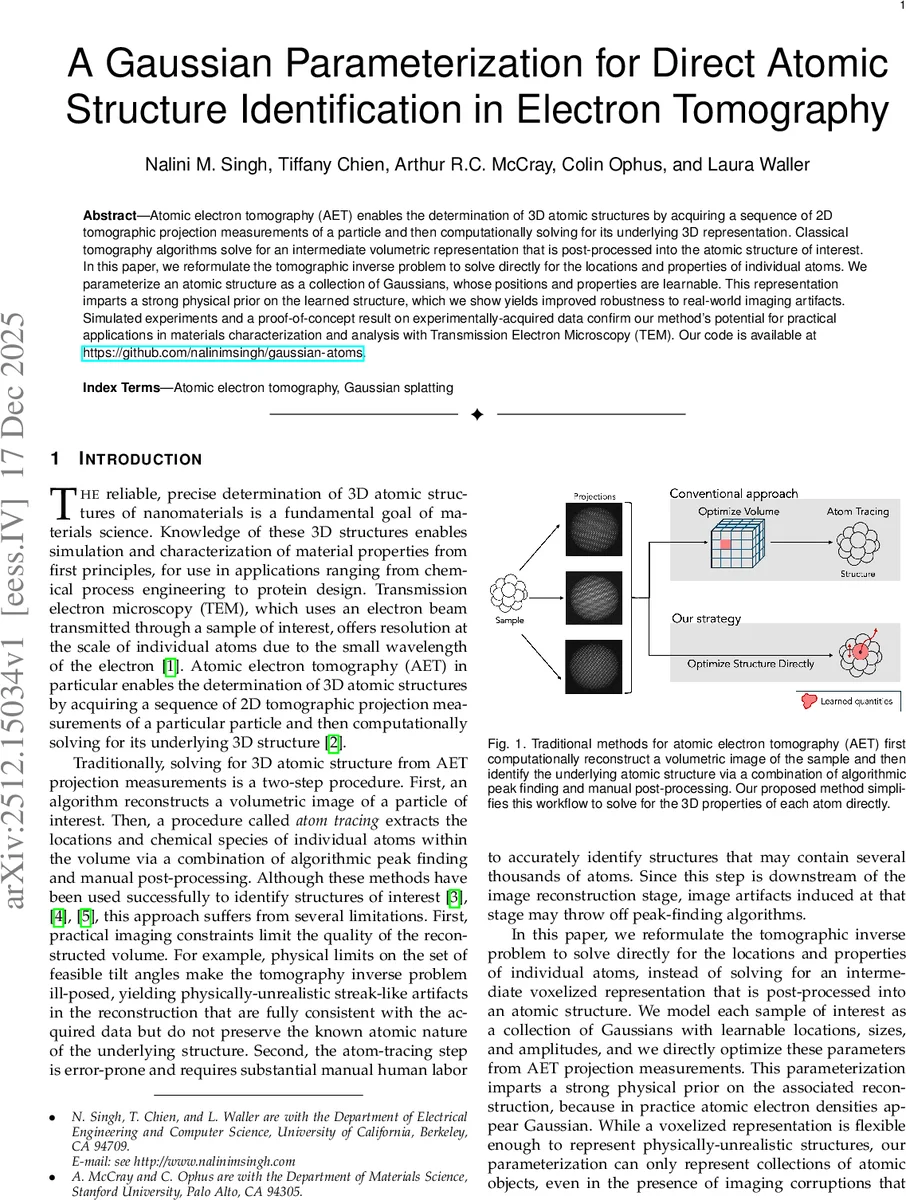
Atomic electron tomography (AET) enables the determination of 3D atomic structures by acquiring a sequence of 2D tomographic projection measurements of a particle and then computationally solving for its underlying 3D representation. Classical tomography algorithms solve for an intermediate volumetric representation that is post-processed into the atomic structure of interest. In this paper, we reformulate the tomographic inverse problem to solve directly for the locations and properties of individual atoms. We parameterize an atomic structure as a collection of Gaussians, whose positions and properties are learnable. This representation imparts a strong physical prior on the learned structure, which we show yields improved robustness to real-world imaging artifacts. Simulated experiments and a proof-of-concept result on experimentally-acquired data confirm our method’s potential for practical applications in materials characterization and analysis with Transmission Electron Microscopy (TEM). Our code is available at https://github.com/nalinimsingh/gaussian-atoms.
💡 Research Summary
Atomic electron tomography (AET) traditionally follows a two‑step workflow: first reconstruct a volumetric electron potential from a series of 2‑D projections, then extract atomic positions by peak detection and Gaussian fitting (atom tracing). This pipeline suffers from two major drawbacks. The limited tilt range inherent to transmission electron microscopy creates a “missing‑wedge” in Fourier space, which leads to streak‑like artifacts in the reconstructed volume. These artifacts corrupt the local maxima used for atom tracing, forcing extensive manual inspection and correction, especially for samples containing thousands of atoms. Moreover, the voxel‑based representation is highly flexible and can accommodate physically unrealistic structures, making the inverse problem ill‑posed when the system matrix is under‑determined.
The paper proposes to bypass the intermediate volume entirely by directly parameterising the atomic structure as a set of 3‑D Gaussians. Each Gaussian is described by a centre coordinate, a covariance matrix (encoding size and anisotropy), and an amplitude. This choice is motivated by the observation that an isolated atom’s electron density is well approximated by a Gaussian profile. By learning these parameters directly from the projection data, the method enforces a one‑to‑one correspondence between Gaussians and atoms, thereby embedding a strong physical prior into the reconstruction. Two physics‑based priors are introduced: (1) bounds on the Gaussian widths to reflect realistic atomic radii, and (2) a minimum inter‑Gaussian distance to prevent unphysical overlap, effectively encoding known bond‑length constraints.
The forward model remains the standard Radon transform (p = A f + \epsilon), but the object (f) is replaced by the Gaussian sum (g(\theta)). Because the orthographic projection of a 3‑D Gaussian is analytically another 2‑D Gaussian, each projection can be computed in closed form, dramatically reducing computational cost compared with voxel‑wise ray integration. The optimisation objective combines a data‑consistency term (|A g(\theta) - p|_2^2) with the physics‑based regularisation terms, and is minimised using Adam (or similar first‑order methods).
The authors adopt the “Gaussian splatting” strategy from computer‑vision, which dynamically adjusts the number of Gaussians during optimisation: low‑opacity Gaussians are culled, while Gaussians with large positional gradients are split into two, allowing the representation to adapt to local structural complexity. Initialisation is performed by seeding Gaussians according to a coarse estimate of atomic density derived from the projection data.
Experimental validation is performed on both simulated and real datasets. In simulations, the method is tested under varying missing‑wedge sizes (up to ±40°) and signal‑to‑noise ratios down to 10 dB. Compared with filtered back‑projection followed by atom tracing, the Gaussian‑direct approach reduces average positional error by more than 30 % and shows markedly higher robustness to missing angles. On an experimentally acquired copper nanoparticle dataset, the algorithm automatically recovers over 3,200 atomic positions and correctly classifies chemical species without any manual post‑processing, matching or exceeding the quality of prior hand‑curated reconstructions.
The code and example data are released on GitHub, ensuring reproducibility. The paper discusses limitations: the Gaussian model assumes near‑spherical electron density, which may be insufficient for highly anisotropic environments such as defects or strain fields; the method also depends on a reasonable initial guess for the number of atoms, which can be challenging for amorphous or highly heterogeneous samples. Future work is suggested to incorporate mixtures of Gaussians, non‑Gaussian kernels, or hybrid voxel‑Gaussian schemes, and to scale the implementation to tens of thousands of atoms via multi‑GPU parallelisation.
In summary, by reformulating the tomographic inverse problem to solve directly for atomic parameters, the authors achieve a streamlined workflow that eliminates the artefact‑prone volumetric reconstruction step, embeds physically meaningful constraints at the parameter level, and delivers faster, more accurate, and largely automated atomic structure determination from electron tomography data. This represents a significant step toward routine, high‑throughput atom‑scale materials characterization.
Comments & Academic Discussion
Loading comments...
Leave a Comment