On the Jacobian of the Douady-Earle extension
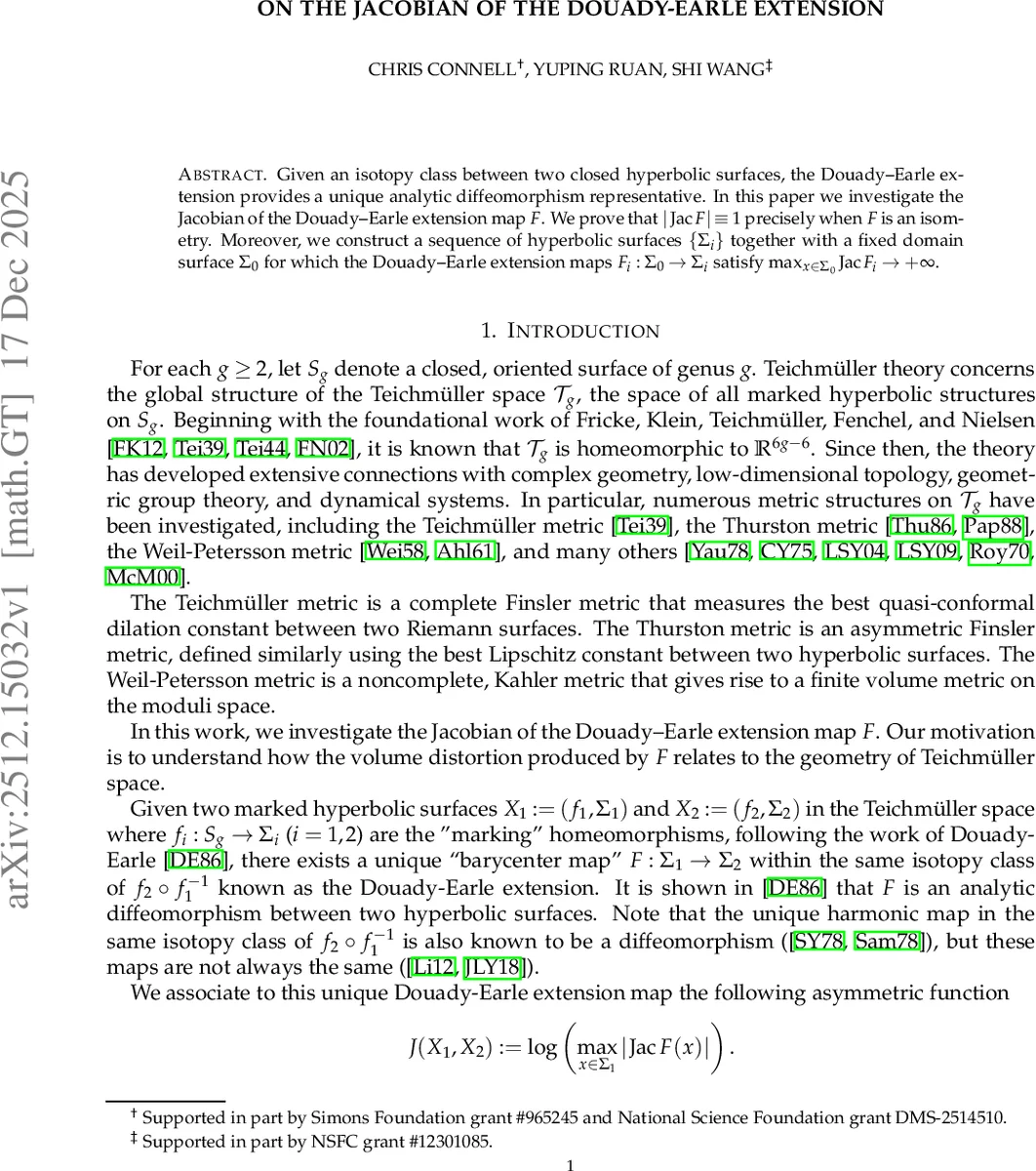
Given an isotopy class between two closed hyperbolic surfaces, the Douady–Earle extension provides a unique analytic diffeomorphism representative. In this paper we investigate the Jacobian of the Douady–Earle extension map $F$. We prove that $|\operatorname{Jac} F| \equiv 1$ precisely when $F$ is an isometry. Moreover, we construct a sequence of hyperbolic surfaces ${Σ_i}$ together with a fixed domain surface $Σ_0$ for which the Douady–Earle extension maps $F_i:Σ_0\toΣ_i$ satisfy $\max_{x\inΣ_0} \operatorname{Jac} F_i \to +\infty$.
💡 Research Summary
The paper investigates the Jacobian of the Douady–Earle extension, a canonical analytic diffeomorphism associated to a homotopy class of maps between two closed hyperbolic surfaces. For any pair of marked hyperbolic structures X₁=(f₁,Σ₁) and X₂=(f₂,Σ₂) in Teichmüller space T_g, the Douady–Earle construction produces a unique map F:Σ₁→Σ₂ that is analytic, orientation‑preserving, and area‑preserving. The authors define a non‑negative, mapping‑class‑invariant function
J(X₁,X₂)=log max_{x∈Σ₁}|Jac F(x)|,
which measures the maximal volume distortion of the extension.
Theorem 1.1 states that J(X₁,X₂)=0 if and only if the two hyperbolic structures are isometric. The proof proceeds by first observing that if |Jac F|≡1 then there exists a point x₀ where the differential dF_{x₀} is an isometry. Using the integral equation (7) derived from the barycenter condition, the authors take the trace, apply the arithmetic–geometric mean inequality, and deduce that for almost every boundary point θ the Busemann gradients satisfy dB_θ,x₀(e_i)=dB_{ϕ(θ)},y₀(e_i) for an orthonormal basis {e_i}. This forces the boundary homeomorphism ϕ to be a Möbius transformation, i.e., the boundary map of an isometry G of ℍ². Since the Douady–Earle extension of ϕ is unique, it must coincide with G, and consequently F is an isometry. The converse is immediate because any isometry has Jacobian identically one.
Theorem 1.2 shows that J is unbounded on T_g×T_g. To exhibit this, the authors work in Fenchel–Nielsen coordinates. They fix a pants decomposition of the reference surface Σ₁ and consider a one‑parameter family X_ε = (f_ε,Σ_ε) where the length ℓ₁ of a distinguished simple closed curve γ₁ is set to ε>0 while all other length and twist parameters remain constant (twists are zero). The family is chosen so that as ε→0 the curve γ₁ collapses symmetrically. The resulting surfaces Σ_ε admit two commuting involutive isometries σ_ε and τ_ε (up‑down and front‑back symmetries) which descend from the original symmetries of Σ₁. These symmetries force the induced boundary maps ϕ_ε to preserve the four quadrants of the circle at infinity and to fix the four points corresponding to the axes of the symmetries.
Analyzing the barycenter equation for the Douady–Earle extension in this symmetric setting, the authors derive a differential inequality showing that the derivative of F_ε in the direction orthogonal to the collapsing curve grows like ε^{-1}. More precisely, they obtain an estimate
max_{x∈Σ₁}|Jac F_ε(x)| ≥ C·ε^{-1},
for a universal constant C>0. As ε→0, this quantity diverges to +∞, proving that J can be arbitrarily large. The construction exploits the fact that the collapsing geodesic creates a region where the barycenter map must stretch dramatically to match the boundary data, and the symmetry guarantees that this stretching cannot be compensated elsewhere.
The paper concludes with a discussion of the geometric meaning of the J‑function. Since J is non‑negative, mapping‑class invariant, and vanishes exactly on the diagonal, it resembles an asymmetric distance on Teichmüller space. The authors pose the open question whether J satisfies the triangle inequality and how it compares quantitatively to the classical Teichmüller, Thurston, and Weil–Petersson metrics. They also remark on the contrast with higher‑dimensional analogues (Besson–Courtois–Gallot) where the Jacobian of the barycenter map is uniformly bounded, highlighting a distinctive feature of two‑dimensional hyperbolic geometry.
Overall, the work provides a clear characterization of when the Douady–Earle extension is volume‑preserving (i.e., an isometry) and demonstrates that, unlike in higher dimensions, the Jacobian can become arbitrarily large in the surface case. This contributes a new quantitative tool for probing the geometry of Teichmüller space and opens avenues for further study of asymmetric metrics derived from natural geometric constructions.
Comments & Academic Discussion
Loading comments...
Leave a Comment