A Framework for Handling and Exploiting Symmetry in Benders' Decomposition
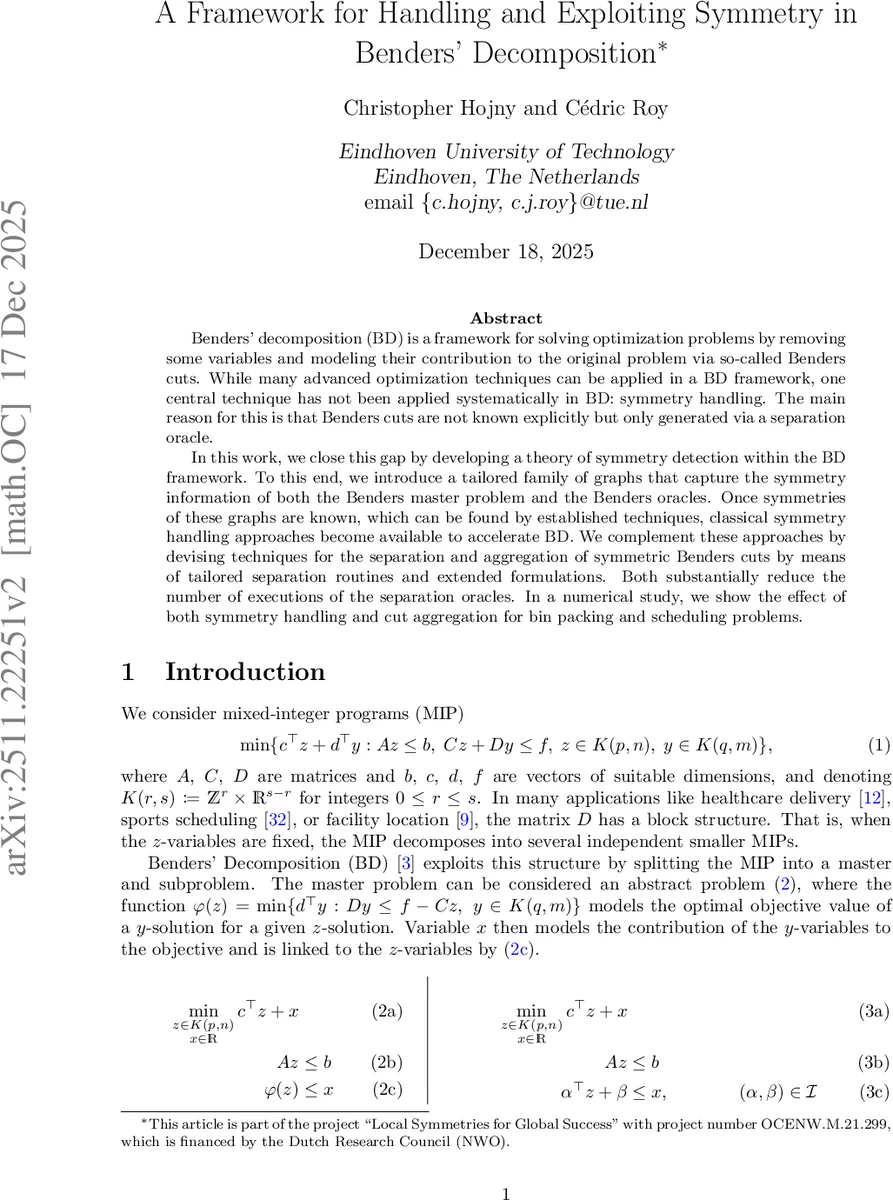
Benders’ decomposition (BD) is a framework for solving optimization problems by removing some variables and modeling their contribution to the original problem via so-called Benders cuts. While many advanced optimization techniques can be applied in a BD framework, one central technique has not been applied systematically in BD: symmetry handling. The main reason for this is that Benders cuts are not known explicitly but only generated via a separation oracle. In this work, we close this gap by developing a theory of symmetry detection within the BD framework. To this end, we introduce a tailored family of graphs that capture the symmetry information of both the Benders master problem and the Benders oracles. Once symmetries of these graphs are known, which can be found by established techniques, classical symmetry handling approaches become available to accelerate BD. We complement these approaches by devising techniques for the separation and aggregation of symmetric Benders cuts by means of tailored separation routines and extended formulations. Both substantially reduce the number of executions of the separation oracles. In a numerical study, we show the effect of both symmetry handling and cut aggregation for bin packing and scheduling problems.
💡 Research Summary
This paper addresses a long‑standing gap in the application of symmetry handling to Benders decomposition (BD). While modern mixed‑integer programming (MIP) solvers routinely detect and exploit problem symmetries, BD has been unable to do so because Benders cuts are generated on‑the‑fly by a separation oracle and are not explicitly present in the model. The authors develop a comprehensive theory and a practical algorithmic framework that brings symmetry detection and exploitation into the BD workflow.
The core idea is to construct symmetry detection graphs (SDGs) for both the master problem and the Benders oracles, then merge them into a single graph that captures the full symmetry structure of the BD formulation. To make this possible, they introduce “anchored” SDGs: each sub‑component (the master constraints and each oracle) is represented by a graph that contains a special anchor node, ensuring that any graph automorphism corresponds to a legitimate symmetry of the underlying optimization problem. By applying standard graph‑automorphism tools to the merged SDG, the full symmetry group Π of the BD model can be identified automatically.
Once Π is known, two complementary exploitation mechanisms are proposed. First, any Benders cut (α,β) yields an entire orbit of symmetric cuts { (π⁻¹(α),β) : π∈Π }. For many practical problems—most notably the multiple‑knapsack problem (MKP) where items with identical weight form symmetry groups—this orbit can be separated in O(n log n) time by sorting the coefficients of α and the current solution vector, thus avoiding costly oracle calls. Second, the authors present an extended formulation that aggregates an exponential family of symmetric cuts into a polynomial‑size set of linear constraints. For each symmetry group G they introduce binary ordering variables ζᵏ_G that encode whether the k‑th largest variable in G is set to one. Using these ζ‑variables, all cuts in the orbit can be expressed by a single inequality Σ_{k≤|C∩G|} ζᵏ_G ≤ |C|−1, eliminating the need to separate each cut individually.
The methodology is evaluated on three classes of problems that naturally admit BD: sphere packing, rectangle packing, and machine scheduling. Each class features a master assignment model with Benders cuts that enforce feasibility of the packing or scheduling sub‑problems. Experiments compare four variants: plain BD, BD with symmetry detection only, BD with cut aggregation only, and the full combination. Results show dramatic reductions in runtime and oracle calls. In highly symmetric instances (e.g., many identical items), the full approach achieves speed‑ups of 5–30× over plain BD, and in some cases the oracle is never invoked after the first cut, effectively turning BD into a pure master‑problem solve.
The paper’s contributions are threefold: (1) a practical SDG‑based framework for detecting symmetries in BD, (2) algorithmic techniques for generating whole families of symmetric Benders cuts without additional oracle work, and (3) an extended formulation that compresses exponentially many symmetric cuts into a compact linear model. Together, these advances bring the powerful symmetry‑handling capabilities that are standard in MIP solvers to the Benders decomposition context, opening the door to more scalable solution methods for large‑scale mixed‑integer programs with block‑structured sub‑problems. Future work is suggested on dynamic symmetry updates, multi‑level BD hierarchies, and extensions to non‑linear sub‑problems.
Comments & Academic Discussion
Loading comments...
Leave a Comment