Rhaly operators acting on Hardy, Bergman, and Dirichlet spaces
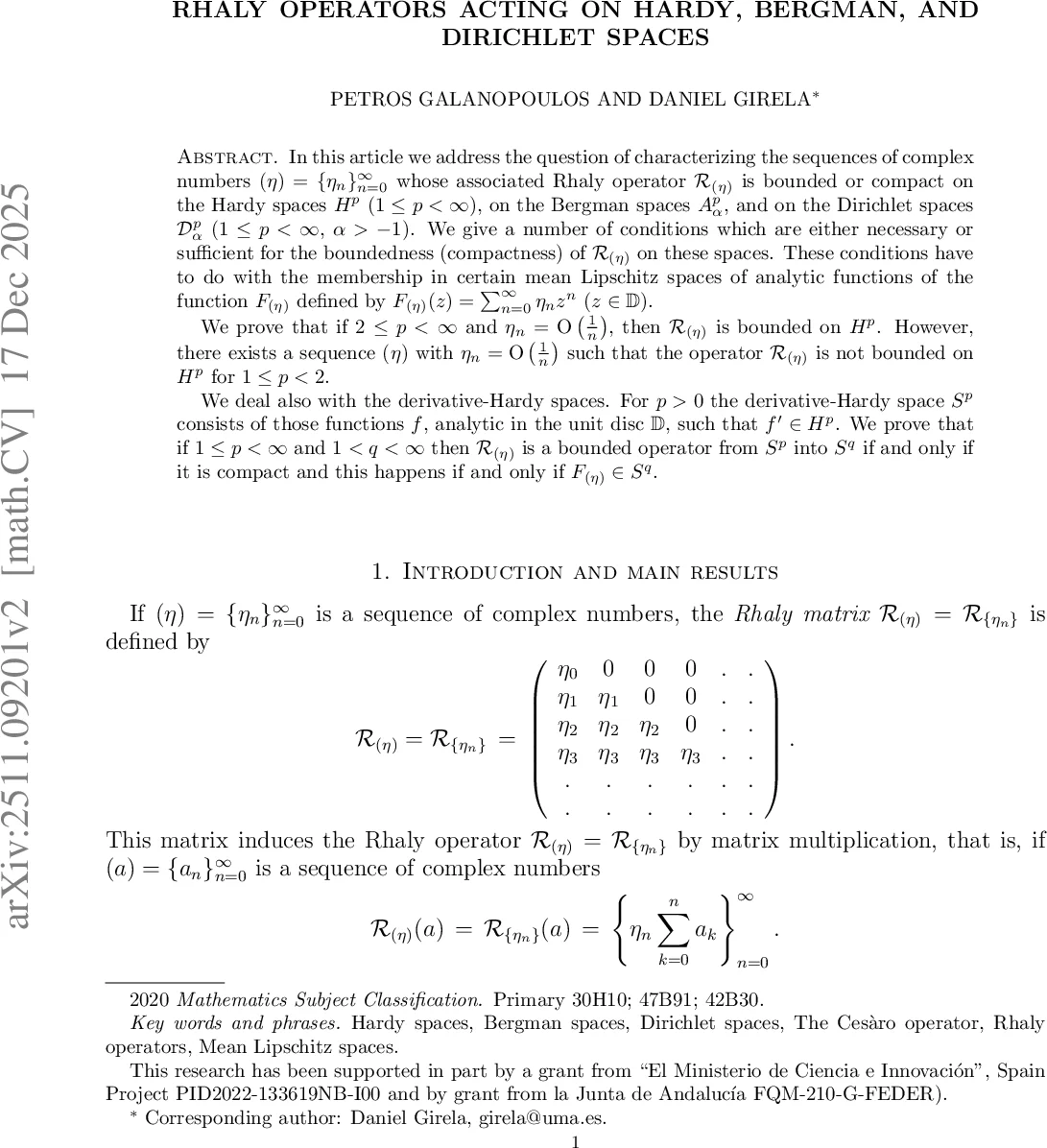
In this article we address the question of characterizing the sequences of complex numbers $(η)={ η_n}{n=0}^\infty $ whose associated Rhaly operator $\mathcal R{(η)}$ is bounded or compact on the Hardy spaces $H^p$ ($1\le p<\infty $), on the Bergman spaces $A^p_α$, and on the Dirichlet spaces $\mathcal D^p_α$ ($1\le p<\infty $, $α>-1$). We give a number of conditions which are either necessary or sufficient for the boundedness (compactness) of $\mathcal R_{(η)}$ on these spaces. These conditions have to do with the membership in certain mean Lipschitz spaces of analytic functions of the function $F_{(η)}$ defined by $F_{(η)}(z)=\sum_{n=0}^\infty η_nz^n$ ($z\in \mathbb D$). \par We prove that if $2\le p<\infty $ and $η_n=\og \left (\frac{1}{n}\right )$, then $\mathcal R_{(η)}$ is bounded on $H^p$. However, there exists a sequence $(η)$ with $η_n=\og \left (\frac{1}{n}\right )$ such that the operator $\mathcal R_{(η)}$ is not bounded on $H^p$ for $1\le p<2$. \par We deal also with the derivative-Hardy spaces. For $p>0$ the derivative-Hardy space $S^p$ consists of those functions $f$, analytic in the unit disc $\mathbb D$, such that $f^\prime \in H^p$. We prove that if $1\le p<\infty $ and $1<q<\infty $ then $\mathcal R_{(η)}$ is a bounded operator from $S^p$ into $S^q$ if and only if it is compact and this happens if and only if $F_{(η)}\in S^q$.
💡 Research Summary
The paper investigates the boundedness and compactness of Rhaly operators ℛ₍η₎ associated with a complex sequence η = {ηₙ}ₙ₌₀^∞ when acting on several classical spaces of analytic functions: the Hardy spaces H^p (1 ≤ p < ∞), the weighted Bergman spaces A^p_α (α > −1, 1 ≤ p < ∞), the Dirichlet-type spaces D^p_α (α > −1, 1 ≤ p < ∞), and the derivative‑Hardy spaces S^p (functions whose derivative belongs to H^p). The Rhaly matrix is defined by (ℛ{ηₙ}){n,k}=η_n for 0 ≤ k ≤ n and zero otherwise; consequently ℛ₍η₎ acts on a power series f(z)=∑ a_k z^k by ℛ₍η₎(f)(z)=∑{n=0}^∞ η_n (∑_{k=0}^n a_k) z^n. When the generating function F₍η₎(z)=∑ η_n z^n is analytic in the unit disc, ℛ₍η₎ can be regarded as a linear operator on spaces of analytic functions.
The central theme is to relate the operator‑theoretic properties of ℛ₍η₎ to the membership of F₍η₎ (or its derivative) in certain mean‑Lipschitz spaces Λ(p,α) and their “little‑o’’ counterparts λ(p,α). For a function g analytic in the disc, Λ(p,α) consists of those g∈H^p whose integral modulus of continuity satisfies ω_p(δ,g)=O(δ^α) as δ→0; λ(p,α) requires ω_p(δ,g)=o(δ^α). Classical results of Hardy and Littlewood show that Λ(p,α) can be characterized by the growth of M_p(r,g′)≈(1−r)^{α−1}.
Hardy spaces.
Theorem 1 establishes a necessary condition: if ℛ₍η₎∈B(H^p) (bounded), then the derivative of the generating function satisfies
M_p(r,F₍η₎′)=O\bigl(\log\frac1{1−r},(1−r)^{1−1/p}\bigr) as r→1.
Conversely, for 1 < p ≤ 2, the inclusion F₍η₎∈Λ(p,1/p) is sufficient for boundedness; for p>2, it suffices that F₍η₎ belong to Λ(q,1/q) for some q∈(2,p). In the Hilbert case p=2, boundedness is equivalent to F₍η₎∈Λ(2,½). Theorem 2 gives the analogous compactness criteria, replacing the O‑estimate by an o‑estimate and Λ by λ.
Bergman and Dirichlet spaces.
Theorems 3 and 4 extend the Hardy‑space results to A^p_α and D^p_α. For any α>−1 and 1≤p<∞, the condition F₍η₎∈Λ(p,1/p) guarantees ℛ₍η₎∈B(A^p_α) (and similarly for D^p_α when α>p−2). The corresponding little‑o condition yields compactness. Conversely, when −1<α<2p−2, boundedness (or compactness) of ℛ₍η₎ forces the same growth condition (1.2) (or (1.3)) on F₍η₎′, mirroring the Hardy‑space necessity. In the special case α>0 and p=2, the criteria reduce again to Λ(2,½) and λ(2,½).
Sequences with ηₙ=O(1/n).
Theorem 5 addresses the natural growth condition ηₙ=O(1/n). Part (i) shows that for any p≥2, this condition alone ensures ℛ₍η₎∈B(H^p). Part (ii) constructs a concrete counterexample: a sequence with ηₙ=O(1/n) for which ℛ₍η₎ fails to be bounded on H^p when 1≤p<2. Part (iii) proves a sharp equivalence for non‑negative decreasing sequences: ℛ₍η₎ is bounded on H^p iff ηₙ=O(1/n). Thus the same asymptotic bound has dramatically different implications depending on the exponent p and on monotonicity.
Derivative‑Hardy spaces.
Theorem 6 treats the spaces S^p={f: f′∈H^p}. For 1≤p<∞ and 1<q<∞, the three statements are equivalent:
(i) ℛ₍η₎∈B(S^p,S^q);
(ii) ℛ₍η₎∈K(S^p,S^q);
(iii) F₍η₎∈S^q.
Thus boundedness and compactness coincide, and they are completely characterized by the membership of the generating function in the target derivative‑Hardy space. This generalizes the known result for p=q=2.
Methodology.
The authors first translate the matrix action into coefficient formulas and then relate those coefficients to the Taylor coefficients of F₍η₎. By exploiting known characterizations of mean‑Lipschitz spaces (via growth of M_p(r,g′), differences Δ_N g, etc.) they derive necessary conditions from the behavior of ℛ₍η₎ on monomials and on reproducing kernels. Sufficient conditions are proved by estimating the operator norm using Hardy–Littlewood and Schur test arguments, together with Carleson measure techniques when appropriate. The counterexample for p<2 is built by carefully choosing ηₙ so that F₍η₎ fails the required Lipschitz condition while still satisfying ηₙ=O(1/n).
Impact.
The paper provides a comprehensive and unified description of when a Rhaly operator is bounded or compact across a wide family of analytic function spaces. It extends the classical theory of the Cesàro operator, clarifies the role of the generating function’s smoothness, and reveals subtle distinctions between different p‑ranges and between monotone versus arbitrary sequences. The results have potential applications to operator theory on spaces of analytic functions, to the study of summability methods, and to the analysis of integral operators defined via moment sequences.
Comments & Academic Discussion
Loading comments...
Leave a Comment