Almost symmetric submanifolds
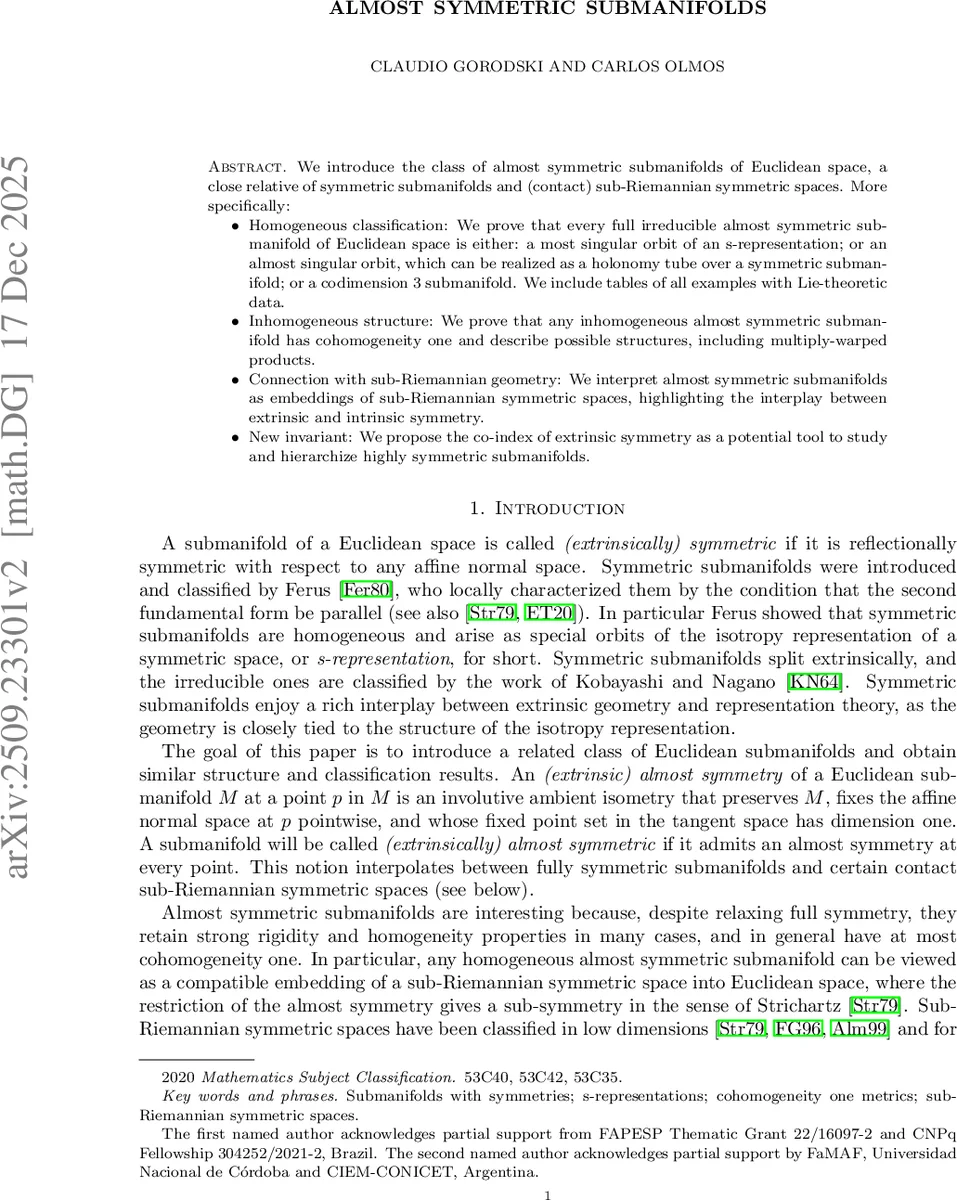
We introduce the class of almost symmetric submanifolds of Euclidean space, a close relative of symmetric submanifolds and (contact) sub-Riemannian symmetric spaces. More specifically, we prove that every full irreducible almost symmetric submanifold of Euclidean space is either: a most singular orbit of an s-representation; or an almost singular orbit, which can be realized as a holonomy tube over a symmetric submanifold; or a codimension 3 submanifold. We also include tables of all examples with Lie-theoretic data. We prove that any inhomogeneous almost symmetric submanifold has cohomogeneity one and describe possible structures, including multiply-warped products. We interpret almost symmetric submanifolds as embeddings of sub-Riemannian symmetric spaces, highlighting the interplay between extrinsic and intrinsic symmetry. We propose the co-index of extrinsic symmetry as new invariant and a potential tool to study and hierarchize highly symmetric submanifolds.
💡 Research Summary
This paper introduces and explores a newly defined class of geometric objects known as “almost symmetric submanifolds” within Euclidean space. Building upon the established framework of symmetric submanifolds and (contact) sub-Riemannian symmetric spaces, the authors aim to bridge the gap between extrinsic embedding properties and intrinsic geometric symmetries.
The core contribution of this research is a rigorous classification theorem for all full irreducible almost symmetric submanifolds in Euclidean space. The authors prove that any such submanifold must fall into one of three distinct categories:
- The most singular orbit of an s-representation, representing the highest level of symmetry. ical orbits, which can be realized as holonomy tubes over existing symmetric submanifolds.
- A submanifold with a codimension of 3.
This classification provides a profound structural understanding of how symmetry can be “almost” preserved even when the manifold deviates from the strict definition of a symmetric space. The paper also delves into the structural properties of inhomogeneous almost symmetric submanifolds. The authors demonstrate that these manifolds possess a cohomogeneity one structure and can exhibit complex geometries, such as multiply-warped products. This finding highlights that even in the absence of full homogeneity, a high degree of geometric order is maintained.
Furthermore, the paper provides a significant interpretation of almost symmetric submanifolds as embeddings of sub-Riemannian symmetric spaces. This perspective is crucial as it illuminates the intricate interplay between the intrinsic sub-Riemannian geometry and the extrinsic Euclidean embedding, showing how internal symmetries manifest in an external space.
A major methodological innovation presented in this work is the proposal of the “co-index of extrinsic symmetry.” The authors introduce this as a new mathematical invariant designed to measure and hierarchize the degree of symmetry in highly symmetric submanifolds. This tool offers a potential pathway for future researchers to study and categorize complex geometric structures by quantifying their deviation from perfect symmetry. By providing comprehensive tables of all examples with their corresponding Lie-theoretic data, the paper serves as a foundational reference for the study of highly symmetric and almost symmetric geometric structures in modern differential geometry.
Comments & Academic Discussion
Loading comments...
Leave a Comment