Carleman approximation by non-critical functions on Riemann surfaces
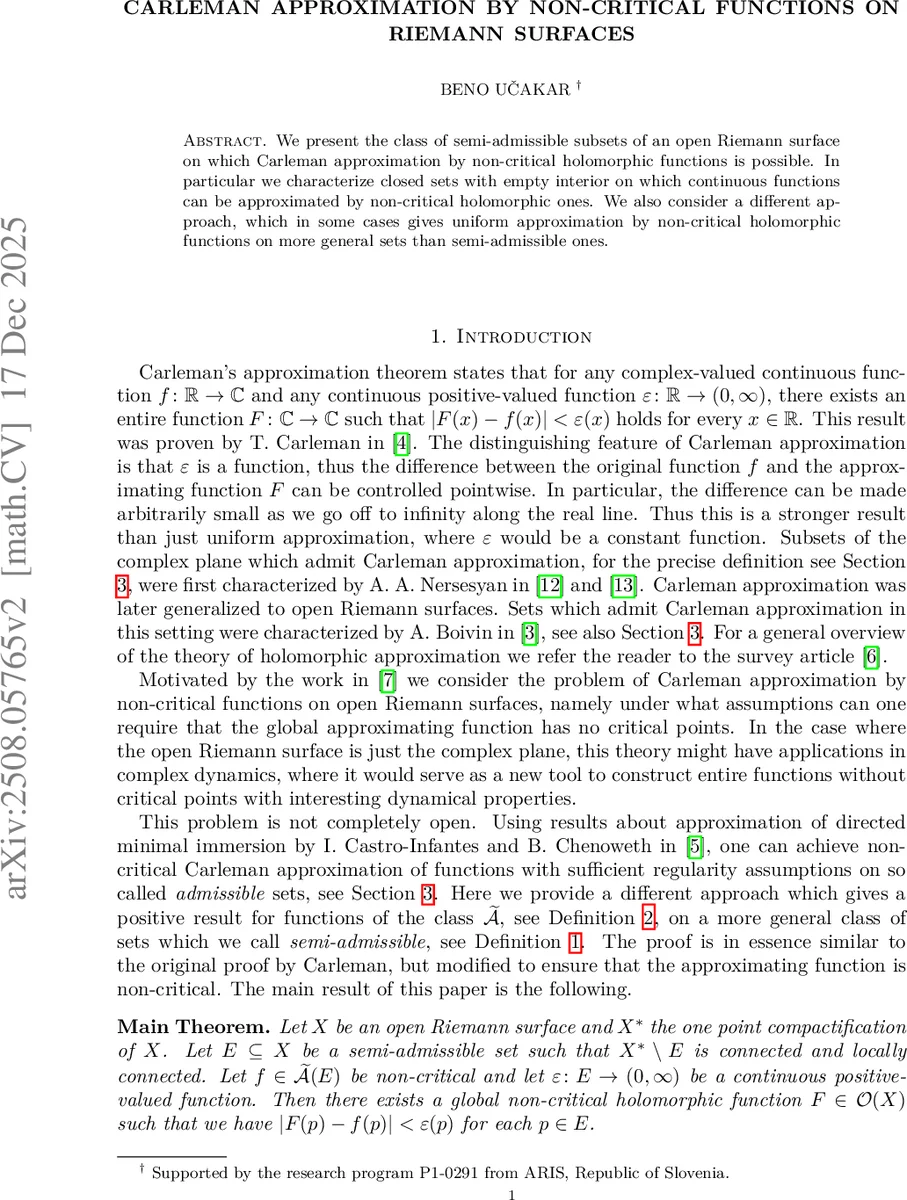
We present the class of semi-admissible subsets of an open Riemann surface on which Carleman approximation by non-critical holomorphic functions is possible. In particular we characterize closed sets with empty interior on which continuous functions can be approximated by non-critical holomorphic ones. We also consider a different approach, which in some cases gives uniform approximation by non-critical holomorphic functions on more general sets than semi-admissible ones.
💡 Research Summary
The paper investigates the problem of Carleman approximation on open Riemann surfaces under the additional requirement that the approximating holomorphic function be non‑critical, i.e., its derivative never vanishes. Classical Carleman approximation, as extended by Nersesyan and Boivin, guarantees pointwise control of the error by a positive continuous function ε on a closed set E, provided that the one‑point compactification X* \ E is connected, locally connected, and E satisfies condition G (a technical separation property). However, these results do not address the derivative of the approximant.
The author introduces a new class of sets called semi‑admissible. A closed set E⊂X is semi‑admissible if it can be written as E = S ∪ H where S is a closed set with empty interior and H is a locally finite disjoint union of compact subsets Hλ (λ∈Λ) each having non‑empty interior. No smoothness or transversality assumptions are imposed on the Hλ; they merely need to be pairwise disjoint and “well‑separated”. This definition relaxes the classical admissible sets (which require smooth arcs and transverse intersections) while still providing enough structure to control the derivative near each compact component.
A function class e𝔄(E) is defined for a semi‑admissible set E: functions are continuous on E, holomorphic on a neighbourhood of the compact part H, and are required to be non‑critical on that neighbourhood. The key observation is that every semi‑admissible set automatically satisfies condition G (Proposition 2), so Boivin’s characterization of Carleman sets applies.
The main result (the “Main Theorem”) states: let X be an open Riemann surface, let E be semi‑admissible, and assume that X* \ E is connected and locally connected. For any non‑critical f∈e𝔄(E) and any continuous positive ε:E→(0,∞), there exists a global non‑critical holomorphic function F∈𝒪(X) such that |F(p)−f(p)|<ε(p) for all p∈E.
The proof combines two powerful tools. First, Forstnerič’s Runge approximation theorem for non‑critical functions (Theorem 1) guarantees that on any compact Runge set K⊂X a non‑critical holomorphic function can be approximated arbitrarily well by a global non‑critical holomorphic function. Second, the Carleman framework provides a sequence of compact exhaustion sets {K_n} covering E, with each K_n intersecting only finitely many Hλ. On each step the author applies Forstnerič’s theorem to the part of f supported on K_n∩H, obtaining a non‑critical approximant F_n that matches f within a prescribed ε_n. By choosing ε_n decreasing fast enough and using the disjointness of the Hλ, the modifications made at step n do not affect the non‑criticality on previously treated components. On the residual set S (which has empty interior) only ordinary Carleman approximation is needed, and the pointwise error can be kept under control because ε is a function rather than a constant. A diagonal argument yields a limit function F that is holomorphic on X, non‑critical everywhere, and satisfies the required pointwise inequality.
A direct corollary treats closed sets with empty interior. In this situation H is empty, so the non‑critical condition is vacuous. The corollary states that for any closed set E⊂X with empty interior such that X* \ E is connected and locally connected, every continuous function f on E can be approximated pointwise by a global non‑critical holomorphic function. This characterizes precisely the closed sets (with empty interior) on which non‑critical Carleman approximation is possible, matching the necessary topological conditions known for uniform approximation.
Section 6 explores a different approach that works for some sets that are not semi‑admissible but still satisfy Boivin’s Carleman criteria. The idea is to treat each connected component of the interior of E separately, construct non‑critical approximants on large open neighbourhoods of those components, and then glue them together using a “stitching” technique that preserves non‑criticality. This yields uniform (rather than pointwise) non‑critical approximation on a broader class of Carleman sets, though the method currently applies only to specific configurations.
Overall, the paper makes three substantive contributions:
- A new geometric class (semi‑admissible) that bridges the gap between admissible sets and arbitrary Carleman sets, allowing the use of Forstnerič’s non‑critical Runge theorem in a Carleman context.
- A complete topological characterization of closed sets with empty interior that admit non‑critical Carleman approximation, namely those for which the complement in the one‑point compactification is connected and locally connected.
- An alternative uniform approximation scheme for certain non‑semi‑admissible Carleman sets, suggesting that the semi‑admissible restriction is not essential in all cases.
These results open avenues for applications in complex dynamics (construction of entire functions without critical points), minimal surface theory (directed minimal immersions with prescribed non‑criticality), and more generally in the theory of holomorphic approximation where control of the derivative is crucial. Future work may aim to relax the semi‑admissible condition further, to identify sharper necessary conditions for non‑critical Carleman approximation, and to develop explicit dynamical models using the constructed non‑critical entire functions.
Comments & Academic Discussion
Loading comments...
Leave a Comment