Charged Dirac fermions with anomalous magnetic moment in the presence of the chiral magnetic effect and of a noncommutative phase space
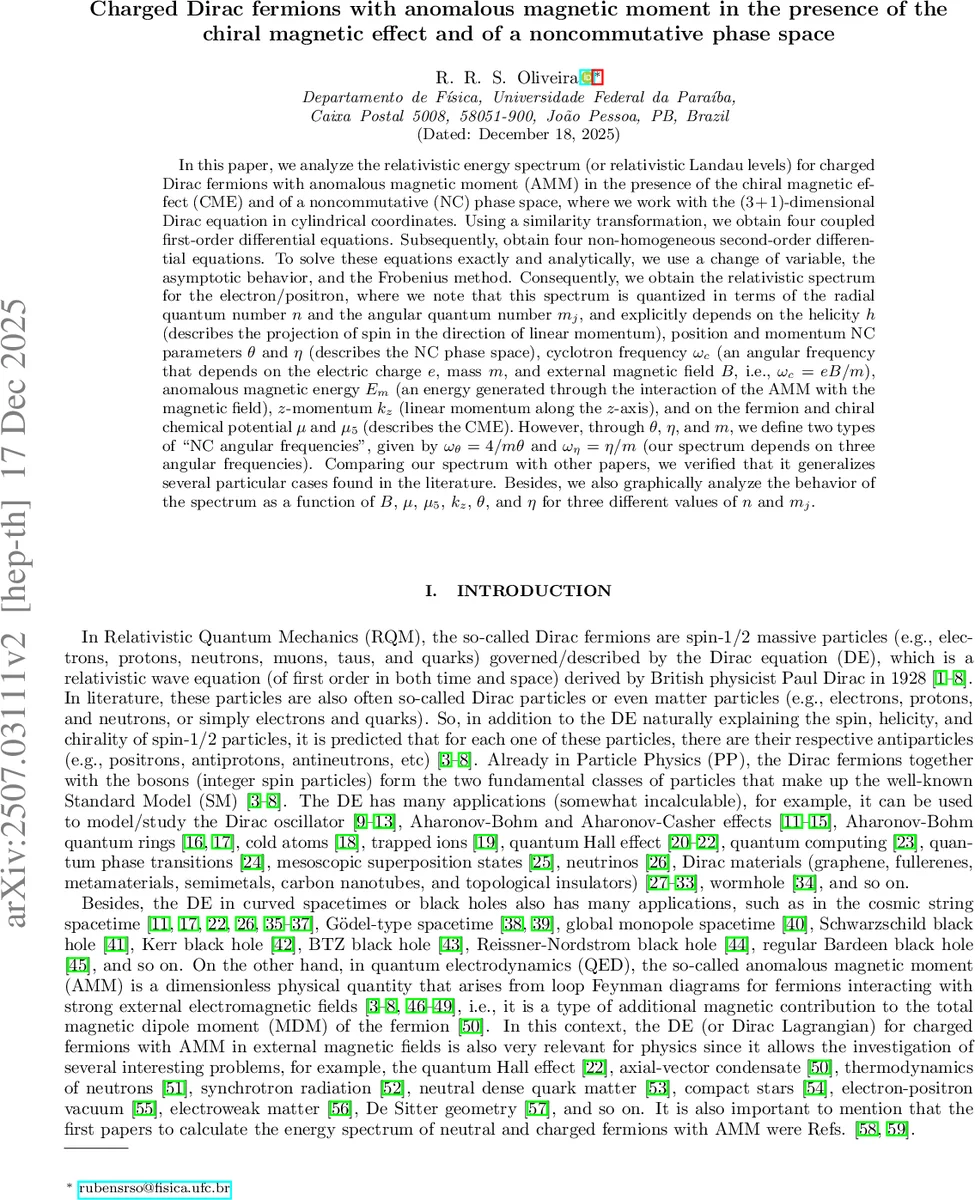
In this paper, we analyze the relativistic energy spectrum (or relativistic Landau levels) for charged Dirac fermions with anomalous magnetic moment (AMM) in the presence of the chiral magnetic effect (CME) and of a noncommutative (NC) phase space, where we work with the $(3+1)$-dimensional Dirac equation in cylindrical coordinates. Using a similarity transformation, we obtain four coupled first-order differential equations. Subsequently, obtain four non-homogeneous second-order differential equations. To solve these equations exactly and analytically, we use a change of variable, the asymptotic behavior, and the Frobenius method. Consequently, we obtain the relativistic spectrum for the electron/positron, where we note that this spectrum is quantized in terms of the radial quantum number $n$ and the angular quantum number $m_j$, and explicitly depends on the position and momentum NC parameters $θ$ and $η$ (describes the NC phase space), cyclotron frequency $ω_c$ (an angular frequency that depends on the electric charge $e$, mass $m$, and external magnetic field $B$, i.e., $ω_c=eB/m$), anomalous magnetic energy $E_m$ (an energy generated through the interaction of the AMM with the external magnetic field), $z$-momentum $k_z$ (linear momentum along the $z$-axis), and on the fermion and chiral chemical potential $μ$ and $μ_5$ (describes the CME). However, through $θ$, $η$, and $m$, we define two types of ‘‘NC angular frequencies’’, given by $ω_θ=4/mθ$ and $ω_η=η/m$ (our spectrum depends on three angular frequencies). Comparing our spectrum with other papers, we verified that it generalizes several particular cases found in the literature. Besides, we also graphically analyze the behavior of the spectrum as a function of $B$, $μ$, $μ_5$, $k_z$, $θ$, and $η$ for three different values of $n$ and $m_j$.
💡 Research Summary
**
In this work the authors investigate the relativistic Landau‑type energy spectrum of charged Dirac fermions (electrons and positrons) that possess an anomalous magnetic moment (AMM) while being subjected simultaneously to three distinct physical ingredients: a constant external magnetic field, a chiral chemical potential (μ₅) that generates the chiral magnetic effect (CME), and a non‑commutative (NC) phase‑space characterized by position‑space non‑commutativity θ and momentum‑space non‑commutativity η.
The starting point is a Dirac Lagrangian that includes minimal coupling to the electromagnetic potential, the AMM term (½ μ_m σ^{μν}F_{μν}), the ordinary fermion chemical potential μ, and the chiral chemical potential term μ₅ ψ̄ γ⁰γ⁵ ψ. The magnetic field is taken to be uniform and directed along the z‑axis (B = B ẑ), and the problem is formulated in cylindrical coordinates (ρ, φ, z) with the symmetric gauge A = (B ρ/2) φ̂.
To treat the curved (cylindrical) gamma matrices the authors apply a unitary similarity transformation U = exp
Comments & Academic Discussion
Loading comments...
Leave a Comment