How Warm-Glow Alters the Usability of Technology
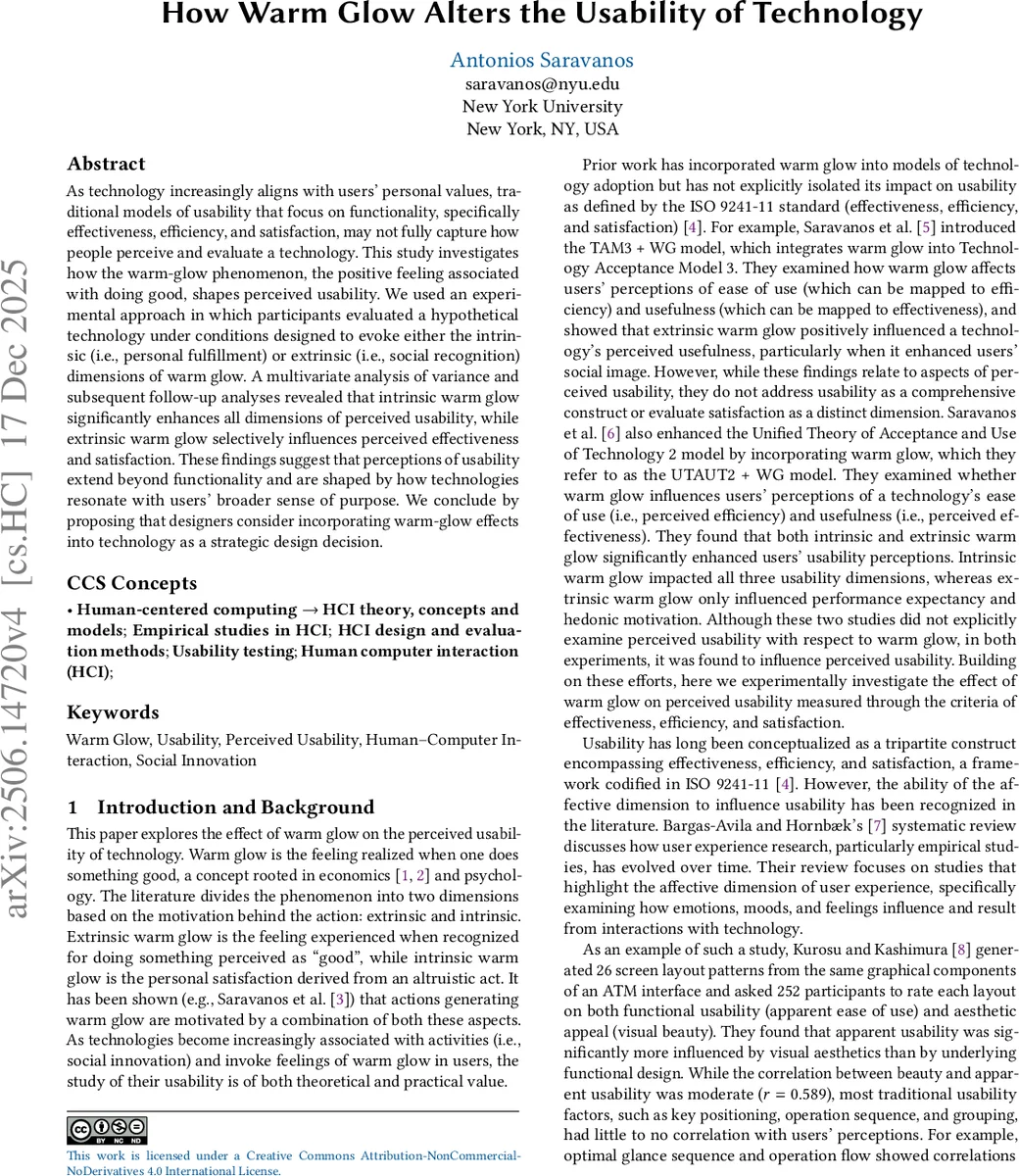
As technology increasingly aligns with users’ personal values, traditional models of usability, focused on functionality and specifically effectiveness, efficiency, and satisfaction, may not fully capture how people perceive and evaluate it. This study investigates how the warm-glow phenomenon, the positive feeling associated with doing good, shapes perceived usability. An experimental approach was taken in which participants evaluated a hypothetical technology under conditions designed to evoke either the intrinsic (i.e., personal fulfillment) or extrinsic (i.e., social recognition) dimensions of warm-glow. A Multivariate Analysis of Variance as well as subsequent follow-up analyses revealed that intrinsic warm-glow significantly enhances all dimensions of perceived usability, while extrinsic warm-glow selectively influences perceived effectiveness and satisfaction. These findings suggest that perceptions of usability extend beyond functionality and are shaped by how technology resonates with users’ broader sense of purpose. We conclude by proposing that designers consider incorporating warm-glow into technology as a strategic design decision.
💡 Research Summary
The paper investigates how the warm‑glow effect—people’s positive feeling from doing good—shapes perceived usability of technology. Usability, as defined by ISO 9241‑11, consists of three dimensions: effectiveness, efficiency, and satisfaction. Warm‑glow is split into intrinsic (personal moral fulfillment) and extrinsic (social recognition) components. The authors designed an online experiment with 164 adult participants who evaluated a hypothetical search‑engine technology after being exposed to vignette manipulations intended to evoke either intrinsic or extrinsic warm‑glow.
All constructs were measured with validated multi‑item Likert scales (7‑point). Perceived effectiveness, efficiency, and satisfaction were adapted from Venkatesh and Bala (2008); intrinsic and extrinsic warm‑glow items were taken from prior work by Saravanos et al. (2020). Reliability analyses showed excellent internal consistency (Cronbach’s α > 0.84 for all scales).
Statistical analysis was performed in Python using pandas, statsmodels, pingouin, and scipy. A multivariate analysis of variance (MANOVA) examined the joint effect of the two warm‑glow dimensions on the three usability outcomes. The MANOVA was significant (Wilks’ λ = 0.62, F(3,160) = 32.1, p < .001), indicating that warm‑glow influences perceived usability as a whole. Follow‑up univariate ANOVAs revealed that intrinsic warm‑glow significantly increased effectiveness (p < .001), efficiency (p < .001), and satisfaction (p < .001). Extrinsic warm‑glow, by contrast, significantly boosted effectiveness (p = .002) and satisfaction (p = .023) but did not affect efficiency (p = .27). No significant interaction between intrinsic and extrinsic warm‑glow was found for any usability dimension. To confirm robustness, the authors supplemented parametric tests with permutation testing (10,000 permutations) and bootstrapped confidence intervals (5,000 resamples), all of which supported the same pattern of results.
The discussion interprets these findings in light of prior literature on affective user experience and value‑sensitive design. Intrinsic warm‑glow appears to act as a broad enhancer of usability, likely because personal moral satisfaction reduces perceived cognitive load and creates a positive evaluation bias that transfers across all usability dimensions. Extrinsic warm‑glow’s selective impact suggests that social image concerns improve perceived usefulness (effectiveness) and overall enjoyment (satisfaction) but do not make the system feel easier to use (efficiency).
Practical implications are drawn for designers: embedding cues that trigger intrinsic warm‑glow—such as highlighting personal impact, moral alignment, or charitable outcomes—can raise overall usability perceptions. Adding features that provide social recognition (badges, shareable achievements) can specifically boost perceived effectiveness and satisfaction.
Limitations include reliance on a hypothetical scenario (reducing external validity), lack of cross‑cultural validation, and a cross‑sectional design that cannot capture long‑term usage effects. Future work should test warm‑glow mechanisms in real products, explore cultural and age differences, and employ longitudinal designs to assess durability of the effects.
In sum, the study provides empirical evidence that affective motivations, particularly intrinsic warm‑glow, extend the traditional functionality‑centric view of usability. By demonstrating that warm‑glow can systematically enhance effectiveness, efficiency, and satisfaction, the paper offers a compelling argument for integrating moral and social value cues into technology design to create richer, more meaningful user experiences.
Comments & Academic Discussion
Loading comments...
Leave a Comment