Demonstration Sidetracks: Categorizing Systematic Non-Optimality in Human Demonstrations
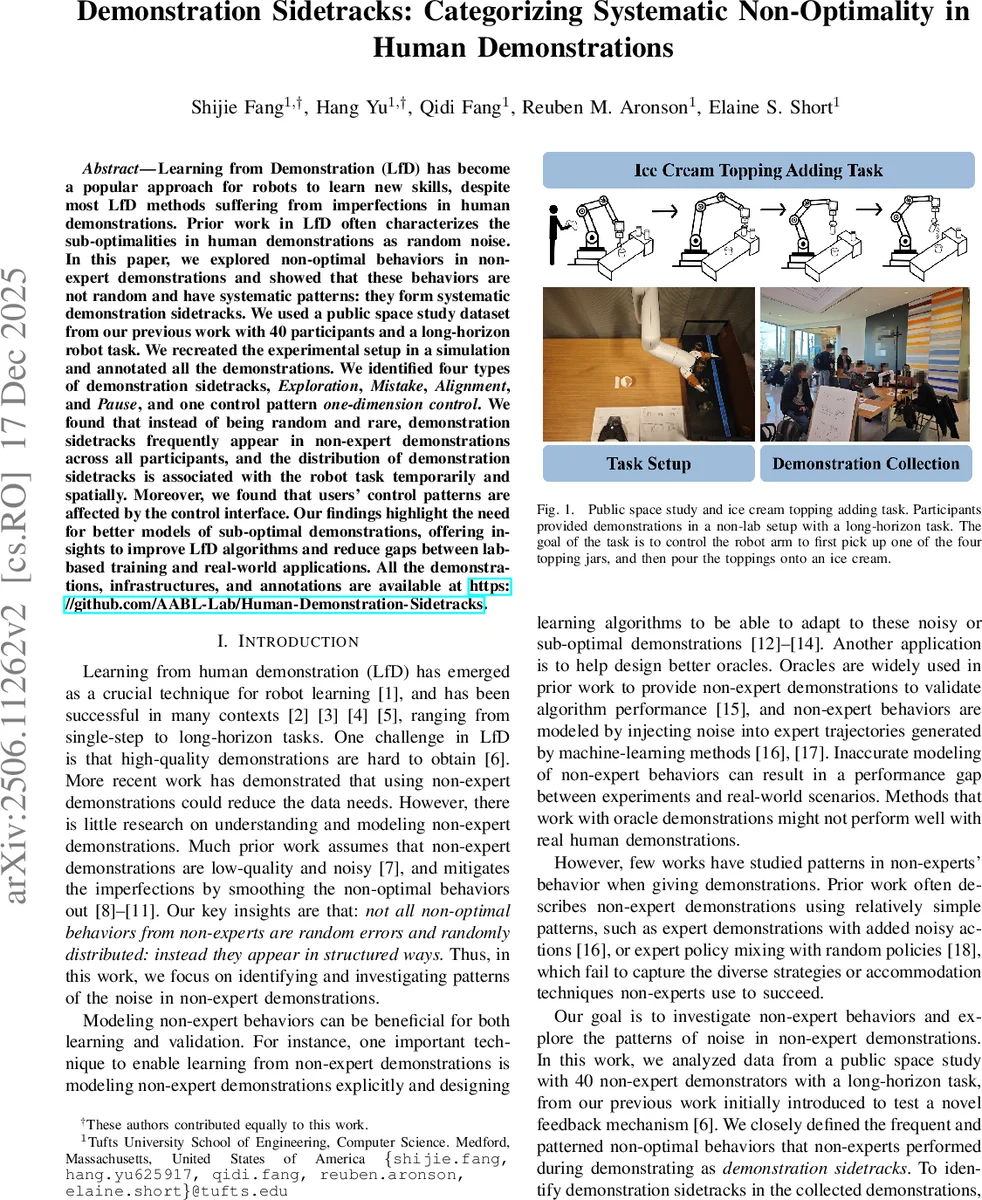
Learning from Demonstration (LfD) is a popular approach for robots to acquire new skills, but most LfD methods suffer from imperfections in human demonstrations. Prior work typically treats these suboptimalities as random noise. In this paper we study non-optimal behaviors in non-expert demonstrations and show that they are systematic, forming what we call demonstration sidetracks. Using a public space study with 40 participants performing a long-horizon robot task, we recreated the setup in simulation and annotated all demonstrations. We identify four types of sidetracks (Exploration, Mistake, Alignment, Pause) and one control pattern (one-dimension control). Sidetracks appear frequently across participants, and their temporal and spatial distribution is tied to task context. We also find that users’ control patterns depend on the control interface. These insights point to the need for better models of suboptimal demonstrations to improve LfD algorithms and bridge the gap between lab training and real-world deployment. All demonstrations, infrastructure, and annotations are available at https://github.com/AABL-Lab/Human-Demonstration-Sidetracks.
💡 Research Summary
The field of Learning from Demonstration (LfD) is pivotal for enabling robots to acquire complex skills by observing human actions. However, a persistent challenge in LfD is the inherent suboptimality of human demonstrations, which often include errors, hesitations, and inefficient trajectories. Traditionally, the robotics community has treated these suboptimalities as stochastic noise, applying filtering and smoothing techniques to “clean” the data. This paper challenges that fundamental assumption, proposing that human suboptimality is not random but systematic, a phenomenon the authors term “Demonance Sidetracks.”
To investigate this, the researchers conducted a large-scale study involving 40 participants performing long-horizon robotic tasks. By recreating these tasks in a controlled simulation environment, the authors were able to meticulously annotate and analyze the deviations from optimal paths. The study’s primary contribution is the establishment of a taxonomy for these “sidetracks,” categorizing them into four distinct types: Exploration, Mistake, Alignment, and Pause.
“Exploration” refers to intentional deviations where the demonstrator tests different movements to find better solutions. “Mistake” represents actual execution errors or slips. “Alignment” involves the demonstrator adjusting their control strategy to match the task context or the specific constraints of the control interface. “Pause” captures the cognitive latency during periods of deliberation. Additionally, the study identified a “one-dimension control” pattern, where users simplify their control inputs based on the interface’s complexity.
The findings reveal that these sidetracks are not distributed randomly; rather, their temporal and spatial occurrences are deeply tied to the task context. Furthermore, the researchers discovered that the user’s control patterns are significantly influenced by the design of the control interface. This implies that the “noise” in LfD is actually structured information that carries meaning about the task difficulty and the human-machine interaction dynamics.
The implications for the future of robotics are profound. If suboptimality is systematic, then current LfD algorithms that treat it as Gaussian noise are missing a critical opportunity to learn from the structured deviations of humans. By developing models that can explicitly distinguish between “mistakes” to be ignored and “explorations” or “alignments” to be learned, researchers can bridge the gap between controlled laboratory training and the unpredictable, messy reality of real-world deployment. This paper provides the necessary framework to move toward more robust, context-aware imitation learning, paving the way for robots that can truly understand the nuances of human intent and environmental adaptation.
Comments & Academic Discussion
Loading comments...
Leave a Comment