Riemannian and Lorentzian Calderón problem under Magnetic Perturbation
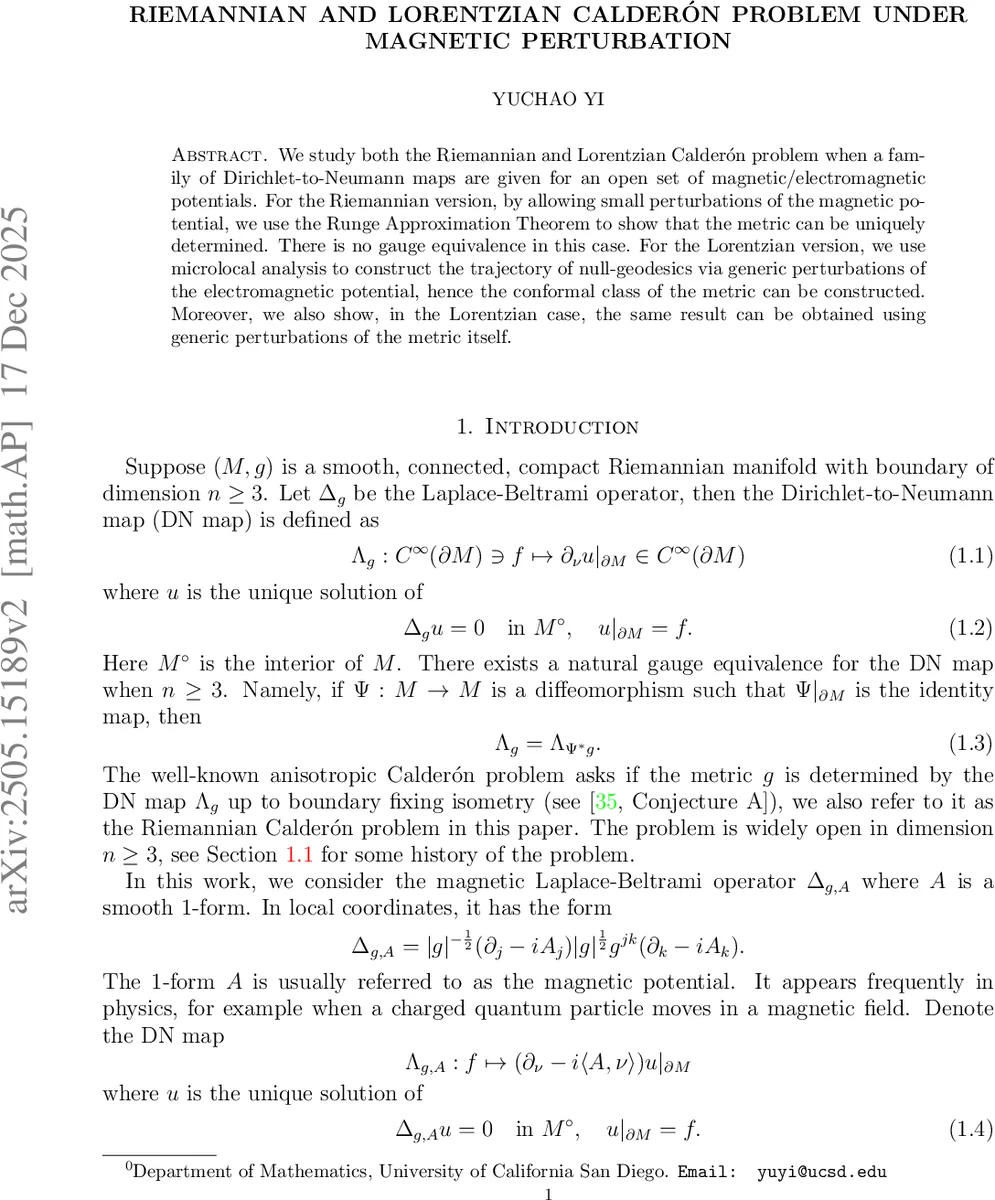
We study both the Riemannian and Lorentzian Calderón problem when a family of Dirichlet-to-Neumann maps are given for an open set of magnetic/electromagnetic potentials. For the Riemannian version, by allowing small perturbations of the magnetic potential, we use the Runge Approximation Theorem to show that the metric can be uniquely determined. There is no gauge equivalence in this case. For the Lorentzian version, we use microlocal analysis to construct the trajectory of null-geodesics via generic perturbations of the electromagnetic potential, hence the conformal class of the metric can be constructed. Moreover, we also show, in the Lorentzian case, the same result can be obtained using generic perturbations of the metric itself.
💡 Research Summary
The paper addresses two classical inverse problems – the Riemannian and Lorentzian Calderón problems – by exploiting families of Dirichlet‑to‑Neumann (DN) maps generated through small perturbations of magnetic or electromagnetic potentials. In the Riemannian setting, the authors consider the magnetic Laplace‑Beltrami operator Δ_{g,A} on a compact manifold (M,g) with boundary, where A is a smooth 1‑form (magnetic potential). The associated DN map Λ_{g,A} incorporates the tangential component of A on the boundary. A natural gauge equivalence exists: if Ψ is a boundary‑fixing diffeomorphism and ω is an exact 1‑form vanishing on ∂M, then Λ_{g,A}=Λ_{Ψ^{}g,Ψ^{}A+dω}. The main result (Theorem 1.1) shows that if Λ_{g₁,A}=Λ_{g₂,A} for every A in a C^{k}‑neighbourhood of the zero 1‑form, then the metrics coincide: g₁=g₂. The proof uses the Runge Approximation Theorem to approximate any interior solution by boundary‑driven solutions, thereby eliminating the gauge freedom and allowing pointwise recovery of the metric without any boundary‑fixing isometry. This is a substantial improvement over classical results that require analyticity or additional geometric constraints.
In the Lorentzian case, the manifold (M,g) is assumed non‑trapping and admissible, with a timelike boundary. The wave operator with electromagnetic perturbation is □_{g,A,q}=|g|^{-½}(∂j−iA_j)|g|^{½}g^{jk}(∂k−iA_k)+q, where A is now the electromagnetic 4‑potential (dA=F) and q a scalar potential. The DN map Λ{g,A,q} maps boundary data to the normal derivative corrected by A. Gauge equivalences now involve both diffeomorphisms fixing the boundary and exact 1‑forms, as well as conformal scalings of the metric combined with suitable transformations of q (Equation 1.9). Theorem 1.3 proves that, given the full family of DN maps for all A in a C^{k}‑neighbourhood of a fixed potential, one can reconstruct the null‑geodesic flow (the lens relation) and hence the conformal class of g. The key idea is microlocal analysis: for any interior point x, a generic local perturbation of A in a small neighbourhood U will alter the principal symbol σ(Λ{g,A,q}) precisely when a null geodesic passes through x. This is interpreted as a linear‑in‑A Aharonov–Bohm type phase shift detectable at the boundary. By varying U throughout M, the entire set of null geodesics is recovered, yielding the conformal metric.
The authors also treat perturbations of the metric itself. They consider a wave equation (□g+q_g)u=0 where q_g depends locally on g (e.g., the Yamabe operator). Theorem 1.5 shows that generic compactly supported metric perturbations h in a neighbourhood of a point x affect the wavefront set of the DN map exactly when a null geodesic traverses x. Consequently, the conformal class of g can be reconstructed from the family {Λ{g′}} where g′ runs over a C^{k}‑neighbourhood of g.
Overall, the paper introduces a novel “parametric data” paradigm: instead of a single DN map, one uses an open family of DN maps indexed by small variations of magnetic/electromagnetic potentials or the metric itself. This approach bypasses many traditional obstacles—such as the need for analyticity, curvature bounds, or a priori conformal class—by leveraging the nonlinear dependence of the forward operator on the parameters. In the Riemannian case it eliminates the boundary‑fixing diffeomorphism gauge; in the Lorentzian case it provides a robust method to recover the null‑geodesic structure and thus the conformal geometry. The techniques combine Runge approximation, microlocal propagation of singularities, and genericity arguments, and they open avenues for further work on partial‑data problems, relaxation of the non‑trapping assumption, and practical implementation in physical settings where one can control electromagnetic fields or metric‑like parameters.
Comments & Academic Discussion
Loading comments...
Leave a Comment