Explicit minimisers for anisotropic Riesz energies
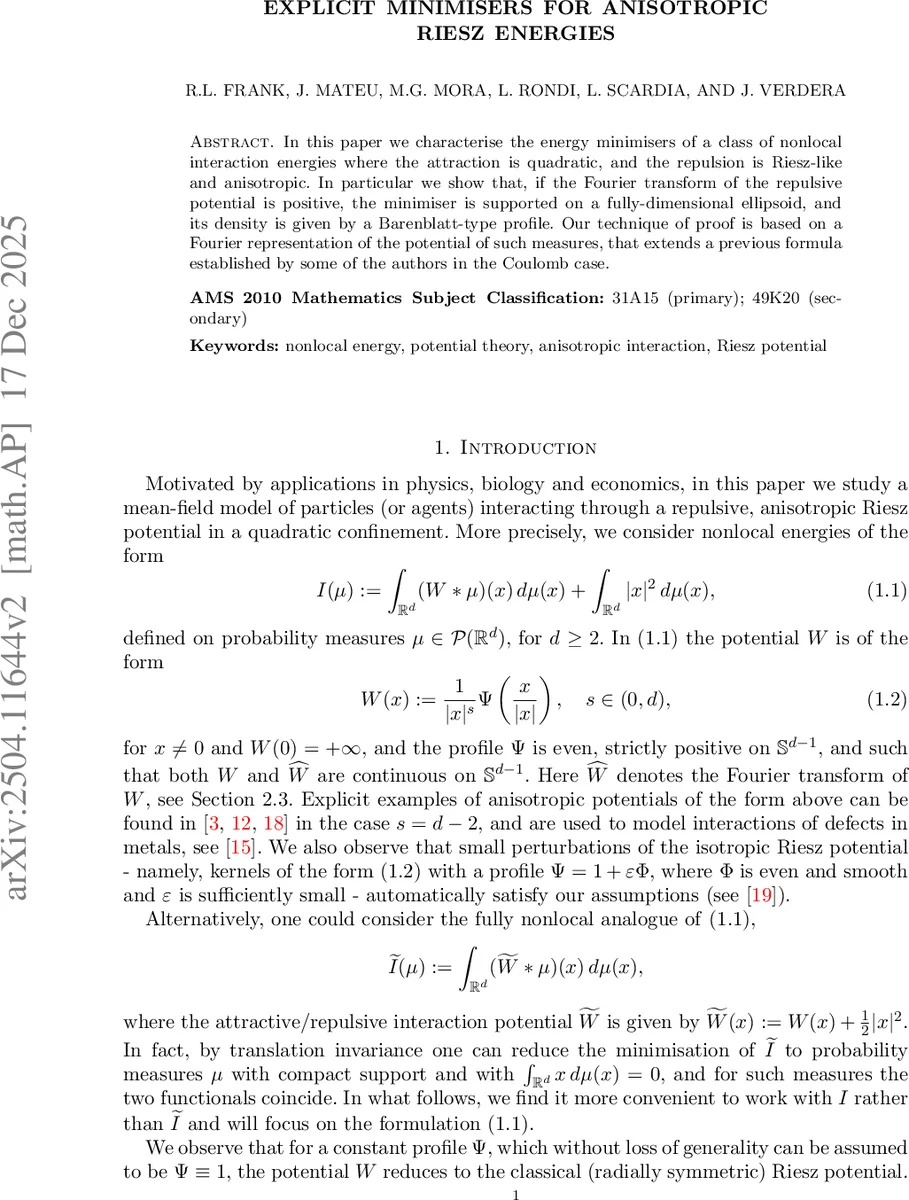
In this paper we describe explicitly the energy minimisers of a class of nonlocal interaction energies where the attraction is quadratic, and the repulsion is Riesz-like and anisotropic.
💡 Research Summary
The paper investigates the variational problem of minimizing a nonlocal interaction energy that combines a quadratic confinement with an anisotropic repulsive Riesz-type potential. The energy functional is defined for probability measures μ on ℝⁿ (n ≥ 2) by
I(μ) = ∫ (W * μ)(x) dμ(x) + ∫ |x|²/2 dμ(x),
where the kernel W has the form
W(x) = |x|^{-s} Ψ(x/|x|), 0 < s < d,
with Ψ an even, strictly positive, continuous function on the unit sphere S^{d‑1}. A crucial hypothesis is that the Fourier transform of W, denoted c_W, is also strictly positive and continuous on S^{d‑1}.
Under these assumptions the authors first establish existence and uniqueness of a minimizer μ₀ (Proposition 2.1). The minimizer is characterized by the Euler–Lagrange conditions
(W * μ₀)(x) + |x|²/2 = C for μ₀‑a.e. x ∈ supp μ₀,
(W * μ₀)(x) + |x|²/2 ≥ C for x outside the support (up to a set of zero (d‑s)-Riesz capacity).
The core of the paper is a detailed Fourier‑space analysis of the potential W * μ₀. By taking Fourier transforms, the convolution becomes a product: \widehat{W * μ₀}(ξ) = \widehat{W}(ξ) \widehat{μ₀}(ξ). The authors compute \widehat{μ₀} explicitly for a class of measures that are push‑forwards of the isotropic Barenblatt profile (the known minimizer when Ψ ≡ 1). This computation involves Bessel functions J_{s/2+1} and Gauss hypergeometric functions ₂F₁, leading to the integral identity (2.10)–(2.18). The analysis is valid for s ∈ (0,5] and requires careful handling of integrability near the origin and at infinity.
The main result (Theorem 1.1) states that for exponents s belonging to the interval
Comments & Academic Discussion
Loading comments...
Leave a Comment