Bilevel linear optimization belongs to NP and admits polynomial-size KKT-based reformulations
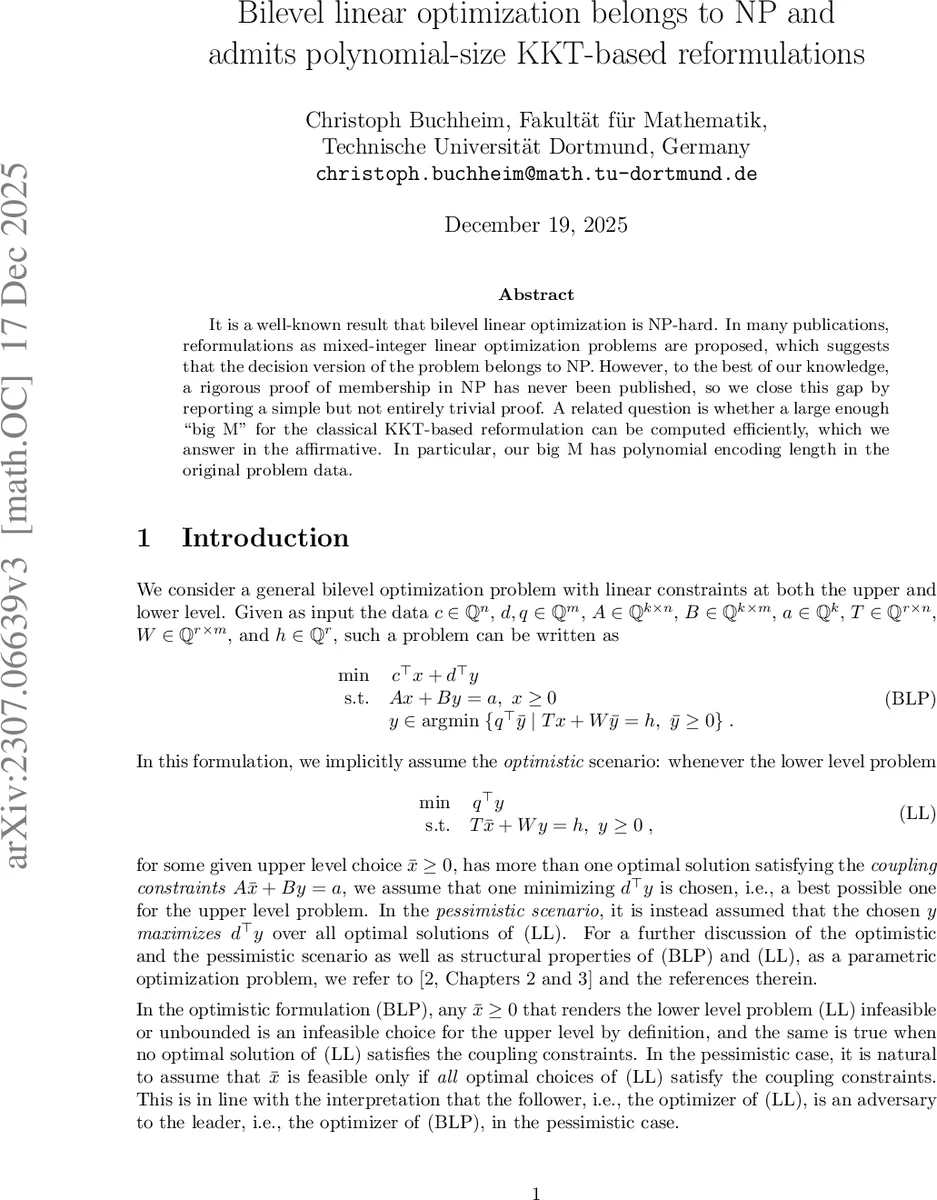
It is a well-known result that bilevel linear optimization is NP-hard. In many publications, reformulations as mixed-integer linear optimization problems are proposed, which suggests that the decision version of the problem belongs to NP. However, to the best of our knowledge, a rigorous proof of membership in NP has never been published, so we close this gap by reporting a simple but not entirely trivial proof. A related question is whether a large enough “big M” for the classical KKT-based reformulation can be computed efficiently, which we answer in the affirmative. In particular, our big M has polynomial encoding length in the original problem data.
💡 Research Summary
The paper addresses two fundamental questions concerning bilevel linear programming (BLP): (i) whether the decision version of BLP belongs to the complexity class NP, and (ii) whether the classic KKT‑based mixed‑integer linear programming (MILP) reformulation can be equipped with “big‑M” constants whose size is polynomial in the original input data.
Problem setting.
A BLP consists of an upper‑level decision vector (x\in\mathbb{R}^n) and a lower‑level decision vector (y\in\mathbb{R}^m). Both levels are subject to linear constraints, and the lower‑level problem is required to be solved optimally for the given (x). Two scenarios are considered: the optimistic one, where the follower chooses a lower‑level optimal solution that is most favorable to the leader, and the pessimistic one, where the follower acts adversarially and selects the worst feasible lower‑level optimal solution.
NP‑membership for the optimistic case.
The authors define the decision version of BLP as follows: given rational data ((c,d,q,A,B,a,T,W,h)) and a threshold (\alpha), decide whether there exists a feasible upper‑level vector (\bar x\ge 0) such that the lower‑level problem has at least one optimal solution (\bar y) satisfying the coupling constraints (A\bar x + B\bar y = a) and the objective bound (c^\top \bar x + d^\top \bar y \le \alpha).
The key insight is to use an optimal basis (B) of the lower‑level linear program as a certificate. If (B) has non‑negative reduced costs with respect to the lower‑level objective (q), then the basic solution defined by (B) is optimal for any given (\bar x). The authors show that the existence of such a basis together with a feasible triple ((\bar x,\bar y,\lambda)) can be verified by solving a linear system consisting of constraints (2a)–(2e) in the paper. All coefficients of this system are polynomially bounded by the size of the original data, and the verification can be performed in polynomial time. Hence the decision problem is in NP.
NP‑membership for the pessimistic case.
In the pessimistic scenario the universal quantifier (“all optimal lower‑level solutions must satisfy the coupling constraints”) makes the certificate more involved. The authors construct a certificate consisting of several bases:
- a basis (B) for the lower‑level feasible region,
- a basis (\widehat B) with non‑positive reduced costs for the leader’s objective (d), and
- for each coupling constraint row (i), two bases (\widehat B_i^{+}) and (\widehat B_i^{-}) that respectively have non‑negative and non‑positive reduced costs with respect to the row vector (b_i^\top).
These bases together encode the inclusion of the lower‑level optimal face inside the feasible polyhedron defined by the coupling constraints. The authors prove that checking the corresponding linear systems (3), (6), and (7) is again polynomial‑time, establishing NP‑membership for the pessimistic decision problem as well.
KKT‑based MILP reformulation and polynomial‑size big‑M.
A widely used approach to solve BLPs is to replace the lower‑level optimality conditions by the Karush‑Kuhn‑Tucker (KKT) system, which introduces complementarity constraints (y^\top(q-W^\top\lambda)=0). Standard linearization replaces each complementarity pair by binary variables (z_i) and large constants (M_p, M_d) via inequalities
(y_i \le M_p(1-z_i),; (q-W^\top\lambda)_i \le M_d z_i).
Choosing (M_p) and (M_d) too small cuts off feasible bilevel solutions; choosing them too large leads to numerical instability. The paper shows that both constants can be computed in polynomial time with a size polynomial in the input encoding.
The construction relies on Lemma 4, which provides a bound on the absolute values of basic variables of a polyhedron defined by an integer matrix (A) and integer right‑hand side (b). Specifically, any basic variable is bounded by (m!,
Comments & Academic Discussion
Loading comments...
Leave a Comment