Neural networks for dengue forecasting: a systematic review
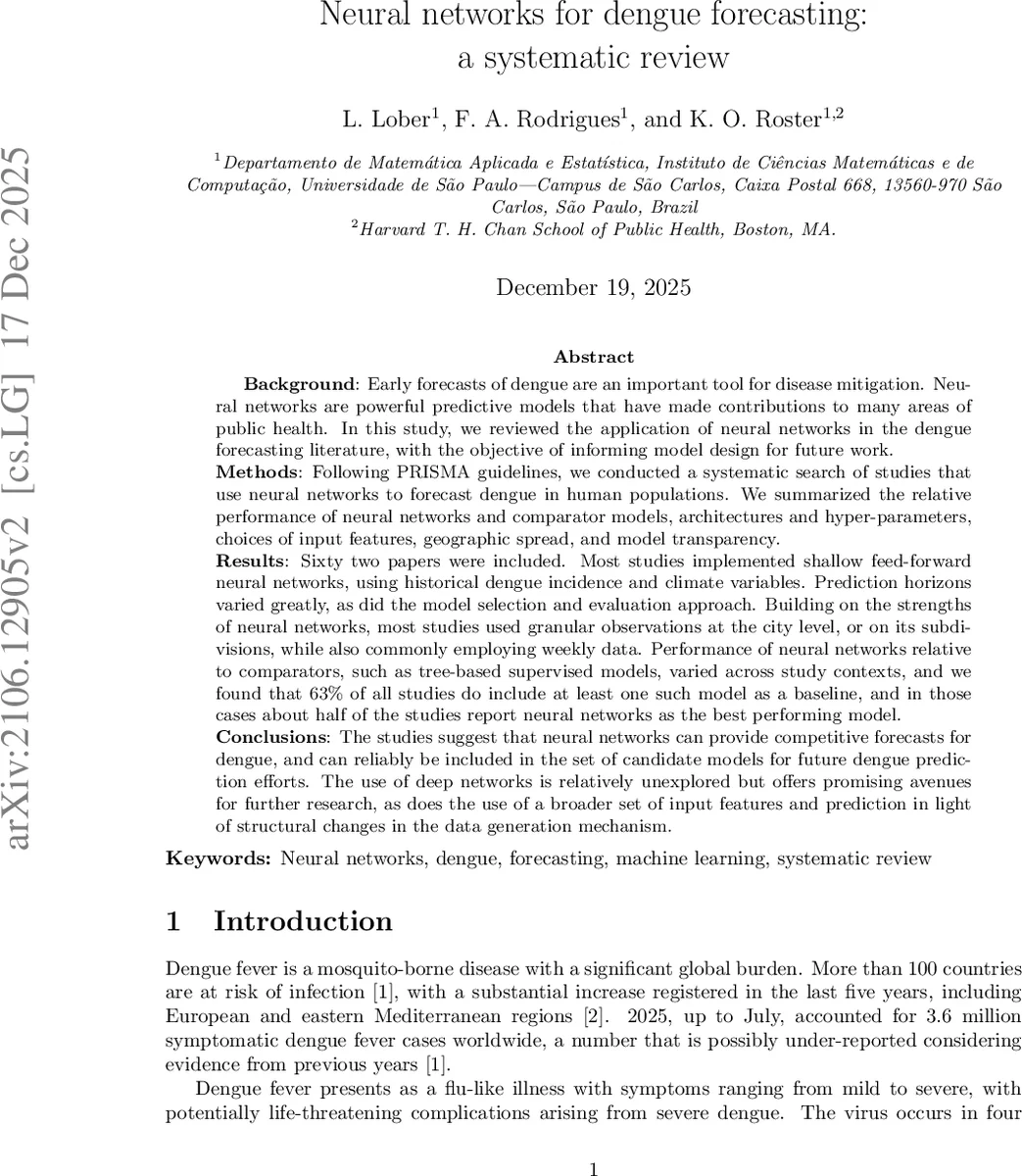
Background: Early forecasts of dengue are an important tool for disease mitigation. Neural networks are powerful predictive models that have made contributions to many areas of public health. In this study, we reviewed the application of neural networks in the dengue forecasting literature, with the objective of informing model design for future work. Methods: Following PRISMA guidelines, we conducted a systematic search of studies that use neural networks to forecast dengue in human populations. We summarized the relative performance of neural networks and comparator models, architectures and hyper-parameters, choices of input features, geographic spread, and model transparency. Results: Sixty two papers were included. Most studies implemented shallow feed-forward neural networks, using historical dengue incidence and climate variables. Prediction horizons varied greatly, as did the model selection and evaluation approach. Building on the strengths of neural networks, most studies used granular observations at the city level, or on its subdivisions, while also commonly employing weekly data. Performance of neural networks relative to comparators, such as tree-based supervised models, varied across study contexts, and we found that 63% of all studies do include at least one such model as a baseline, and in those cases about half of the studies report neural networks as the best performing model. Conclusions: The studies suggest that neural networks can provide competitive forecasts for dengue, and can reliably be included in the set of candidate models for future dengue prediction efforts. The use of deep networks is relatively unexplored but offers promising avenues for further research, as does the use of a broader set of input features and prediction in light of structural changes in the data generation mechanism.
💡 Research Summary
This systematic review follows PRISMA guidelines to assess how neural networks (NNs) have been employed for dengue fever forecasting up to September 2024. A comprehensive search of Web of Science, Scopus, PubMed and Science Direct using the query “(deep learning OR neural network) AND dengue” identified 62 eligible studies. Inclusion criteria required that the work predict dengue incidence or risk in human populations, implement a neural network (or deep learning) model as a primary method or comparator, and provide clear data processing and modeling details without data leakage.
Data sources and predictors
The overwhelming majority of studies (43 / 62, ≈ 69 %) incorporated meteorological variables—temperature, rainfall, humidity, wind speed, solar radiation, pressure, sea‑surface temperature and El Niño indices. Non‑meteorological inputs were far less common: satellite‑derived vegetation indices, street‑level imagery, mosquito density or biting rates, social‑media messages, human mobility (call‑detail records, bus routes, transit station usage), and socioeconomic indicators (population density, housing quality, literacy). Only four papers used such auxiliary data without climate variables.
Geographic and temporal scope
Research settings ranged from city districts to whole countries, with Brazil (12 studies), Indonesia (8) and India (5) being the most represented. Prediction horizons varied widely: daily, weekly, monthly, seasonal and yearly forecasts were all reported, though weekly aggregation was the most frequent. Publication trends show a sharp rise after 2017, peaking in 2019, 2023 and 2025.
Neural network architectures
Four architecture families were identified:
- Artificial Neural Networks (ANN, feed‑forward MLP) – used in 58 studies, making them the dominant approach.
- Recurrent Neural Networks (RNN) – primarily Long Short‑Term Memory (LSTM) models (20 studies) and a few Gated Recurrent Units (GRU) (4 studies).
- Convolutional Neural Networks (CNN) – only two studies employed a U‑Net style architecture to fuse satellite imagery with epidemiological time series.
- Other specialized models (Hopfield network, Radial Basis Function NN, fuzzy clustering) appeared in a handful of papers.
Hyper‑parameter reporting was heterogeneous. Reported ranges included epochs (85–8000), hidden layers (1–100), hidden units (1–256), learning rates (1e‑5–0.9), batch sizes (10–204) and dropout rates (0–0.8). The Adam optimizer was most popular (six studies), with occasional use of Adamax and RMSProp. ReLU was the most common activation function (six studies), followed by sigmoid and tanh.
Performance comparison
Sixty‑three percent of the papers included at least one baseline model (often tree‑based ensembles, ARIMA, linear regression, or support vector machines). Among those, roughly half reported that the neural network achieved the best predictive performance, while the remainder found comparable or inferior results. The lack of standardized evaluation metrics (RMSE, MAE, MAPE, AUC) and validation schemes (k‑fold cross‑validation, hold‑out, temporal split) prevents a formal meta‑analysis of superiority.
Transparency and reproducibility
Seventy‑one percent of the studies were published in open‑access venues, yet only 44 provided fully public datasets, 5 offered partial access, and 13 required restricted access (e.g., proprietary call‑detail records). Source code was shared in just 13 papers, predominantly when journals mandated code availability (e.g., Nature Communications Medicine, PLOS ONE, PLOS Neglected Tropical Diseases). Consequently, reproducibility remains limited.
Key insights and future directions
- Shallow models dominate – Most work relies on simple feed‑forward networks, which are easy to implement but may under‑utilize complex spatiotemporal patterns.
- Deep learning is underexplored – CNNs and advanced RNNs are scarce; integrating high‑resolution imagery, mobility streams, or social‑media feeds with deep architectures could improve forecasts.
- Input diversity is needed – Expanding beyond climate variables to include vector surveillance, land‑use change, and socioeconomic drivers may capture context‑specific dynamics.
- Structural changes – Climate change, urbanization, and pandemic‑induced mobility shifts alter the data‑generation process; models that incorporate transfer learning or domain adaptation are promising.
- Interpretability – Applying post‑hoc explanation tools (SHAP, LIME, Grad‑CAM) can reveal feature importance, aiding public‑health decision‑making.
- Standardized reporting – Adoption of common evaluation metrics, transparent data/code sharing policies, and clear validation protocols would enhance comparability and policy relevance.
In summary, neural networks have proven to be competitive tools for dengue forecasting, especially when combined with granular, weekly epidemiological data. However, the field would benefit from deeper architectures, richer multimodal inputs, stronger emphasis on model interpretability, and improved openness to ensure reproducibility and facilitate translation of forecasts into actionable public‑health interventions.
Comments & Academic Discussion
Loading comments...
Leave a Comment