Pulsed single-photon spectroscopy of an emitter with vibrational coupling
We analytically derive the quantum state of a single-photon pulse scattered from a single quantum two-level emitter interacting with a vibrational bath. This solution for the quadripartite system enables an information-theoretic characterization of vibrational effects in quantum light spectroscopy. We show that vibration-induced dephasing reduces the quantum Fisher information (QFI) for estimating the emitter’s linewidth, largely reflecting the Franck-Condon suppression of light-matter coupling. Comparing time- and frequency-resolved photodetection, we find the latter to be more informative in estimating the emitter’s linewidth for stronger vibrational coupling.
💡 Research Summary
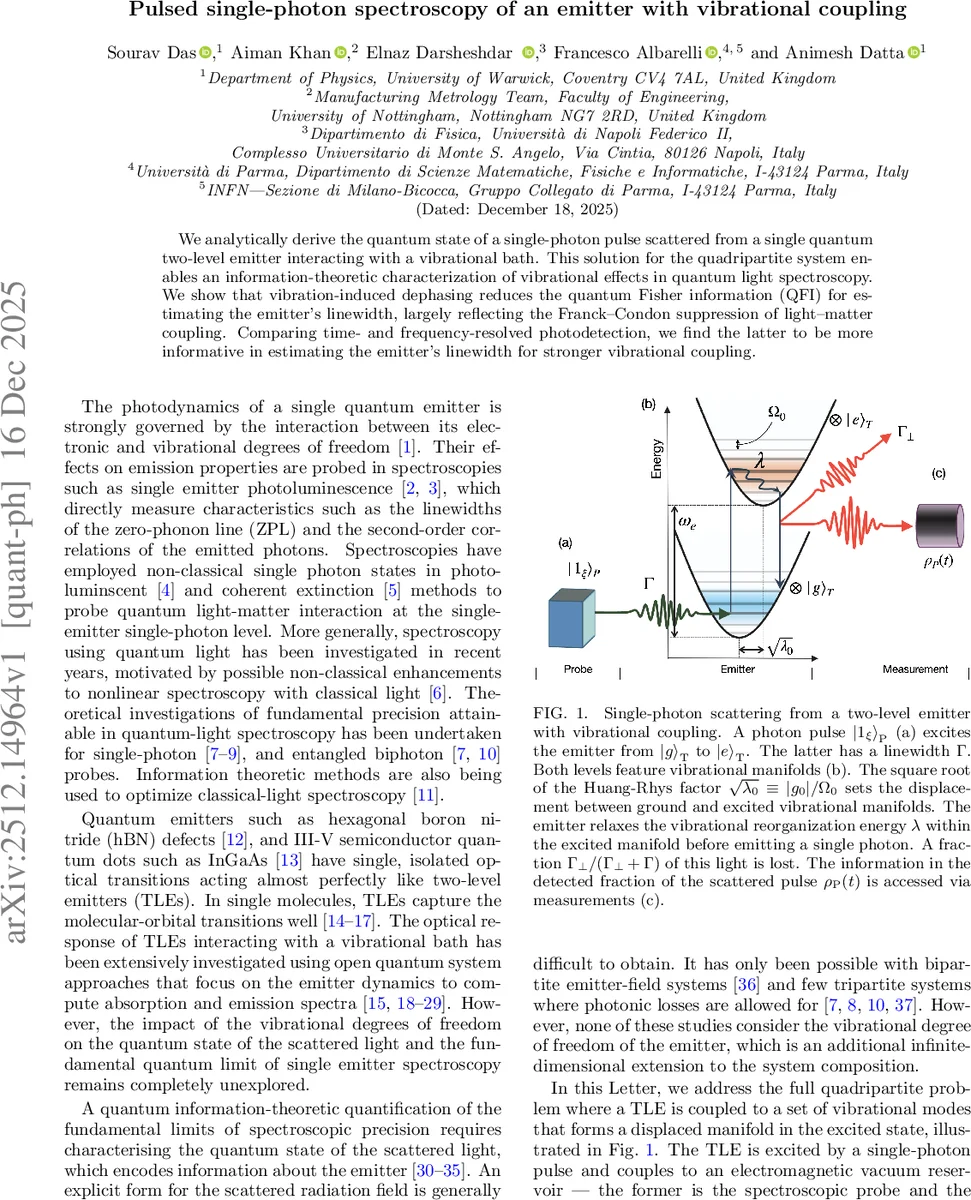
In this work the authors present a fully analytical treatment of the quantum state of a single‑photon pulse that is scattered from a two‑level emitter (TLE) which is coupled to a vibrational environment. By modelling the whole system as a quadripartite entity—comprising the emitter (T), the vibrational bath (V), the incoming photon pulse (P) and the electromagnetic vacuum reservoir (E)—they derive exact solutions of the time‑dependent Schrödinger equation in the interaction picture. The total Hamiltonian H(t)=H_TV+H_TPE(t) contains a pure dephasing‑type coupling between the excited state of the emitter and a set of harmonic vibrational modes, as well as a dipole interaction with both the driving pulse and the loss channel. Under the rotating‑wave and white‑noise approximations the total excitation number N_TPE is conserved, which makes the analytical solution tractable.
Starting from the initial state |g⟩_T⊗|γ⟩_V⊗|1_ξ⟩_P⊗|0⟩_E (with |γ⟩_V a generic pure vibrational state, later taken as a thermal mixture), the authors propose an ansatz that separates the dynamics into three sectors: (i) the emitter in the excited state together with an unnormalised vibrational state |A_γ(t)⟩_V, (ii) the emitter in the ground state with a joint pulse‑vibration excitation |1_γ(t)⟩_PV, and (iii) the emitter in the ground state with a joint vacuum‑vibration excitation |1_γ(t)⟩_EV. Solving the coupled differential equations yields closed‑form expressions for the excited‑state population p_e(t) (Eq. 4) and for the vibrational propagators Λ₁(t) and Λ₂(t) (Eqs. 5–9). Λ₁(t) encodes the influence of the spectral density J(Ω) of the vibrational bath, while Λ₂(t) captures the two‑time correlations that generate entanglement between the photon and the vibrations.
After the emitter has fully decayed (t≫1/(Γ+Γ_⊥)), the reduced state of the pulse at the detector is given by Eq. 7: a mixture of the vacuum component (proportional to the loss rate Γ_⊥) and a single‑excitation subspace described by the time‑domain density matrix ϱ_P(τ,τ′) (Eq. 8). This matrix is generally mixed because of residual entanglement with the vibrational modes, even at zero temperature. The authors then turn to quantum metrology: they consider the problem of estimating the emitter’s radiative linewidth Γ from measurements on the scattered pulse. The ultimate bound is set by the quantum Fisher information (QFI) Q(ρ_P(∞)), which they compute by solving the Lyapunov equation for the symmetric logarithmic derivative (SLD). Numerical evaluation (Fig. 2) shows that QFI decreases monotonically with the Huang‑Rhys factor λ₀, reflecting the Franck–Condon suppression of the effective light‑matter coupling.
An analytical upper bound Q_bound (Eq. 11) is derived by tracing over the vibrational degrees of freedom while keeping track of the modified Franck–Condon factors f_k. In the limit of a narrow emitter (Γ≪Ω₀) and a long pulse (T_σΩ₀≫1), the bound reduces to Q_bound≈f₀·Q_no‑vibration, where f₀=e^{-λ₀} is the zero‑phonon line (ZPL) Franck–Condon factor and Q_no‑vibration is the QFI for an uncoupled emitter. Hence the loss of information is directly proportional to the reduction of the ZPL weight.
To assess realistic measurement strategies, the authors compare time‑resolved photon counting (which yields a classical Fisher information CFI_time) with frequency‑resolved spectroscopy (CFI_freq). Their simulations reveal that for weak vibrational coupling (λ₀≲0.2) time‑resolved detection approaches the QFI, whereas for stronger coupling (λ₀≳0.3) frequency‑resolved detection becomes superior, as sidebands carry a significant fraction of the information. The ratio CFI/QFI is plotted in Fig. 2(c,d), confirming this crossover.
The paper also discusses extensions to non‑zero loss (Γ_⊥≠0) and to continuous spectral densities (Drude‑Lorentz, Brownian), showing that the same formalism applies with minor modifications. However, the main quantitative results are presented for a single vibrational mode at temperatures 0 K and 300 K, with Γ_⊥ set to zero for clarity.
In summary, this study provides a complete quantum‑optical description of single‑photon scattering from a vibrationally dressed emitter, quantifies how vibrational dephasing limits the precision of linewidth estimation via the QFI, and identifies the measurement regime (time vs frequency) that best extracts the available information. The work bridges quantum optics, open‑system theory, and quantum metrology, offering practical guidance for designing single‑photon spectroscopy experiments on molecules, solid‑state defects, or quantum dots where vibronic effects are non‑negligible.
Comments & Academic Discussion
Loading comments...
Leave a Comment