Vector Flow Imaging in Layered Models With a High Speed of Sound Contrast Using Pulse-Echo Ultrasound and Photoacoustics
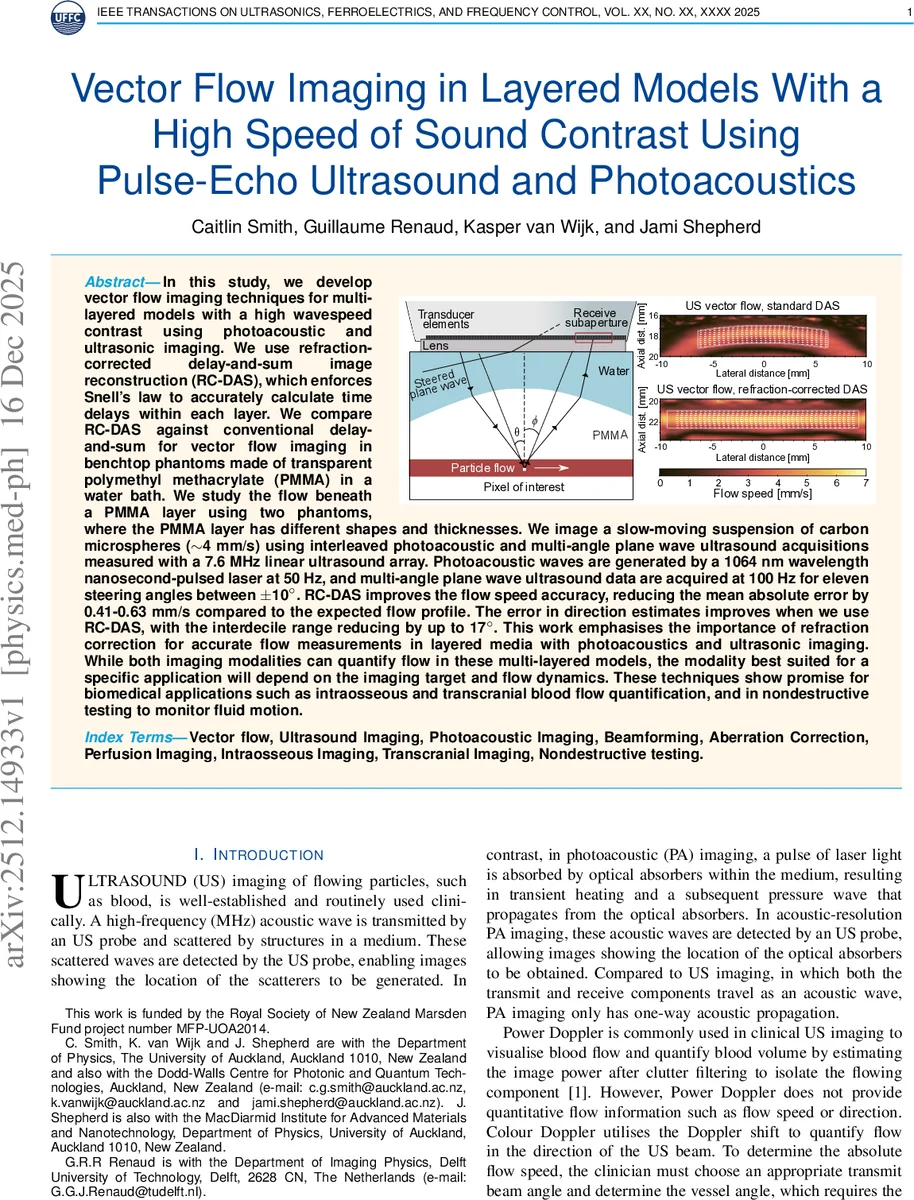
In this study, we develop vector flow imaging techniques for multi-layered models with a high wavespeed contrast using photoacoustic and ultrasonic imaging. We use refraction-corrected delay-and-sum image reconstruction (RC-DAS), which enforces Snell’s law to accurately calculate time delays within each layer. We compare RC-DAS against conventional delay-and-sum for vector flow imaging in benchtop phantoms made of transparent polymethyl methacrylate (PMMA) in a water bath. We study the flow beneath a PMMA layer using two phantoms, where the PMMA layer has different shapes and thicknesses. We image a slow-moving suspension of carbon microspheres (~4 mm/s) using interleaved photoacoustic and multi-angle plane wave ultrasound acquisitions measured with a 7.6 MHz linear ultrasound array. Photoacoustic waves are generated by a 1064 nm wavelength nanosecond-pulsed laser at 50 Hz, and multi-angle plane wave ultrasound data are acquired at 100 Hz for eleven steering angles between $\pm$10$^\circ$. RC-DAS improves the flow speed accuracy, reducing the mean absolute error by 0.41-0.63 mm/s compared to the expected flow profile. The error in direction estimates improves when we use RC-DAS, with the interdecile range reducing by up to 17$^\circ$. This work emphasises the importance of refraction correction for accurate flow measurements in layered media with photoacoustics and ultrasonic imaging. While both imaging modalities can quantify flow in these multi-layered models, the modality best suited for a specific application will depend on the imaging target and flow dynamics. These techniques show promise for biomedical applications such as intraosseous and transcranial blood flow quantification, and in nondestructive testing to monitor fluid motion.
💡 Research Summary
This paper presents a novel vector flow imaging (VFI) framework designed for layered media with a high speed‑of‑sound (SOS) contrast, such as a transparent polymethyl methacrylate (PMMA) slab immersed in water. Conventional delay‑and‑sum (DAS) beamforming assumes a homogeneous SOS and straight‑line acoustic propagation, which leads to geometric distortion and inaccurate flow quantification when strong refraction occurs at layer interfaces. To overcome this limitation, the authors develop a Refraction‑Corrected Delay‑and‑Sum (RC‑DAS) algorithm that explicitly enforces Snell’s law. RC‑DAS requires knowledge of the interface locations and the SOS of each layer; these can be measured a priori or automatically segmented from ultrasound data. For each transducer element, rays are launched over a range of angles, refracted at each interface, and the travel time is computed as the sum of distance‑over‑SOS for all traversed layers (t = ∑ di/ci). Both transmit and receive paths are corrected, including refraction at the transducer lens, yielding accurate time‑delay maps for image reconstruction.
After reconstructing both photoacoustic (PA) and ultrasound (US) images with either standard DAS or RC‑DAS, the authors apply a multi‑angle VFI algorithm. The algorithm exploits the phase shift (ΔΨ) between consecutive frames, estimated via lag‑one autocorrelation, for a set of receive angles (ϕ) and, for US, also transmit angles (θ). The phase shift obeys the Doppler relation ΔΨ/2π = U f0 / c
Comments & Academic Discussion
Loading comments...
Leave a Comment