Contact surgery distance
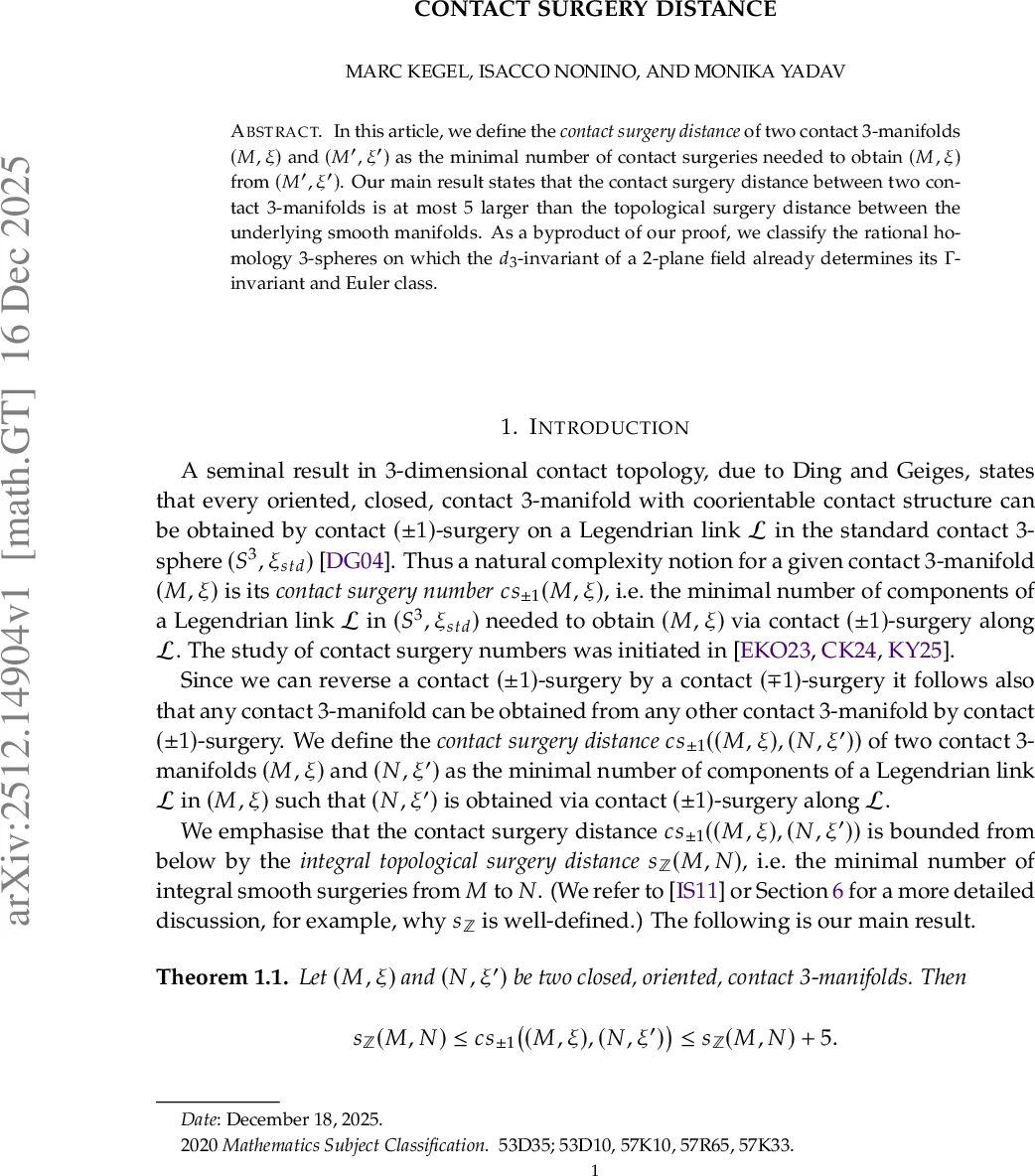
In this article, we define the contact surgery distance of two contact 3-manifolds $(M,ξ)$ and $(M’,ξ’)$ as the minimal number of contact surgeries needed to obtain $(M,ξ)$ from $(M’,ξ’)$. Our main result states that the contact surgery distance between two contact $3$-manifolds is at most $5$ larger than the topological surgery distance between the underlying smooth manifolds. As a byproduct of our proof, we classify the rational homology $3$-spheres on which the $d_3$-invariant of a $2$-plane field already determines its $Γ$-invariant and Euler class.
💡 Research Summary
In this paper the authors introduce a new quantitative invariant for contact 3‑manifolds, the contact surgery distance. Given two closed, oriented contact 3‑manifolds ((M,\xi)) and ((N,\xi’)), the distance (c^{\pm1}s((M,\xi),(N,\xi’))) is defined as the smallest number of Legendrian ((\pm1)) contact surgeries needed to transform ((M,\xi)) into ((N,\xi’)). This notion is a natural contact‑theoretic analogue of the classical integral topological surgery distance (s{\mathbb Z}(M,N)), which counts the minimal number of integral Dehn surgeries required to pass from (M) to (N).
The main theorem (Theorem 1.1) establishes a sharp inequality relating the two distances: \
Comments & Academic Discussion
Loading comments...
Leave a Comment