The spin of prime ideals and level-raising of even Galois representations
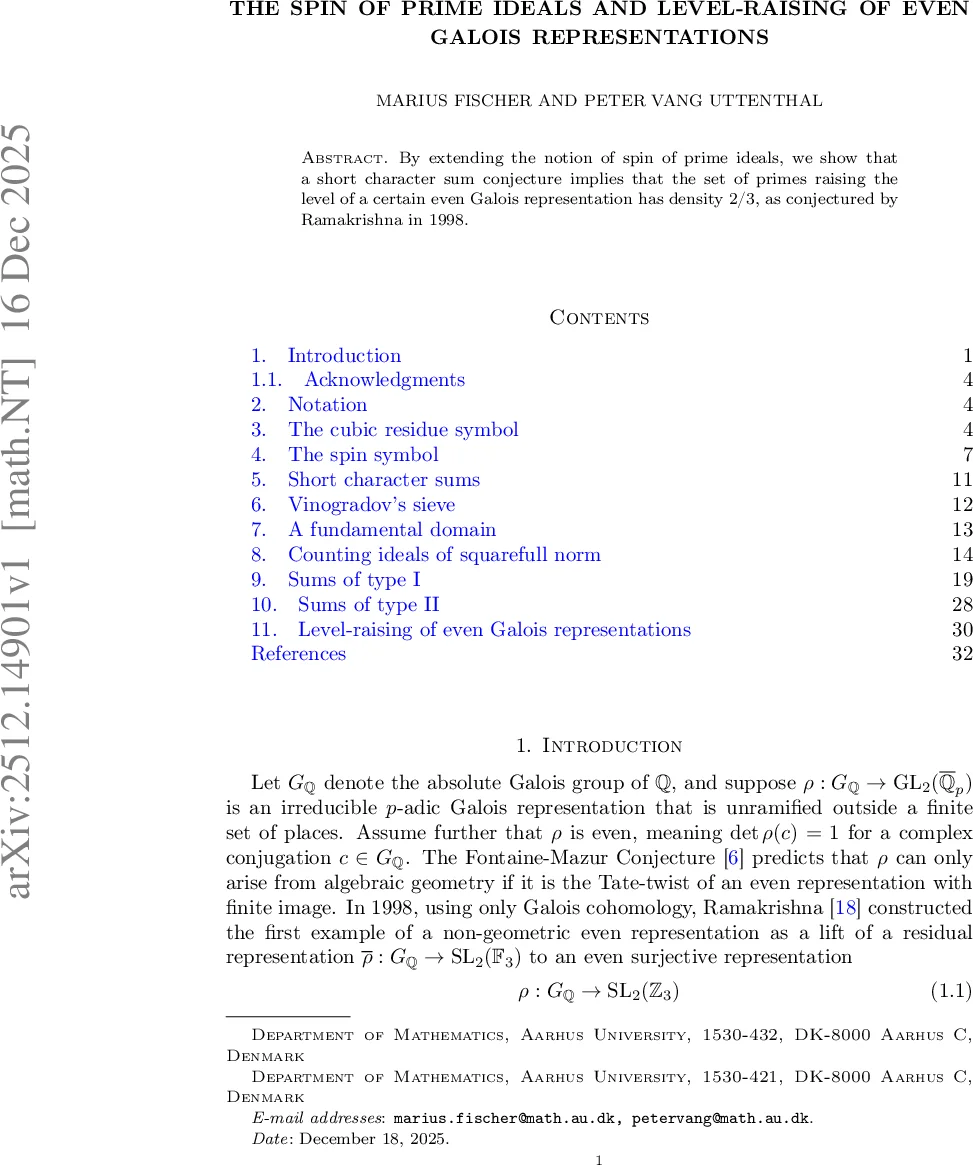
By extending the notion of spin of prime ideals, we show that a short character sum conjecture implies that the set of primes raising the level of a certain even Galois representation has density 2/3, as conjectured by Ramakrishna in 1998.
💡 Research Summary
The paper by M. Fischer and P. Vang Uttenthal studies the density of primes that raise the level of a particular even two‑dimensional p‑adic Galois representation ρ. The representation in question is the Ramakrishna example, a surjective lift ρ : G_ℚ → SL₂(ℤ₃) ramified only at 3 and 349. For a prime p ≡ 1 (mod 3) the authors define the set C of such primes for which the Frobenius element ρ(Frob_p) has order three. The level‑raising criterion, originally proved in Ramakrishna’s work, says that p raises the level of ρ precisely when the maximal 3‑elementary extension K(p) of the totally real A₄‑field K (the splitting field of a quartic polynomial with discriminant 349²) has inertial degree 9 over ℚ at p. This condition cannot be handled by the Chebotarev density theorem because the defining field depends on p itself.
The authors introduce a “spin” symbol attached to prime ideals, extending the notion originally developed by Friedlander, Iwaniec, Mazur and Rubin for quadratic characters. Because the relevant extensions contain a primitive cube root of unity ζ₃, they work with cubic residue symbols (α/𝔭)_3,F(ζ₃) and develop a cubic reciprocity law (Proposition 3.1, Lemma 3.2). They then define, for suitable integral ideals 𝔞 of the non‑Galois field F(ζ₃) (where F is a quartic subfield of K), a spin value
s_𝔞 = ( N_{K/F}(σ(α)) / 𝔞 )_3,F(ζ₃),
where α generates the principal ideal N_{F(ζ₃)/F}(𝔞) and σ is any element of Gal(K/ℚ) not lying in Gal(K/F). The spin is shown to be independent of the choices and to take values in {1, ζ₃, ζ₃²}. Theorem 1.2 proves that for p∈C, coprime to a certain modulus m, the prime p raises the level of ρ if and only if the associated spin satisfies s_p = 1.
To obtain statistical information about the spin values, the authors assume a short character sum conjecture (Conjecture Cₙ). For a non‑principal cubic Dirichlet character χ modulo q, Conjecture Cₙ asserts a power‑saving bound for incomplete sums of χ over intervals of length q^{1/n}. The paper requires n = 12; this is a strong hypothesis but is analogous to the conjecture used in the quadratic spin literature.
Under Conjecture C₁₂, the authors apply Vinogradov’s sieve (following the method of Friedlander‑Iwaniec‑Mazur‑Rubin) together with a careful analysis of the distribution of ideals in F(ζ₃). Sections 5–10 develop the necessary analytic tools: a fundamental domain for the action of the unit group, counting of square‑full norm ideals (Section 8), and the treatment of Type I and Type II sums involving the spin. The key analytic result (Theorem 1.3) shows that the sum of the spin over degree‑one primes of F(ζ₃) that are inert in the Galois closure K(ζ₃) exhibits cancellation: there exists δ > 0 such that
∑_{N(p)≤X, p∈C, s_p=1} 1 ≪ X^{1−δ}.
This cancellation implies that the proportion of primes in C with spin equal to 1 is 2/3. Combining this with Theorem 1.2 yields the main theorem:
Theorem 1.1. Assuming Conjecture C₁₂, the set of primes that raise the level of ρ has natural density 2/3 inside C.
The paper also derives a Selmer‑group corollary. Let S = {3, 349} and consider the adjoint representation Ad⁰(ρ). For a prime p∈C, the Selmer rank over G_{S∪{p}} increases by one precisely when s_p = 1, and stays unchanged otherwise. Consequently, under the conjecture, the Selmer rank grows by one for exactly one‑third of the level‑raising primes and remains constant for the remaining two‑thirds.
Beyond the specific application, the authors highlight several technical innovations. Working over the non‑Galois field F(ζ₃) forces a new definition of the spin symbol, careful handling of unit congruences, and a novel lattice‑point counting argument (Section 8) that replaces the classical approach which fails in this setting. Moreover, the paper demonstrates that the spin technique, previously confined to quadratic or cubic characters over Galois extensions, can be successfully adapted to non‑Galois contexts and to problems in deformation theory of Galois representations.
In summary, assuming a plausible short‑character‑sum conjecture, the authors prove Ramakrishna’s predicted density 2/3 for level‑raising primes of an even Galois representation, introduce a new cubic spin invariant over a non‑Galois field, and provide analytic tools that may be applicable to a broad class of problems involving Selmer groups, deformation rings, and non‑abelian extensions.
Comments & Academic Discussion
Loading comments...
Leave a Comment