Hearing the light: stray-field noise from the emergent photon in quantum spin ice
Decisive experimental confirmation of the $U(1)$ quantum spin liquid phase in quantum spin ice remains an outstanding challenge. In this work, we propose stray-field magnetometry as a direct probe of the emergent photons – the gapless excitation of the emergent electrodynamics in quantum spin ice. The emergent photons are transverse magnetization waves, which, in a finite sample, form discrete modes governed by one of two sets of natural boundary conditions: insulating'' or superconducting’’. Considering cavity and thin film geometries, we find that the spectrum and spatial structure of the stray magnetic noise provide a sharp qualitative signature of the underlying electrodynamics. The predicted stray-field noise power lies comfortably within the detection range of present-day solid-state defect magnetometry.
💡 Research Summary
The paper addresses one of the most pressing challenges in the field of frustrated magnetism: the definitive experimental detection of the emergent photon, the gapless transverse magnetization mode that underlies the U(1) quantum spin liquid (QSL) phase in quantum spin ice (QSI). While numerous indirect signatures have been reported, the photon’s low energy (≲ 1 GHz), low temperature (≲ 0.5 K) and lack of a conventional charge make it extremely difficult to observe with standard probes such as neutron scattering or bulk susceptibility.
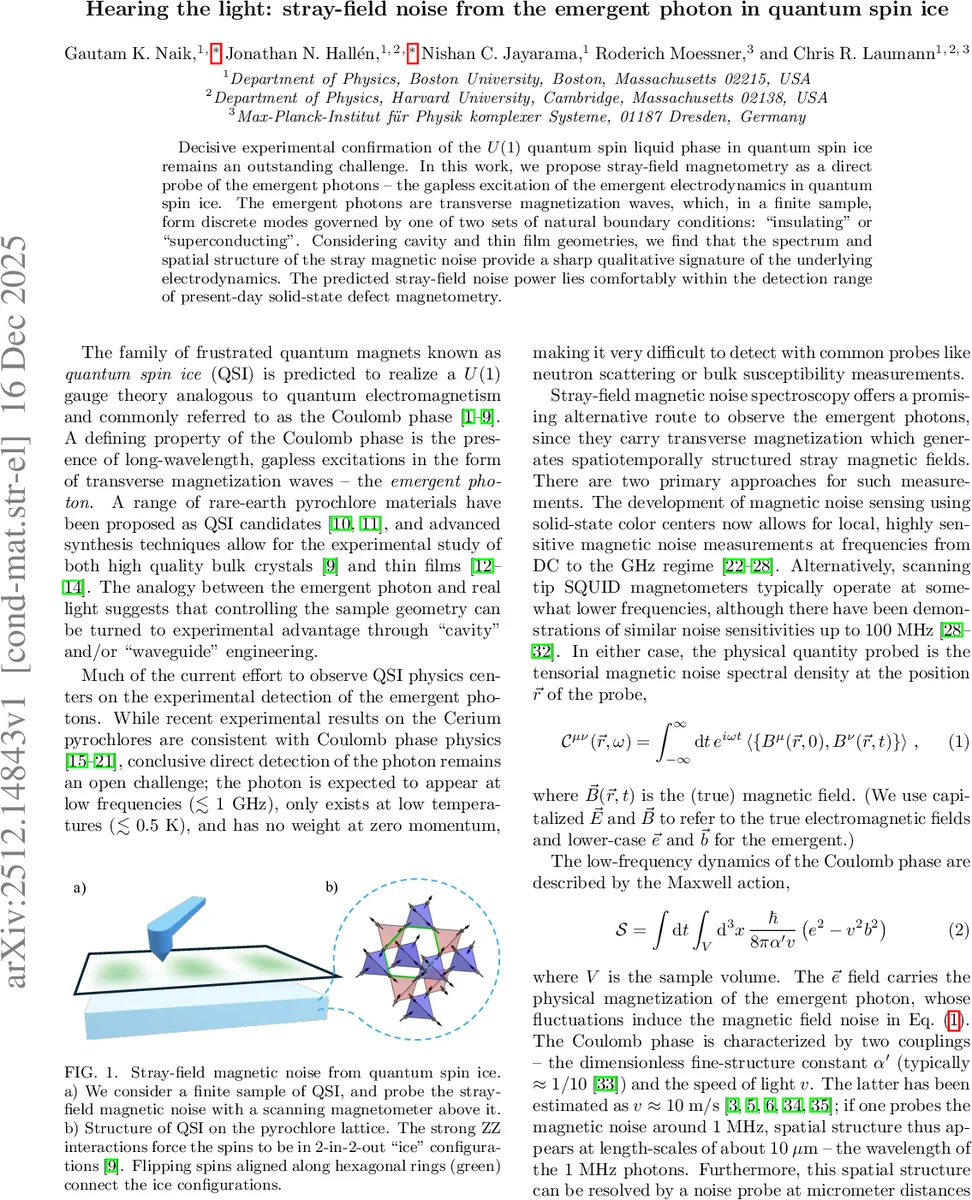
The authors propose a fundamentally different strategy: measure the stray magnetic field noise generated by the photon’s transverse magnetization waves using ultra‑sensitive solid‑state defect magnetometers (e.g., nitrogen‑vacancy (NV) centers) or scanning SQUID tips. The key insight is that, in a finite sample, the emergent electromagnetic field obeys Maxwell‑type equations with an effective fine‑structure constant α′≈0.1 and a photon velocity v≈10 m/s. The photon therefore behaves like a low‑frequency electromagnetic wave whose wavelength at 1 MHz is of order 10 µm, a scale that can be resolved by a probe placed a few micrometers above the sample surface.
Two natural long‑wavelength boundary conditions are derived from the assumptions that (i) no energy flows through the surface, (ii) the system respects time‑reversal symmetry, and (iii) the photon wavelength far exceeds any microscopic length at the boundary. These lead to (a) “insulating” conditions (b‖ = 0, e⊥ = 0) and (b) “superconducting” conditions (e‖ = 0, b⊥ = 0). The insulating case forbids any normal component of the emergent magnetic field at the surface, which, together with the bulk Gauss law (∇·M = 0), eliminates all sources of stray magnetic field outside the crystal. Consequently, the stray‑field noise is exactly zero for this boundary. In contrast, the superconducting case allows a surface magnetic charge (M·n ≠ 0), producing a measurable stray field.
The authors quantize the photon modes in two representative geometries. In a cuboid of dimensions Lx, Ly, Lz, the wavevectors are k = π(nₓ/Lₓ, nᵧ/Lᵧ, n_z/L_z) with at least two non‑zero components; if all three are non‑zero there are two independent polarizations, whose selection depends on the boundary condition. The mode frequencies are ω = v|k|. For a thin film of thickness Lz (infinite in‑plane), the modes are labeled by a transverse momentum k⊥ and an integer nz, with ωₙ(k⊥)=v√(k⊥²+(πnz/Lz)²). In both cases the discrete spectrum leads to sharp peaks in the magnetic noise spectral density.
To connect theory with experiment, the magnetic field generated by each mode is computed via a dipole kernel, Bₛ(r)=μ₀g (4πα′v/ωₛ) ∫V d³r′ H(r−r′)·Wₛ(r′), where Wₛ(r) encodes the mode’s spatial polarization. The noise tensor C{μν}(r,ω) follows from the Bose‑Einstein occupation of each mode, yielding delta‑function peaks at the mode frequencies weighted by the squared field amplitudes.
The feasibility analysis focuses on NV‑center magnetometry. Using realistic parameters (α′=0.1, v=10 m/s, μ₀g²≈10⁻³⁸ T² m⁻² s²) and a temperature of 100 mK, the predicted magnetic noise power at 1 MHz is on the order of 10⁻¹⁴ T²/Hz, well within the detection limits of current NV‑based sensors (≈10⁻¹³ T/√Hz). Simulated XY8‑4 dynamical decoupling sequences show distinct dips in the NV T₂ time whenever the pulse spacing matches a photon mode frequency, providing a clear spectroscopic signature. Moreover, the spatial pattern of the stray field (different for longitudinal Bz versus transverse B⊥ components) can be mapped by scanning the probe or by an array of sensors, offering a direct visualization of the photon mode structure.
The paper also discusses the microscopic origin of the boundary conditions. In a microscopic spin‑ice Hamiltonian H=J_{zz}∑⟨ij⟩ s_i^z s_j^z + H′, the dominant Ising term enforces the 2‑in‑2‑out ice rule, while H′ generates ring‑exchange processes that give rise to the emergent photon in the bulk. At a crystal termination, broken tetrahedra host “electric charges” (e‑charges) that can hop via boundary exchange processes. By coupling the emergent gauge field to a gapped bosonic field ψ localized at the surface (action S_boundary), the sign of the mass term m² determines whether the surface is in an insulating (m²>0) or superconducting (m²<0) phase. This provides a concrete microscopic mechanism for the two boundary conditions, and explains why the energy scale for surface dynamics can differ from that of the bulk photon.
Finally, the authors assess experimental parameters and conclude that the stray‑field noise from the emergent photon is not only theoretically robust but also experimentally accessible with existing technology. Observation of the predicted discrete noise peaks, their dependence on sample geometry, and the stark contrast between insulating and superconducting boundary conditions would constitute a decisive, direct detection of the emergent photon and, by extension, of the U(1) quantum spin liquid itself. This work thus opens a realistic pathway toward confirming one of the most exotic phases of matter predicted in frustrated quantum magnets.
Comments & Academic Discussion
Loading comments...
Leave a Comment