The fermion sign problem in Gauss law sectors of quantum link models with dynamical matter
The fermion sign problem poses a formidable challenge to the use of Monte Carlo methods for lattice gauge theories with dynamical fermionic matter fields. A meron cluster algorithm recently formulated for gauge fields represented as spin-$\frac{1}{2}$ quantum links coupled to a single flavour of staggered fermions samples only two of the exponentially many Gauss law (GL) sectors at low temperatures, making it possible to simulate either of those two GL sectors at zero temperature in polynomial time. In this article, we analytically identify GL sectors which can be simulated without encountering the fermion sign problem in arbitrary spatial dimensions. Using large-scale exact diagonalization and cluster Monte Carlo methods, we further explore the nature of phases in the GL sectors dominating at zero temperature. The vacuum states lie in sectors which satisfy a staggered Gauss law, in contrast to the zero GL sector familiar in particle physics. Moreover, we prove that while the ground state GL sectors do not suffer from the fermion sign problem, the usual zero-charge GL sector (often considered the physical sector) does. We outline the role of the magnetic energy in causing transitions between GL sectors. We expect our results to be valid for truncated Kogut-Susskind gauge theories, beyond quantum link models.
💡 Research Summary
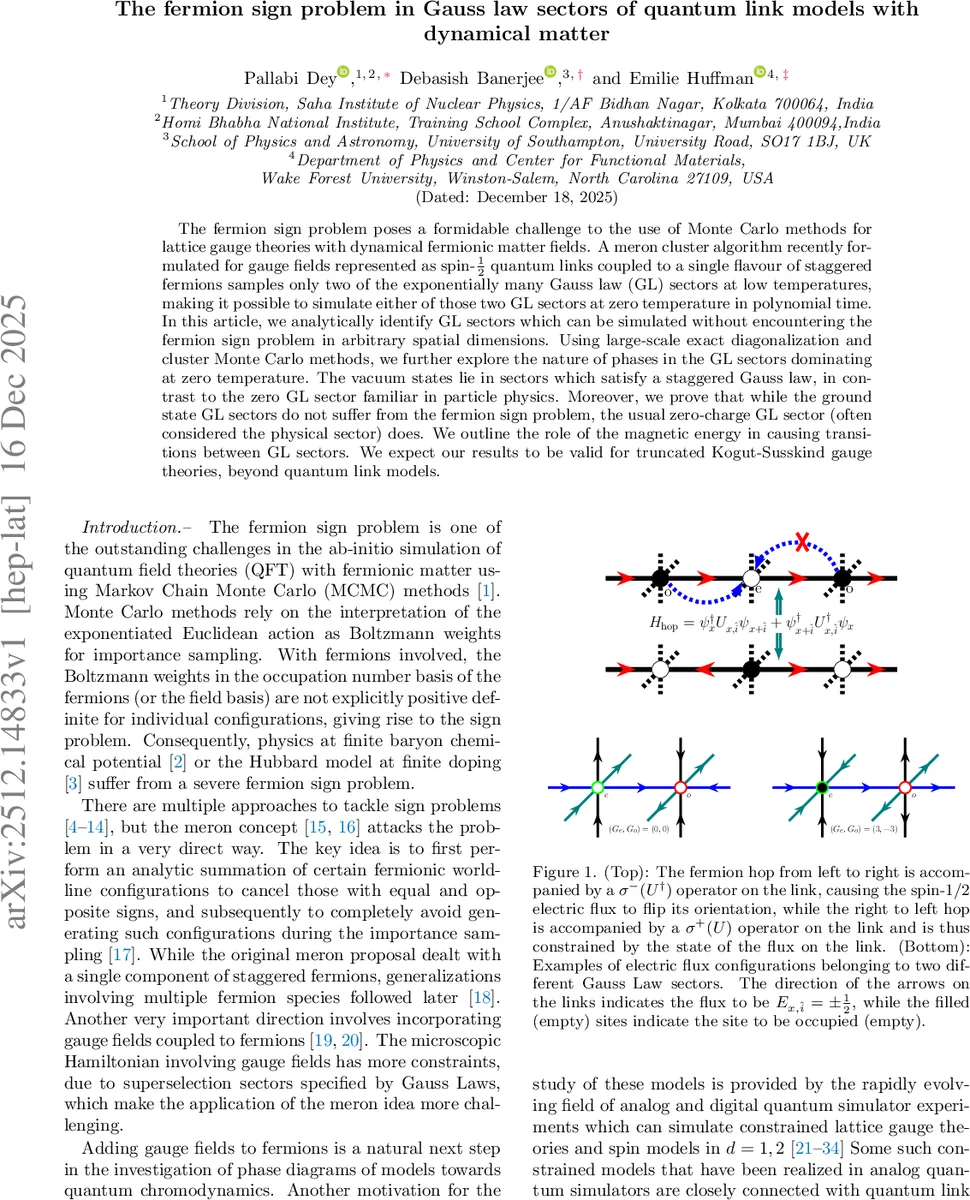
The paper tackles the notorious fermion sign problem that hampers Monte‑Carlo simulations of lattice gauge theories with dynamical fermionic matter. The authors focus on U(1) quantum link models (QLMs) where gauge fields are represented by spin‑½ quantum links and are coupled to a single flavor of staggered fermions. The Hamiltonian consists of three parts: (i) a fermion hopping term that simultaneously creates or annihilates a unit of electric flux on a link, (ii) a “designer” term of equal strength to the hopping term (required for the meron‑cluster construction), and (iii) a nearest‑neighbour density‑density interaction proportional to V. Local gauge invariance is enforced by a Gauss‑law operator Gₓ that combines the staggered fermion occupation with the divergence of the electric flux. Because
Comments & Academic Discussion
Loading comments...
Leave a Comment