Growth and spreading of quantum resources under random circuit dynamics
Quantum many-body dynamics generate nonclassical correlations naturally described by quantum resource theories. Quantum magic resources (or nonstabilizerness) capture deviation from classically simulable stabilizer states, while coherence and fermionic non-Gaussianity measure departure from the computational basis and from fermionic Gaussian states, respectively. We track these resources in a subsystem of a one-dimensional qubit chain evolved by random brickwall circuits. For resource-generating gates, evolution from low-resource states exhibits a universal rise-peak-fall behavior, with the peak time scaling logarithmically with subsystem size and the resource eventually decaying as the subsystem approaches a maximally mixed state. Circuits whose gates do not create the resource but entangle neighboring qubits, give rise to a ballistic spreading of quantum resource initially confined to a region of the initial state. Our results give a unified picture of spatiotemporal resource dynamics in local circuits and a baseline for more structured quantum many-body systems.
💡 Research Summary
The paper investigates how three distinct quantum resources—non‑stabilizerness (often called “magic”), quantum coherence, and fermionic non‑Gaussianity—evolve locally in a one‑dimensional qubit chain subjected to random brick‑wall circuits. Two complementary scenarios are explored.
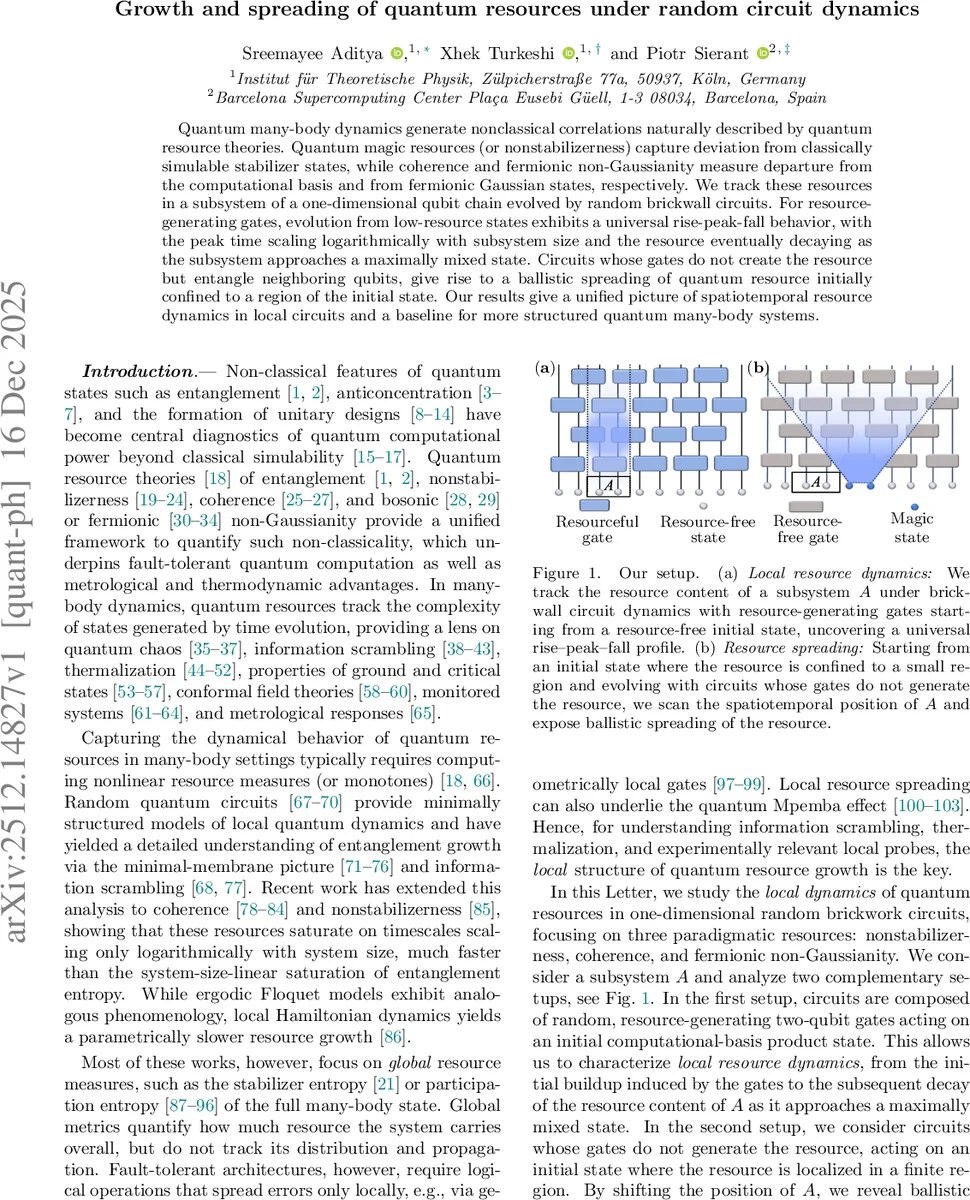
In the first scenario the system starts from a completely “free” product state (all qubits in |0⟩) and the circuit is built from two‑qubit gates drawn from ensembles that are capable of generating the chosen resource. For non‑stabilizerness the authors use Haar‑random two‑qubit unitaries; for coherence and fermionic non‑Gaussianity they restrict to appropriate subsets of Clifford gates that are guaranteed to create the respective resource when acting on computational‑basis states. The resource content of a chosen subsystem A (with L_A qubits) is quantified by faithful monotones: the log‑robustness of magic (LRoM) for magic, the relative entropy of coherence C_d(ρ_A)=S(ρ_A^D)−S(ρ_A) for coherence, and the relative entropy of non‑Gaussianity N_G(ρ_A)=S(ρ_A^F)−S(ρ_A) for fermionic non‑Gaussianity. Numerical simulations (state‑vector for modest sizes, tableau‑based Clifford simulation for up to several hundred qubits) reveal a universal “rise‑peak‑fall” pattern. Each monotone grows rapidly from zero, reaches a maximum at a time τ_m that scales logarithmically with the subsystem size (τ_m∝log L_A), and then decays exponentially as the reduced state approaches the maximally mixed state 𝟙_A/2^{L_A}. The decay time τ_d is essentially independent of L_A, while the peak value itself decreases with increasing L_A, reflecting that larger subsystems become mixed more quickly. This behavior mirrors earlier findings for global magic measures in random circuits, but here the focus is on local dynamics.
The second scenario flips the problem: the circuit consists only of “free” operations (Clifford gates for magic, incoherent Clifford gates for coherence, and matchgate‑type Clifford gates for fermionic non‑Gaussianity), while the initial state contains a localized resourceful region. For magic the authors embed a small block of T‑states (|T⟩=cos(π/8)|0⟩+sin(π/8)|1⟩) in the middle of an otherwise |0⟩ chain; for coherence they use a block of equal superposition states; for fermionic non‑Gaussianity they use a block of non‑Gaussian fermionic states. By scanning the position of the subsystem A relative to the resource block, they map out a spacetime profile of the resource monotone. In all three cases a clear light‑cone emerges: the earliest non‑zero signal at a distance x from the source appears at time t≈x/v_R, with v_R≈1 (one lattice site per circuit layer). Along the front the peak value of the monotone decays exponentially with distance, and after the front passes the subsystem again relaxes exponentially to the maximally mixed state. Thus the resource spreads ballistically but is not a conserved local density; it is transferred into non‑local correlations, so that any finite region eventually becomes free even though the global state retains the same total amount of the resource (e.g., total magic is unchanged under Clifford dynamics).
Methodologically the work combines exact state‑vector evolution for small systems with efficient Clifford tableau simulations that allow tracking of thousands of qubits for the free‑gate cases. The choice of monotones (LRoM, relative entropies) ensures faithful, monotonic quantification even for mixed reduced states, overcoming the difficulty that many resource measures are defined only for pure states.
Key insights: (i) When resource‑generating gates are present, local resource growth is rapid but saturates on a logarithmic timescale, after which entanglement with the environment drives an exponential decay to zero. (ii) When only free gates act, a localized resource spreads ballistically with a front moving at the speed set by the circuit geometry; the front’s amplitude decays exponentially with distance. (iii) In both regimes, the long‑time fate of any finite subsystem is a maximally mixed, resource‑free state, highlighting the distinction between global conserved quantities and locally observable resource densities.
These findings provide a unified picture of how quantum resources propagate and dissipate in minimally structured many‑body dynamics, offering a baseline for more structured Hamiltonian evolutions, for assessing error‑propagation in fault‑tolerant architectures, and for understanding the role of local resource dynamics in quantum thermalization, scrambling, and metrology.
Comments & Academic Discussion
Loading comments...
Leave a Comment