Why the Northern Hemisphere Needs a 30-40 m Telescope and the Science at Stake: Key Targets of Opportunity on Gas and Ice Giants and their satellites
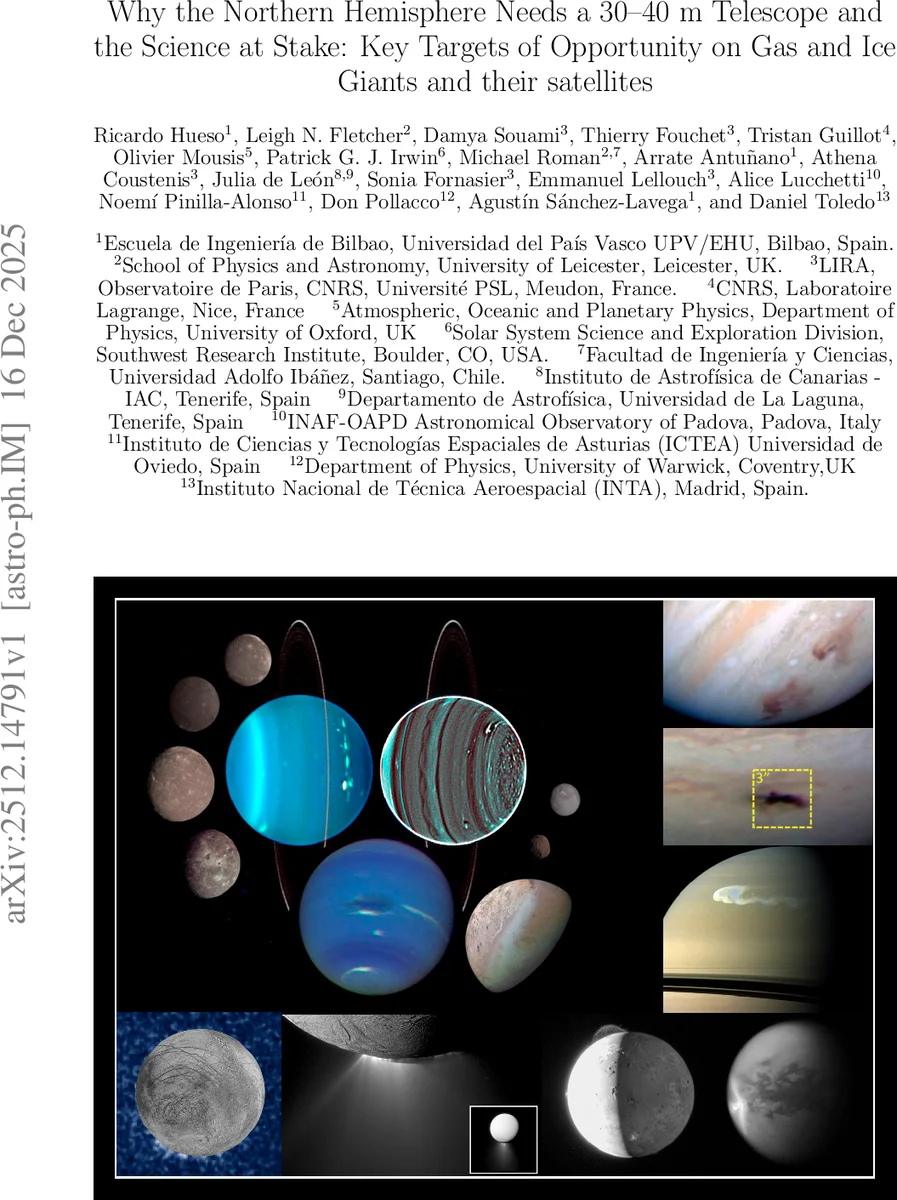
The Extremely Large Telescope (ELT) will transform our knowledge of the outer planets and their satellite systems; however the visibility of unique targets of opportunity with high scientific value will be reduced for northern objects. Uranus’ declination favors observations from the Northern Hemisphere until 2055, and Neptune will be favored from the Northern Hemisphere from 2027 for the next 90 years. Jupiter and Saturn experience cycles of better observability from either hemisphere on cycles of 10 and 30 years. These planets and their satellite systems often offer unique opportunities for discovery through time-critical observations. We argue that a 30-m class size telescope in the Northern Hemisphere with complementary scientific instrumentation to that on the ELT will secure the possibility of observing high-impact unpredictable phenomena in these systems.
💡 Research Summary
The paper makes a compelling case for constructing a 30‑40 m class optical/infrared telescope in the Northern Hemisphere to complement the Extremely Large Telescope (ELT) being built in the Southern Hemisphere. By analysing the declination trajectories of the outer planets—Uranus, Neptune, Jupiter, and Saturn—the authors show that the visibility of these targets from high‑latitude sites varies on decadal to centennial timescales. Uranus will be optimally placed for Northern observatories until roughly 2055, while Neptune will become a Northern‑hemisphere priority from 2027 for the next 90 years. Jupiter and Saturn exhibit 10‑year and 30‑year cycles, respectively, during which one hemisphere enjoys superior elevation and longer adaptive‑optics (AO) windows.
The authors introduce the concept of “Targets of Opportunity” (ToOs) – rare, unpredictable events that demand rapid, high‑resolution observations. They enumerate several classes of ToOs that are scientifically high‑impact: (1) large impacts on giant planets, (2) super‑storm eruptions, (3) Io’s volcanic outbursts, (4) cryovolcanic plumes on Europa, Enceladus, and Triton, and (5) time‑variable phenomena in planetary rings and minor moons. Each class requires a combination of high spatial resolution (sub‑0.05 arcsec), high spectral resolution (R > 10 000), and rapid response capability that only a 30‑40 m aperture equipped with state‑of‑the‑art AO can deliver.
For impact events, the paper notes that Jupiter experiences observable impacts roughly once per decade, with atmospheric debris persisting from days to weeks. High‑resolution imaging and near‑infrared to mid‑infrared spectroscopy can determine impactor composition (hydrocarbons, nitriles, CO, water, oxygen), entry angle, and kinetic energy, thereby constraining impactor population statistics and planetary atmospheric chemistry.
Super‑storms on Jupiter and Saturn provide a laboratory for studying deep convection, moist convection inhibition by molecular weight stratification, and the vertical transport of ammonia and water. A 30‑m telescope would resolve cloud structures down to ~10 km, map wind fields, and retrieve vertical abundance profiles, directly testing models of heat transport in hydrogen‑dominated atmospheres.
Io’s volcanic eruptions are brief but intense, often doubling the moon’s thermal output for hours to days. The authors argue that a Northern‑hemisphere giant telescope could resolve multiple hot spots within a single lava lake, track temperature evolution on minute timescales, and obtain high‑resolution spectra of SO₂, Na, and K emissions, shedding light on tidal heating mechanisms and magma dynamics.
Cryovolcanism on Europa, Enceladus, and especially Triton remains elusive because the plume angular size (~0.1 arcsec) is below the resolution of existing 8‑10 m facilities and even JWST. The proposed telescope, with laser‑guide‑star AO, would achieve the necessary spatial resolution and spectral sensitivity to detect water, organics, and trace gases, enabling quantitative assessments of subsurface ocean–surface exchange and habitability potential.
Ring and minor‑moon dynamics demand long‑term monitoring to capture transient arcs, spokes, and orbital migrations. Continuous high‑cadence imaging from a Northern site would complement Southern observations, allowing three‑dimensional reconstruction of ring particle distributions and precise astrometry of shepherd moons, thereby informing theories of disk evolution and satellite formation.
The paper emphasizes that many of these ToOs are time‑critical; delays of even a few days can cause loss of the scientific signal. A Northern 30‑40 m telescope would provide rapid scheduling flexibility, high‑elevation observing windows (reducing atmospheric turbulence), and the necessary instrumentation (high‑contrast imagers, integral‑field spectrographs, high‑resolution echelle spectrographs) to capture the fleeting phenomena.
In conclusion, the authors argue that without a comparable Northern‑hemisphere facility, the astronomical community would lose a substantial fraction of high‑impact observations of the outer Solar System for the coming half‑century. The synergy between the Southern ELT and a Northern giant telescope would ensure continuous, complementary coverage, maximizing the scientific return on investments in adaptive‑optics technology, and securing critical data for planetary atmosphere physics, satellite geophysics, Solar System formation models, and the broader quest to understand exoplanet analogues.
Comments & Academic Discussion
Loading comments...
Leave a Comment