Sub-millimeter wavelength protostellar accretion rate monitoring with AtLAST
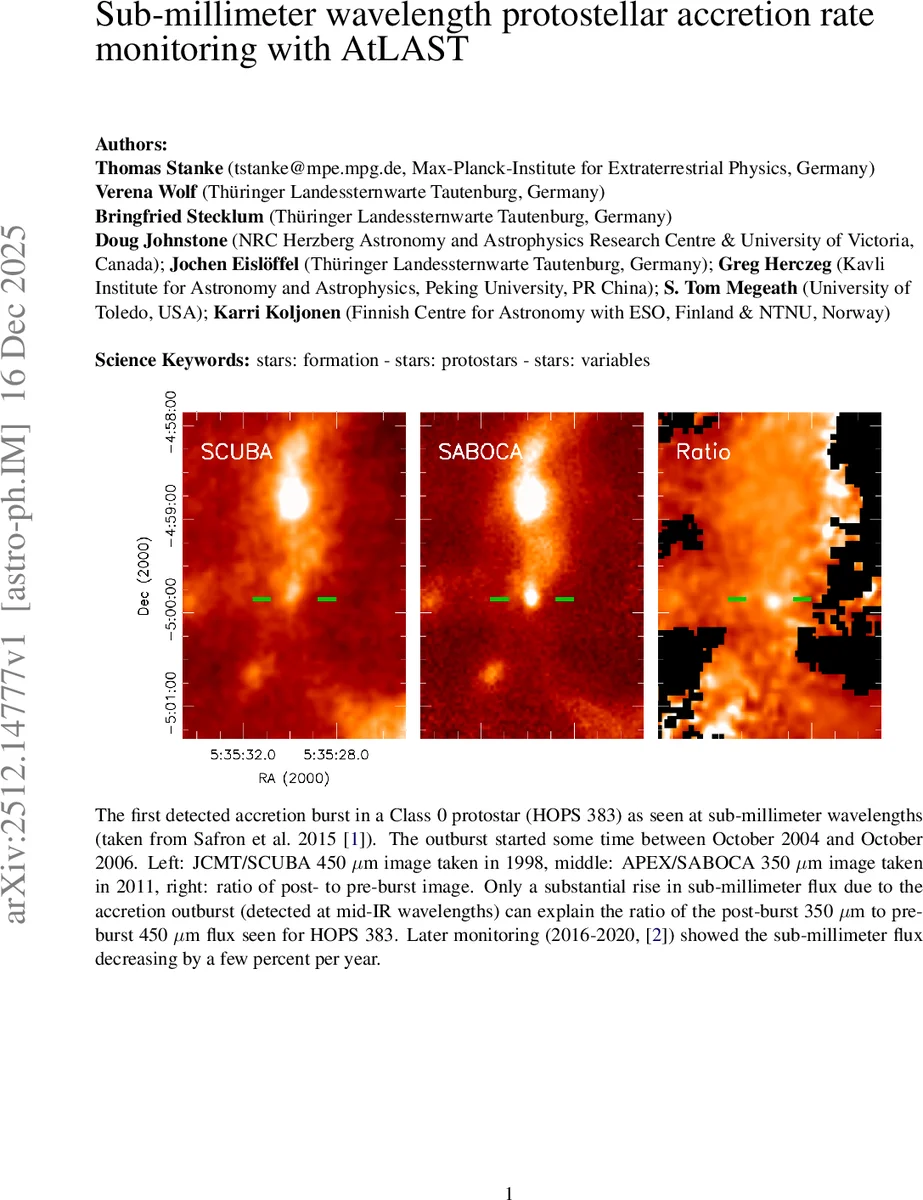
How a star forms is a fundamental question in astrophysics. In the earliest stages of protostellar evolution high extinction prevents a direct study of the accretion processes and their temporal evolution. Monitoring the variations of the accretion luminosity in a large protostar sample over decades is needed to reveal how protostars accrete – in major bursts or in a quasi-steady fashion. We here argue that a large ground based sub-millimeter single-dish facility with a wide FoV is required to fulfill this task.
💡 Research Summary
The paper addresses one of the most fundamental questions in astrophysics: how stars acquire their mass during the deeply embedded, Class 0 phase. In this stage the protostar and its inner disk are hidden behind thick dust, rendering traditional UV/optical/near‑IR accretion diagnostics ineffective. Consequently, the total bolometric luminosity—comprising the intrinsic stellar output and the accretion‑generated heat—must be used as a proxy for the mass‑accretion rate. However, the well‑known “protostellar luminosity problem” (observed luminosities are far lower than steady‑accretion models predict) suggests that accretion is highly variable, occurring in brief, high‑luminosity bursts (episodic accretion).
To test this hypothesis, a statistically robust sample of several thousand protostars must be monitored over decades, capturing both low‑level variability and rare, high‑amplitude outbursts. Existing facilities such as the JCMT Transient Survey can monitor a few hundred sources at 450 µm and 850 µm, but their limited field‑of‑view, modest sensitivity, and short operational baselines constrain the detection of subtle or infrequent events. Interferometers like ALMA provide exquisite spatial resolution but suffer from time‑variable uv‑coverage and spatial filtering, making absolute flux comparisons across epochs unreliable for large‑scale monitoring. Moreover, the integration time required to map thousands of sources with an interferometer is prohibitive.
The authors therefore propose the Atacama Large Aperture Sub‑mm Telescope (AtLAST), a 50‑meter single‑dish instrument designed specifically for sub‑millimeter transient science. AtLAST would operate up to 950 GHz (≈300 µm, ALMA Band 10) with a diffraction‑limited beam of ~1.5″, and, crucially, would provide an instantaneous field‑of‑view of up to 2 degrees. Coupled with a multi‑thousand‑pixel TES/KID camera, this configuration yields a mapping speed up to 10⁵ times faster than ALMA and a continuum sensitivity comparable to the full ALMA array. The combination of large aperture (high instantaneous sensitivity) and wide FoV enables rapid, deep surveys of both nearby star‑forming regions and the Galactic plane, allowing the monitoring of >2 000 low‑mass protostars and a comparable number of intermediate‑ to high‑mass objects.
Observing at the shortest feasible ground‑based sub‑mm wavelengths (350 µm) maximizes the response of the spectral energy distribution to changes in accretion rate, because the envelope re‑emits the burst energy most efficiently in the far‑IR and the sub‑mm regime. While space‑based far‑IR missions (e.g., the proposed PRIMA probe) would directly trace the peak of the burst emission, their limited lifetimes (≈5 yr) and operational constraints preclude the decade‑scale monitoring required for FU‑Orionis‑type events. Ground‑based sub‑mm monitoring with AtLAST thus fills the critical gap, offering a stable, long‑term platform that can capture both rapid (months) and prolonged (decades) variability.
Technical requirements outlined include: (1) sub‑arcsecond resolution to separate individual protostars in clustered, distant regions; (2) a wide FoV to achieve the necessary sample size for robust statistics; (3) high instantaneous sensitivity to detect <0.1 % flux changes; and (4) a site at ~5 000 m altitude (e.g., the Chajnantor plateau) to minimize atmospheric opacity at high frequencies. The authors argue that AtLAST’s capabilities will revolutionize sub‑mm transient science, providing the first systematic, decade‑long census of protostellar accretion variability across the full mass spectrum. This will enable precise measurements of burst frequency, duration, and amplitude as functions of protostellar mass and evolutionary stage, thereby directly testing episodic accretion models and resolving the protostellar luminosity problem. The paper concludes by emphasizing the synergy between AtLAST’s long‑term ground‑based monitoring and future space‑based far‑IR missions, positioning AtLAST as the cornerstone facility for the next generation of star‑formation research.
Comments & Academic Discussion
Loading comments...
Leave a Comment