The Emergence of Prebiotic Chemistry in the ISM
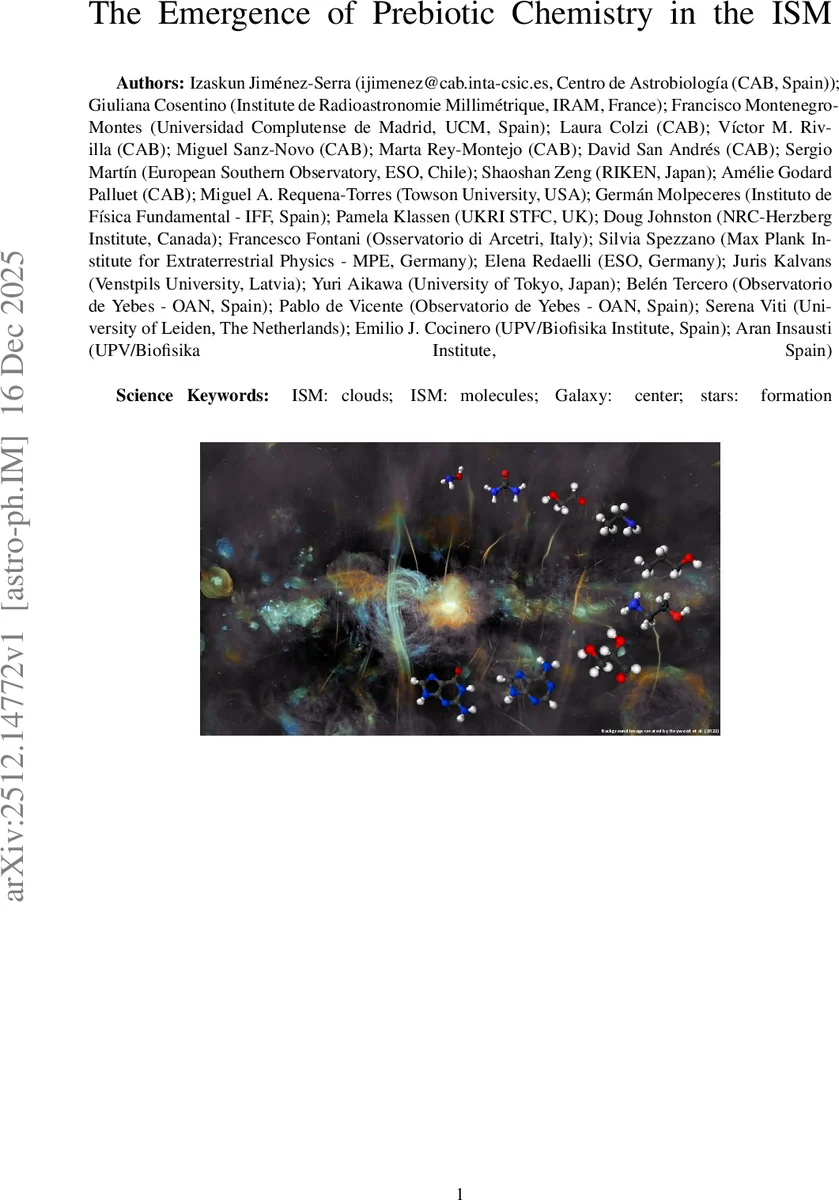
Contrary to popular belief, the interstellar medium (ISM) is not empty; it is filled with atoms, dust particles, and molecules. Some of these molecules may have been the very building blocks of life that, delivered to Earth via comets and meteorites, could have given rise to Life itself. A large-area single-dish telescope with superb sensitivity, field-of-view and multi-band instruments will allow us to explore the limits of chemical complexity in the interstellar medium, across our Galaxy and in external galaxies, determining whether amino acids, sugars, or RNA/DNA nucleobases can form in space.
💡 Research Summary
The paper “The Emergence of Prebiotic Chemistry in the ISM” makes a compelling case that the interstellar medium (ISM) is a fertile laboratory for the synthesis of complex organic molecules that could serve as the building blocks of life. It begins by reviewing the long‑standing hypothesis that a substantial fraction of prebiotic compounds on early Earth were delivered exogenously, via comets and meteorites, after having formed in the cold molecular clouds that pre‑dated the Solar System. Recent analyses of samples from asteroids Ryugu and Bennu have identified all five DNA/RNA nucleobases and 14 of the 20 proteinogenic amino acids, with ^15N isotopic signatures pointing to a pre‑Solar‑System origin. This raises two central questions: (1) which specific organic species can be assembled in the proto‑solar nebula, and (2) how far does chemical complexity extend across the Galaxy and into external galaxies?
To address these questions, the authors summarize the results of ultra‑sensitive, broadband spectral surveys carried out with the IRAM 30 m and Yebes 40 m telescopes. These surveys have already revealed a rich inventory of prebiotic molecules toward the Galactic‑Center molecular cloud G+0.693‑0.027, a region characterized by sub‑thermal excitation (T_ex ≈ 7–15 K) but relatively warm gas (T_kin ≈ 70–150 K). The low excitation temperature preferentially populates low‑energy rotational levels, reducing line confusion and making the cloud an ideal “chemical laboratory.” Detected species include hydroxylamine (NH₂OH), a ribonucleotide precursor; ethanolamine (NH₂CH₂CH₂OH), the simplest phospholipid head group; n‑propanol (n‑C₃H₇OH), a fatty‑alcohol precursor; and carbonic acid (HOCOOH), a precursor to amino acids and lipids. The detection of such molecules demonstrates that the ISM can produce compounds of a complexity previously thought to be confined to planetary environments.
However, the authors argue that current facilities are insufficient to push the frontier further. Detecting larger sugars such as erythrulose (C₄) and ribose (C₅) requires an order‑of‑magnitude improvement in sensitivity: rms noise ≈ 0.1 mK (3σ ≈ 0.3 mK) at the relevant frequencies. Achieving this with existing telescopes would demand > 1 year of integration time, which is impractical. Consequently, the paper proposes the Atacama Large Aperture Sub‑millimeter Telescope (AtLAST) as the essential instrument. AtLAST would operate in the 30–50 GHz band—identified as the “sweet spot” for prebiotic line emission—offering superb sensitivity (0.1 mK in < 100 h), a wide field of view (~2 deg) covered by a multi‑beam heterodyne array, and angular resolution of 27″–38″ (sufficient to resolve parsec‑scale structure at the 8 kpc distance of the Galactic Center). The multi‑band capability would simultaneously capture hundreds of rotational transitions, providing the redundancy needed for robust molecular identification and accurate abundance determinations.
Technical requirements outlined include: (i) broadband receivers covering 30–50 GHz with system temperatures low enough to reach the target rms; (ii) velocity resolution of 1–2 km s⁻¹ (or finer, ≈ 0.2 km s⁻¹ for narrow outer‑Galaxy lines); (iii) a sparse or densely packed 10‑mm multi‑beam array enabling either “staring” observations of selected positions or fast on‑the‑fly mapping; and (iv) the ability to conduct simultaneous observations across the 7 mm, 3 mm, 2 mm, and 1 mm atmospheric windows. The authors stress that no other existing facility (e.g., LMT, SRT) can deliver this combination of sensitivity, sky coverage, and multi‑frequency capability.
Beyond the Galactic Center, the paper highlights that complex organic molecules have already been detected in the Magellanic Clouds (LMC, SMC) and in low‑metallicity outer‑Galaxy clouds, suggesting that COM formation is not strongly dependent on metallicity. With AtLAST, systematic surveys could map the distribution of prebiotic species across the Milky Way, compare chemical inventories in environments of varying metallicity, and extend the search to nearby external galaxies. Such a dataset would enable a statistical assessment of whether prebiotic chemistry is a universal outcome of interstellar chemistry.
In summary, the manuscript presents a well‑structured argument that the next decisive step in astrobiology—demonstrating the interstellar synthesis of true biomolecular precursors—requires a dedicated, high‑sensitivity, large‑area single‑dish telescope. AtLAST, as described, uniquely satisfies these requirements. Its deployment would allow the community to (a) detect sugars and nucleobase analogues in the ISM, (b) map the spatial distribution of prebiotic chemistry across diverse galactic environments, and (c) finally test the hypothesis that the cosmos itself furnishes the raw chemical material for the origin of life.
Comments & Academic Discussion
Loading comments...
Leave a Comment