Serendipitous and targeted mm/sub-mm transient searches with wide-FOV telescope
The millimeter/sub-millimeter (mm/sub-mm) sky remains a rich but under-explored frontier for transient and variable phenomena. A wide-field, high-sensitivity instrument with a large aperture and degree-scale field of view would open this regime, enabling both systematic survey monitoring and rapid-response follow-up. Key science opportunities include Galactic Plane monitoring and surveys to discover and characterize time-variable emission from young stellar objects, magnetically active and flaring stars, compact binaries, and explosive events, as well as prompt responses to multi-messenger alerts with large localization regions (e.g., gravitational-wave triggers). Multi-band capability, rapid slewing, and high sensitivity are essential to probe energetic processes such as jet launching, relativistic shocks and accretion flows in unprecedented detail. While long-term monitoring is well established at radio and optical/infrared wavelengths, mm/sub-mm observations uniquely bridge the spectral gap between these regimes, directly probing obscured environments that are inaccessible elsewhere. Large-scale monitoring programs will yield legacy datasets crucial for population studies through the 2040s and beyond.
💡 Research Summary
The paper makes a compelling case for a next‑generation, wide‑field millimeter/sub‑millimeter (mm/sub‑mm) single‑dish telescope dedicated to time‑domain astronomy. It begins by highlighting the current gap: while radio, optical, and infrared surveys are entering a golden era of transient discovery, the mm/sub‑mm window remains largely unexplored despite its unique ability to probe dust‑obscured environments and early‑time emission from energetic phenomena. The authors argue that a large‑aperture (≥30 m), degree‑scale field‑of‑view (≥1 deg²) instrument with arcsecond resolution can bridge this gap, enabling both systematic monitoring of the Galactic plane and rapid, high‑sensitivity follow‑up of multi‑messenger alerts such as gravitational‑wave (GW) and neutrino events, which typically have localization uncertainties of tens to hundreds of square degrees.
Key science drivers are outlined in two broad categories. First, Galactic variable sources: episodic accretion bursts in young stellar objects, magnetic flares from active stars, and variability in compact binaries all produce non‑thermal or dust‑continuum signatures that peak in the mm/sub‑mm regime. Simultaneous full‑Stokes polarimetry across multiple bands would uniquely diagnose particle acceleration, magnetic geometry, and plasma heating mechanisms. Second, extragalactic transients: reverse shocks in gamma‑ray bursts (GRBs), fast blue optical transients (FBOTs), and tidal disruption events (TDEs) often exhibit their brightest synchrotron emission at 30–300 GHz within hours to days of the explosion. Early mm observations can capture reverse‑shock flashes, constrain jet Lorentz factors, and identify orphan afterglows that lack high‑energy triggers.
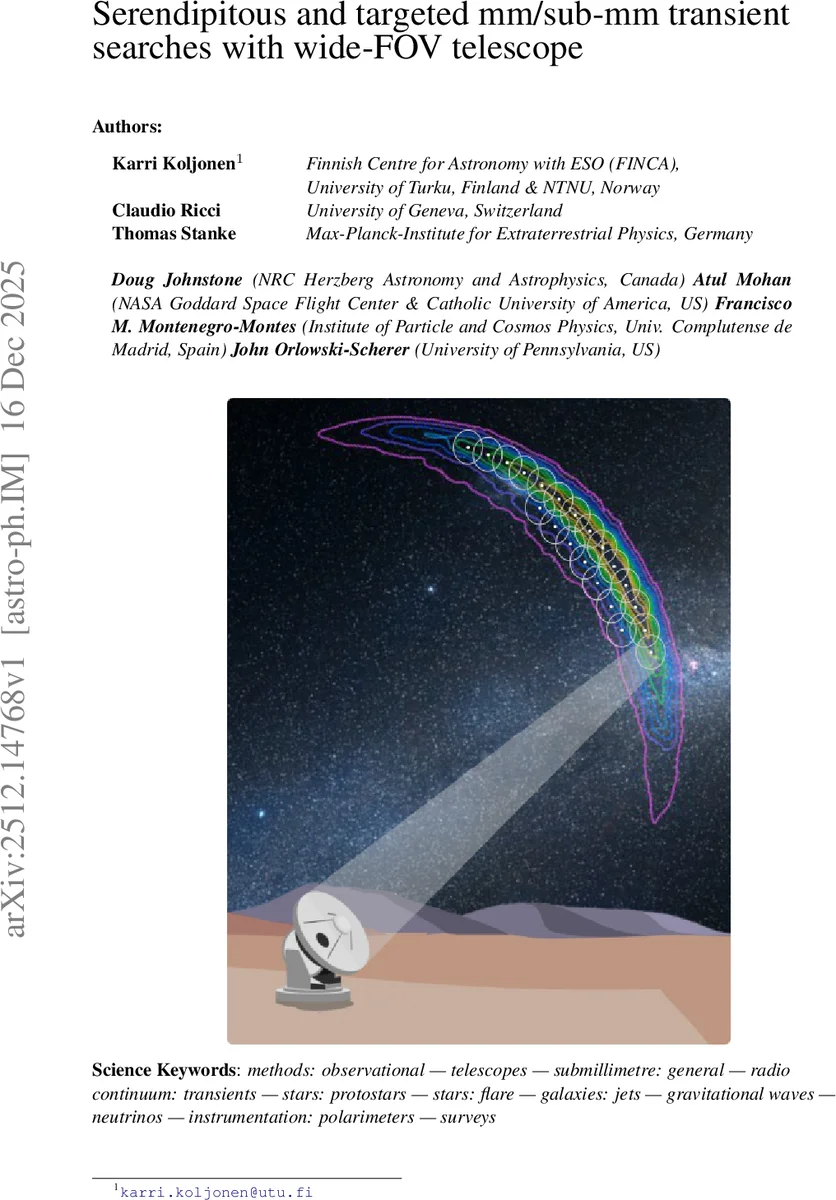
The paper presents a concrete example of tiling a GW localization region (GW170608) with 44 one‑degree fields, achieving a 0.1 mJy beam⁻¹ sensitivity in three hours (Band 3, 91.5 GHz) while slewing at ~2 deg s⁻¹. This demonstrates that a fast‑slewing, wide‑field telescope can efficiently cover large probability maps, a capability lacking in current facilities.
Technical requirements are detailed: (1) a ≥1 deg² instantaneous field of view; (2) arcsecond resolution demanding a ≥30 m dish; (3) broad frequency coverage from 30 to 950 GHz with wide instantaneous bandwidth (≈50 GHz) to maximize continuum sensitivity and enable rapid spectral index measurements; (4) rapid slewing (≈deg s⁻¹) and sub‑minute integration times to capture fast‑evolving transients; (5) on‑the‑fly scanning for uniform coverage; (6) full‑Stokes polarimetric capability for distinguishing synchrotron, gyrosynchrotron, coherent stellar emission, and thermal dust; (7) a real‑time transient pipeline that performs calibrated imaging, difference imaging, and machine‑learning classification to separate astrophysical events from atmospheric fluctuations, instrumental artifacts, and moving foreground objects; (8) bidirectional VOEvent communication for automated trigger receipt and issuance.
The authors compare the proposed facility with existing instruments. Interferometers such as ALMA and NOEMA provide exquisite sensitivity and spectral resolution but lack the field of view and survey speed required for blind discovery. Current CMB experiments (e.g., SPT, ACT) have large sky coverage but insufficient angular resolution and sensitivity for transient science. Thus, a dedicated large‑aperture single‑dish telescope (e.g., the AtLAST concept) uniquely satisfies the combined demands of sensitivity, resolution, and sky coverage.
Potential challenges are acknowledged: structural stability of a very large dish, atmospheric opacity especially at the low‑frequency end (≤30 GHz), and the need for high‑altitude, dry sites to mitigate water‑vapor noise. The data volume generated by continuous wide‑field imaging and real‑time processing will require substantial computing resources and robust, low‑latency networks. Machine‑learning classifiers must be trained on realistic simulations to avoid false positives from atmospheric turbulence or satellite interference.
In conclusion, the paper argues that a wide‑field, high‑sensitivity mm/sub‑mm telescope will become a cornerstone of 2040s multi‑messenger astrophysics. It will enable systematic Galactic monitoring, rapid identification of counterparts to GW and neutrino events, and discovery of new classes of extragalactic transients. Moreover, the long‑term archival dataset produced by routine surveys will provide a legacy resource for population studies, variability statistics, and theoretical model testing well beyond the operational lifetime of the instrument.
Comments & Academic Discussion
Loading comments...
Leave a Comment