The operad associated to a crossed simplicial group
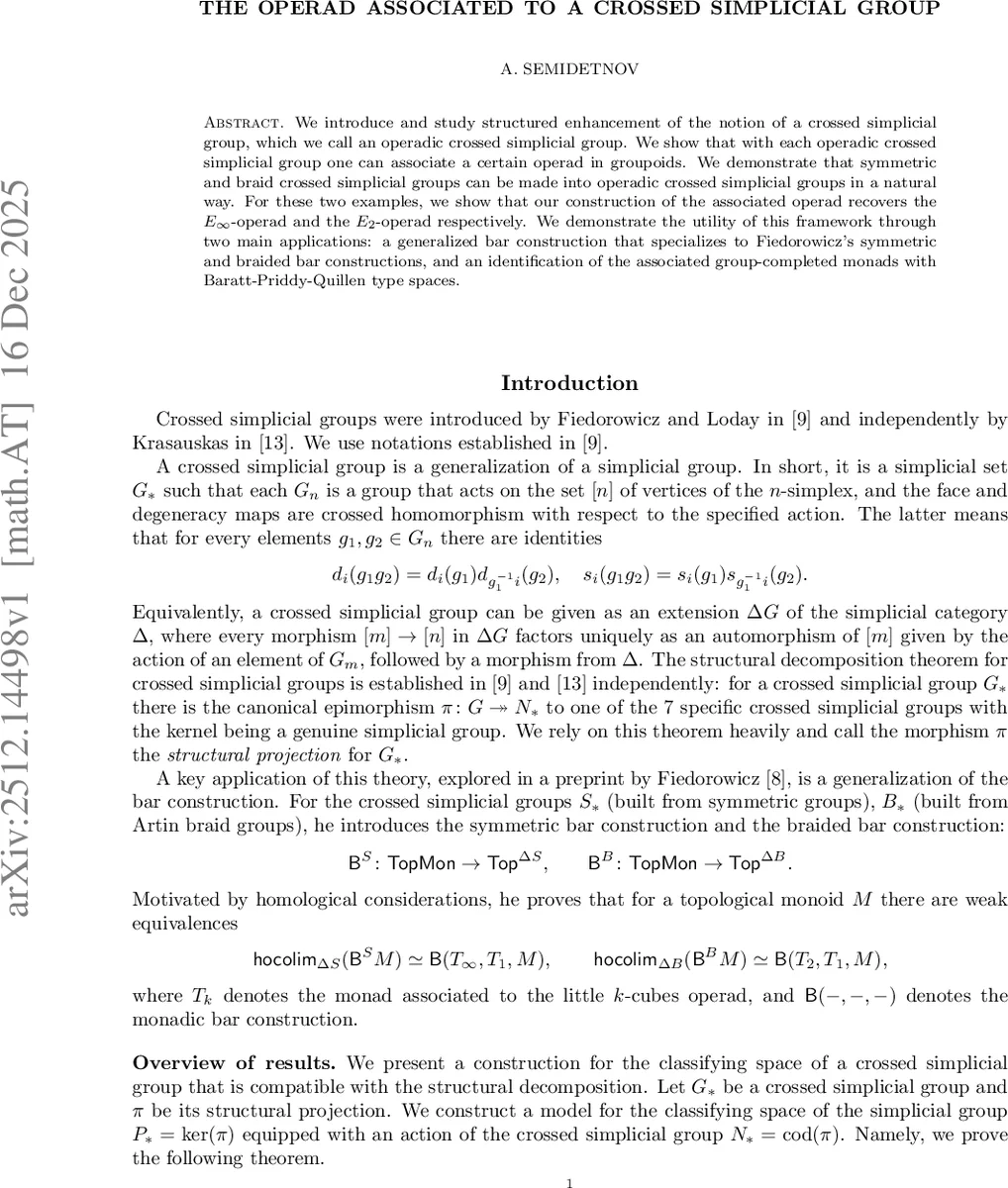
We introduce and study structured enhancement of the notion of a crossed simplicial group, which we call an operadic crossed simplicial group. We show that with each operadic crossed simplicial group one can associate a certain operad in groupoids. We demonstrate that symmetric and braid crossed simplicial groups can be made into operadic crossed simplicial groups in a natural way. For these two examples, we show that our construction of the associated operad recovers the $E_\infty$-operad and the $E_2$-operad respectively. We demonstrate the utility of this framework through two main applications: a generalized bar construction that specializes to Fiedorowicz’s symmetric and braided bar constructions, and an identification of the associated group-completed monads with Baratt-Priddy-Quillen type spaces.
💡 Research Summary
This paper presents a significant advancement in the study of algebraic structures by introducing the concept of “operadic crossed simplicial groups.” This new framework serves as a structured enhancement of the classical notion of crossed simplicial groups, incorporating both monoidal and operadic layers to bridge the gap between group-theoretic structures and operad theory.
The core of the research lies in the construction of an operad in the category of groupoids derived from these enhanced structures. The authors analyze the relationship between a projection $\pi: G_* \to N_$ (where $N_$ is one of the seven fundamental crossed simplicial groups) and its kernel $P_*$. By utilizing this relationship, they construct groupoids $\Gamma_n = G_n // P_n$ and establish a functorial mapping from $(\Delta N)^{op}$ to the category of groupoids ($\mathbf{Gpd}$). A crucial technical achievement is proving that the isomorphism classes of the classifying space $B\Gamma_n$ are equivalent to the Eilenberg-MacLane space $K(P_n, 1)$, thereby linking the algebraic kernel to topological invariants.
The paper further demonstrates the power of this framework through concrete applications to the symmetric ($S_$) and braid ($B_$) crossed simplicial groups. By defining a block sum operation ($\oplus$) using left and right contraction isomorphisms ($s^L, s^R$), the authors show that these groups can be naturally endowed with a monoidal structure. Most remarkably, the construction of the associated operads in these two cases recovers the $E_\infty$-operad and the $E_2$-operad, respectively. This provides a unified algebraic origin for these fundamental objects in homotopy theory, showing that the complex higher-order operations of $E_n$ operads can be understood through the lens of crossed simplicial groups.
Beyond the theoretical construction, the paper provides two major applications that highlight the utility of the “operadic crossed simplicial group” framework. First, it introduces a generalized bar construction that specializes to Fiedorowicz’s symmetric and braided bar constructions, offering a more universal approach to constructing topological spaces from algebraic data. Second, the authors identify the group-completed monads associated with this construction with Baratt-Priddy-Quillen (BPQ) type spaces. This connection is profound, as it links the combinatorial and algebraic properties of crossed simplicial groups directly to the fundamental objects of stable homotopy theory. In conclusion, this work provides a powerful new tool for topologists and algebraists to study the deep interplay between group-theoretic structures, operads, and the homotopy-theoretic properties of loop spaces.
Comments & Academic Discussion
Loading comments...
Leave a Comment