Pragmatic Earth-Fixed Beam Management for 3GPP NTN Common Signaling in LEO Satellites
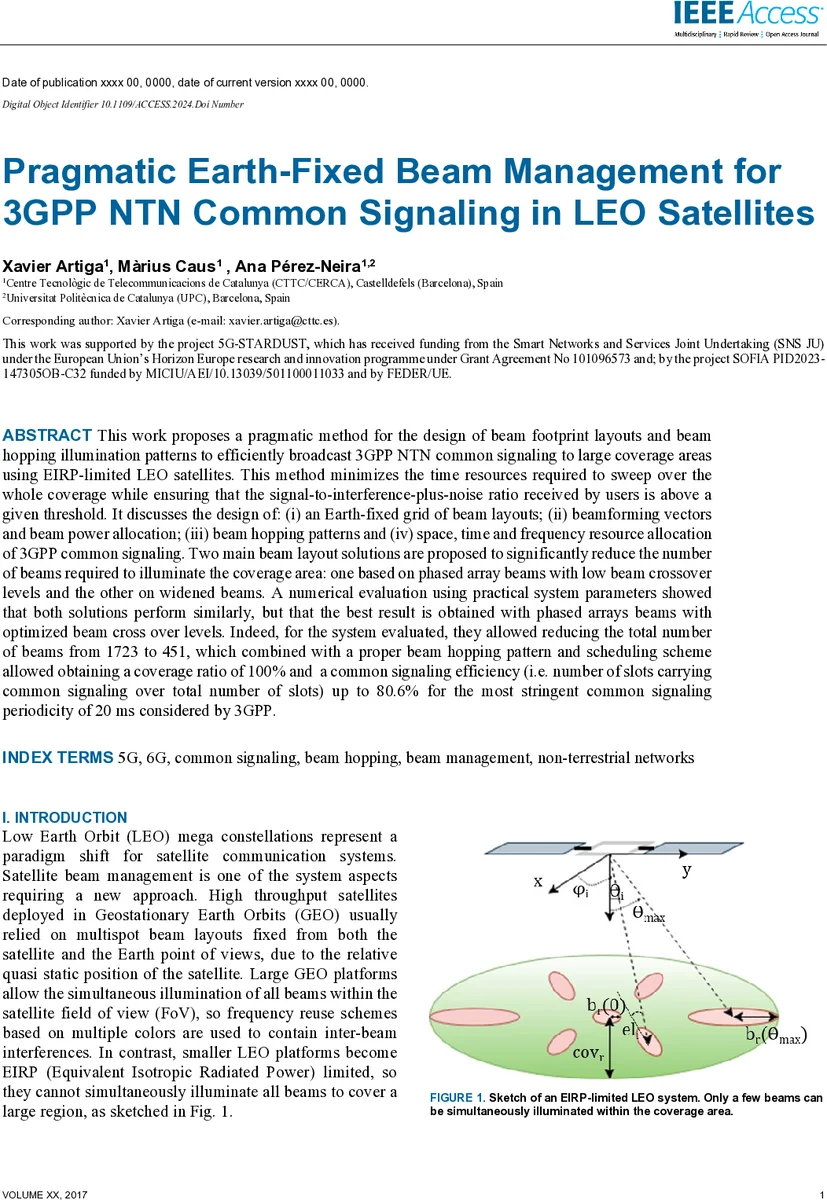
This work proposes a pragmatic method for the design of beam footprint layouts and beam hopping illumination patterns to efficiently broadcast 3GPP NTN common signaling to large coverage areas using EIRP-limited LEO satellites. This method minimizes the time resources required to sweep over the whole coverage while ensuring that the signal-to-interference-plus-noise ratio received by users is above a given threshold. It discusses the design of: (i) an Earth-fixed grid of beam layouts; (ii) beamforming vectors and beam power allocation; (iii) beam hopping patterns and (iv) space, time and frequency resource allocation of 3GPP common signaling. Two main beam layout solutions are proposed to significantly reduce the number of beams required to illuminate the coverage area: one based on phased array beams with low beam crossover levels and the other on widened beams. A numerical evaluation using practical system parameters showed that both solutions perform similarly, but that the best result is obtained with phased arrays beams with optimized beam cross over levels. Indeed, for the system evaluated, they allowed reducing the total number of beams from 1723 to 451, which combined with a proper beam hopping pattern and scheduling scheme allowed obtaining a coverage ratio of 100% and a common signaling efficiency (i.e. number of slots carrying common signaling over total number of slots) up to 80.6% for the most stringent common signaling periodicity of 20 ms considered by 3GPP.
💡 Research Summary
The paper addresses a critical challenge for Low‑Earth‑Orbit (LEO) satellite constellations that must broadcast 3GPP New Radio (NR) non‑terrestrial network (NTN) common control signals (e.g., Synchronization Signal Blocks, PDCCH, SIB1, SIB19, Random Access messages, Paging) under strict Equivalent Isotropically Radiated Power (EIRP) limits. Because a LEO satellite cannot illuminate its entire footprint simultaneously, the authors propose a comprehensive Earth‑fixed beam management framework that jointly designs the beam footprint layout, beamforming vectors, power allocation, beam‑hopping illumination pattern, and the space‑time‑frequency resource allocation for the common signaling.
The methodology proceeds in four stages. First, an Earth‑fixed grid of beam centers is defined based on the half‑power beamwidth at nadir, taking into account Earth curvature and satellite altitude. Second, two alternative beam layout families are investigated: (i) phased‑array beams with deliberately reduced beam‑crossover levels, and (ii) widened beams obtained through aperture truncation, amplitude tapering, or phase tapering. The phased‑array approach preserves high gain while minimizing inter‑beam interference, whereas widened beams reduce the total number of beams at the cost of lower per‑beam EIRP. Third, a beam‑hopping schedule is derived. The satellite can activate only a limited number of beams per hop; each hop lasts one OFDM slot (125 µs), which keeps pointing errors below 0.001°. An activation function selects a subset of beams for each hop, and beamforming weights are updated once per hop, ensuring that footprint variations within a hop are negligible. Fourth, the authors map the 3GPP signaling requirements onto the beam layout. Using a reference BLER of 1 % they extract the minimum SNR needed for each signal (e.g., –6.3 dB for SSB, –10.9 dB for PDCCH, etc.) and allocate power and beam‑crossover levels accordingly.
A numerical evaluation with realistic system parameters (e.g., 600 km orbit, 256‑element antenna array, maximum EIRP ≈ 55 dBW) compares the two layout families. Both achieve the required coverage, but the optimized phased‑array solution dramatically reduces the total number of beams from 1 723 to 451, while still satisfying the most stringent 20 ms periodicity for SSB transmission. This reduction enables a beam‑hopping cycle that sweeps the entire service area within the 20 ms window, yielding a common‑signaling efficiency (ratio of slots carrying signaling to total slots) of up to 80.6 %. The widened‑beam approach attains similar coverage but with slightly lower efficiency due to higher residual interference.
The study’s contributions are threefold: (1) a systematic Earth‑fixed beam‑grid design method for LEO NTN, (2) a joint optimization of beam shape (phased‑array vs. widened) and beam‑crossover level under EIRP constraints, and (3) an integrated beam‑hopping and resource‑allocation scheme that meets 3GPP signaling periodicities while preserving capacity for user‑centric spot‑beam data transmission. The results demonstrate that a carefully engineered beam‑management strategy can reconcile the conflicting demands of wide‑area broadcast signaling and high‑gain, low‑interference spot‑beam data services in future mega‑constellations, paving the way for robust 5G‑NR and upcoming 6G services from LEO platforms.
Comments & Academic Discussion
Loading comments...
Leave a Comment