Estimates for the distances between solutions to Kolmogorov equations with diffusion matrices of low regularity
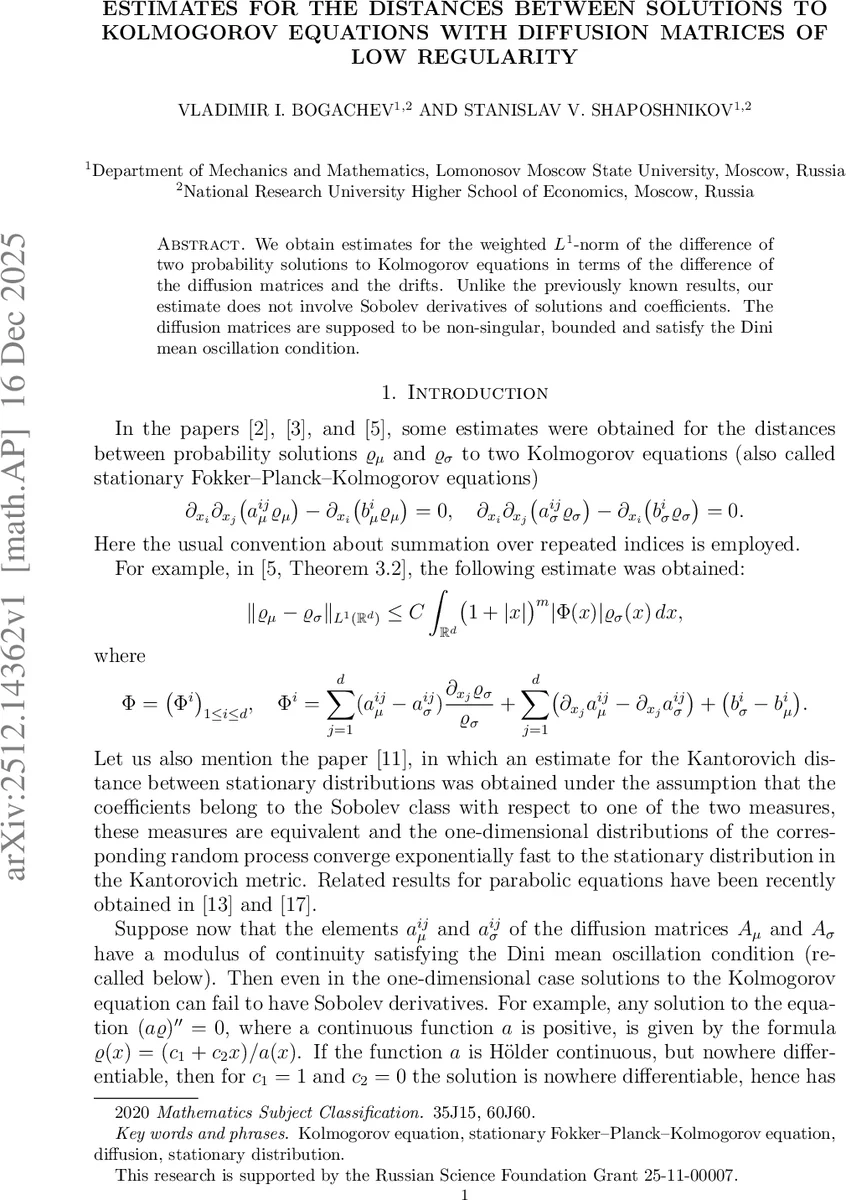
We obtain estimates for the weighted $L^1$-norm of the difference of two probability solutions to Kolmogorov equations in terms of the difference of the diffusion matrices and the drifts. Unlike the previously known results, our estimate does not involve Sobolev derivatives of solutions and coefficients. The diffusion matrices are supposed to be non-singular, bounded and satisfy the Dini mean oscillation condition.
💡 Research Summary
This research presents a significant breakthrough in the stability analysis of Kolmogorov equations, specifically addressing the problem of estimating the distance between two probability solutions when the underlying coefficients—the diffusion matrix $A(x)$ and the drift vector $b(x)$—undergo perturbations. The fundamental objective of the paper is to establish a quantitative bound for the difference between two solutions in terms of the weighted $L^1$-norm, using only the differences in the diffusion and drift coefficients.
Historically, the stability of Kolmogorov equations has been studied under stringent regularity assumptions. Previous mathematical frameworks heavily relied on the coefficients belonging to Sobolev spaces, which necessitates that the coefficients and the solutions themselves possess a certain degree of differentiability. Such requirements pose a significant limitation when modeling real-world phenomena, such as turbulent fluid dynamics, financial market volatility, or biological diffusion processes, where the coefficients are often “rough,” discontinuous, or lack higher-order derivatives.
To overcome these limitations, the authors introduce a much more permissive framework by employing the Dini mean oscillation condition for the diffusion matrix $1$. By assuming that $A(x)$ is non-singular, bounded, and satisfies the Dini condition, the researchers are able to handle much lower levels of regularity than previously possible. Furthermore, the drift $b(x)$ is required to be Borel measurable and subject to specific growth constraints (e.g., $\langle b(x),x \rangle \le \beta_1-\beta_2|x|^2$), ensuring the stability of the underlying stochastic process and preventing uncontrolled divergence.
The most groundbreaking contribution of this work is the derivation of an estimate that completely eliminates the need for Sobolev derivatives of either the solutions or the coefficients. Unlike prior results, the newly derived inequality provides a direct link between the difference in coefficients and the difference in solutions without involving any derivative-based terms. This achievement demonstrates that the $L^1$ distance between two probability solutions can be controlled solely by the differences in the diffusion matrices and the drifts, even in the presence of low-regularity coefficients.
In conclusion, this paper provides a powerful and robust tool for the quantitative analysis of Kolmogorov equations under minimal regularity assumptions. By bypassing the need for smoothness, this research opens new mathematical avenues for studying stochastic differential equations with rough coefficients. The implications are profound for scientific computing, as it allows for more reliable error estimation in numerical approximations of complex stochastic systems where the underlying physical or economic parameters are inherently non-smooth.
Comments & Academic Discussion
Loading comments...
Leave a Comment