Mimicking Human Visual Development for Learning Robust Image Representations
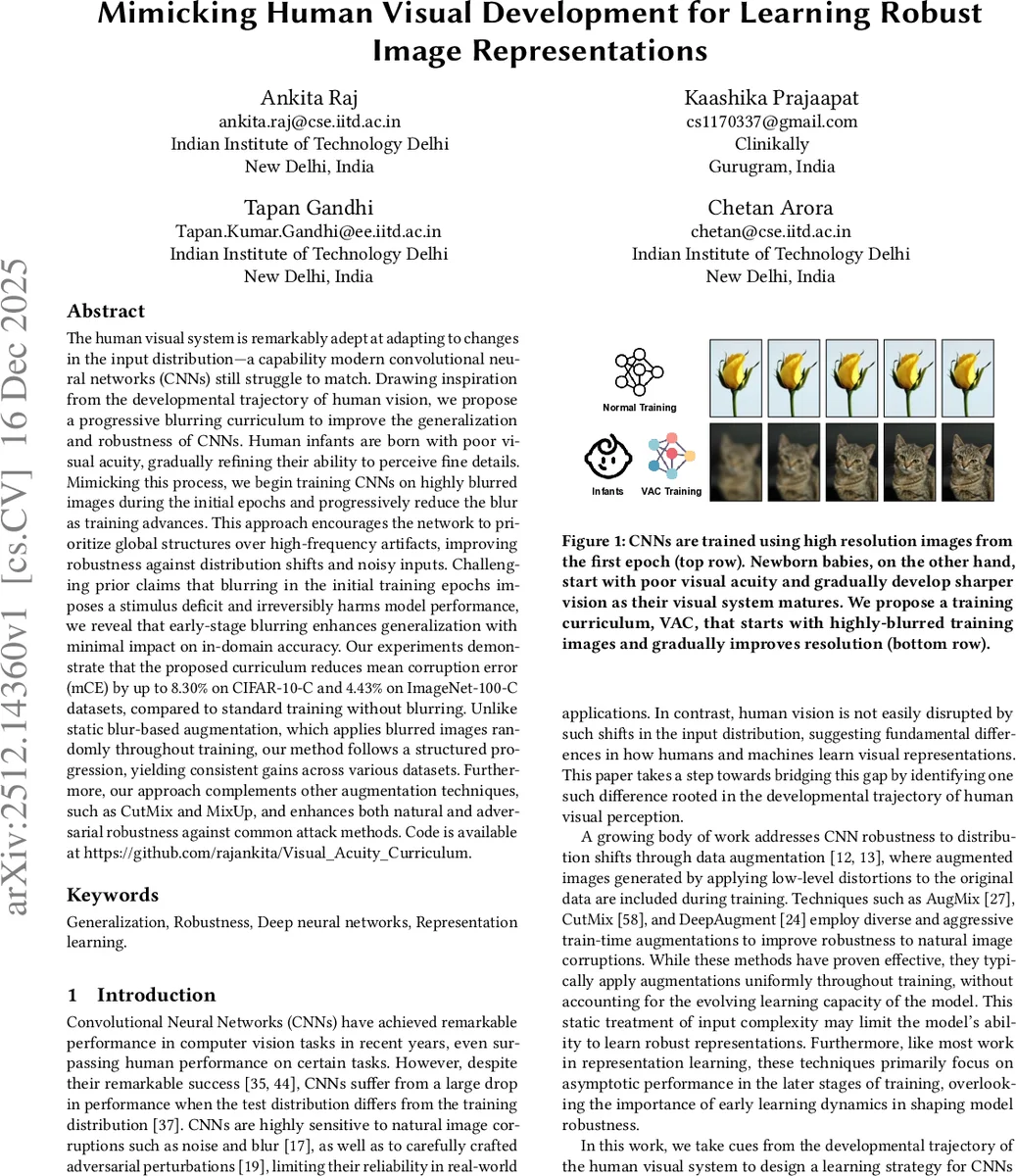
The human visual system is remarkably adept at adapting to changes in the input distribution; a capability modern convolutional neural networks (CNNs) still struggle to match. Drawing inspiration from the developmental trajectory of human vision, we propose a progressive blurring curriculum to improve the generalization and robustness of CNNs. Human infants are born with poor visual acuity, gradually refining their ability to perceive fine details. Mimicking this process, we begin training CNNs on highly blurred images during the initial epochs and progressively reduce the blur as training advances. This approach encourages the network to prioritize global structures over high-frequency artifacts, improving robustness against distribution shifts and noisy inputs. Challenging prior claims that blurring in the initial training epochs imposes a stimulus deficit and irreversibly harms model performance, we reveal that early-stage blurring enhances generalization with minimal impact on in-domain accuracy. Our experiments demonstrate that the proposed curriculum reduces mean corruption error (mCE) by up to 8.30% on CIFAR-10-C and 4.43% on ImageNet-100-C datasets, compared to standard training without blurring. Unlike static blur-based augmentation, which applies blurred images randomly throughout training, our method follows a structured progression, yielding consistent gains across various datasets. Furthermore, our approach complements other augmentation techniques, such as CutMix and MixUp, and enhances both natural and adversarial robustness against common attack methods. Code is available at https://github.com/rajankita/Visual_Acuity_Curriculum.
💡 Research Summary
The paper introduces a novel training curriculum called Visual Acuity Curriculum (VAC) that draws inspiration from the developmental trajectory of human vision. Human infants are born with poor visual acuity, which gradually improves over the first months of life. The authors hypothesize that this early low‑resolution exposure forces the visual system to rely on global, low‑frequency information, thereby fostering robust representations. To emulate this process in convolutional neural networks (CNNs), they propose to start training with heavily Gaussian‑blurred images and progressively reduce the blur intensity as training proceeds.
VAC is defined as a sequence of K curriculum segments. Each segment k is characterized by a pair (n_k, σ_k), where n_k denotes the number of epochs allocated to that segment and σ_k is the standard deviation of the Gaussian kernel applied to the training images. The schedule begins with a high σ_max (chosen based on image resolution) and halves σ at each subsequent segment, while the epoch count for each segment grows roughly exponentially. In practice, only the first ~20 % of total epochs are spent on heavily blurred data; the remainder of training uses progressively sharper images, ending with the original, unblurred inputs.
A key challenge identified by the authors is catastrophic forgetting: once the network moves to a lower‑blur phase, its representations learned under high blur can be overwritten, leading to poor performance on blurred inputs. To mitigate this, VAC incorporates a blur‑replay mechanism. During segment k, each training sample is blurred with a σ_j drawn from the set of all previously encountered blur levels (j ≤ k). The sampling probability p_j is proportional to the number of epochs spent at blur level σ_j, i.e., p_j = n_j / ∑_{i=1}^{k} n_i. This replay strategy, inspired by rehearsal methods in continual learning, preserves low‑frequency features while still allowing the network to adapt to higher‑frequency details.
The authors evaluate VAC on several benchmarks for natural robustness, including CIFAR‑10‑C and ImageNet‑100‑C. Compared with standard training (no blur) and with static blur augmentation, VAC reduces mean corruption error (mCE) by up to 8.30 % on CIFAR‑10‑C and 4.43 % on ImageNet‑100‑C. It also outperforms other curriculum‑learning baselines such as CBS and FixRes. Importantly, in‑domain accuracy (on clean test sets) is largely unchanged, with only a marginal drop (often <0.5 %).
VAC is shown to be complementary to popular augmentation techniques. When combined with CutMix, MixUp, or ℓ₂‑adversarial training, further gains in both natural and adversarial robustness are observed. This demonstrates that the curriculum does not interfere with, but rather enhances, existing regularization methods.
The paper also engages with prior work by Achille et al., which argued that early‑stage stimulus deprivation (e.g., blurring) leads to an irreversible loss of performance—a “critical learning period” hypothesis. The authors counter this claim by presenting empirical evidence that a temporary early blur, followed by a systematic restoration of visual acuity, actually improves robustness without sacrificing clean‑data performance. They reconcile the two viewpoints by suggesting that continuous deprivation is harmful, whereas a brief, structured deprivation followed by normal exposure can be beneficial—a notion that aligns with neuro‑developmental findings that early low acuity may serve a functional role in shaping receptive fields.
In summary, VAC contributes three core ideas: (1) an early‑stage information deficit that forces the model to focus on global, low‑frequency cues; (2) a progressive increase in input detail that gradually introduces high‑frequency information; and (3) a replay mechanism that preserves earlier learned representations. Together, these components yield CNNs that are more resilient to distribution shifts, common corruptions, and adversarial attacks, while maintaining competitive accuracy on the original task. The method is simple to implement, architecture‑agnostic, and can be combined with existing data‑augmentation pipelines, making it a practical tool for building more robust vision systems. Future work may explore extending the curriculum to other sensory modalities, incorporating color or depth development, and testing VAC on large‑scale pre‑training regimes.
Comments & Academic Discussion
Loading comments...
Leave a Comment