Dimension theory of inhomogeneous Diophantine approximation with matrix sequences
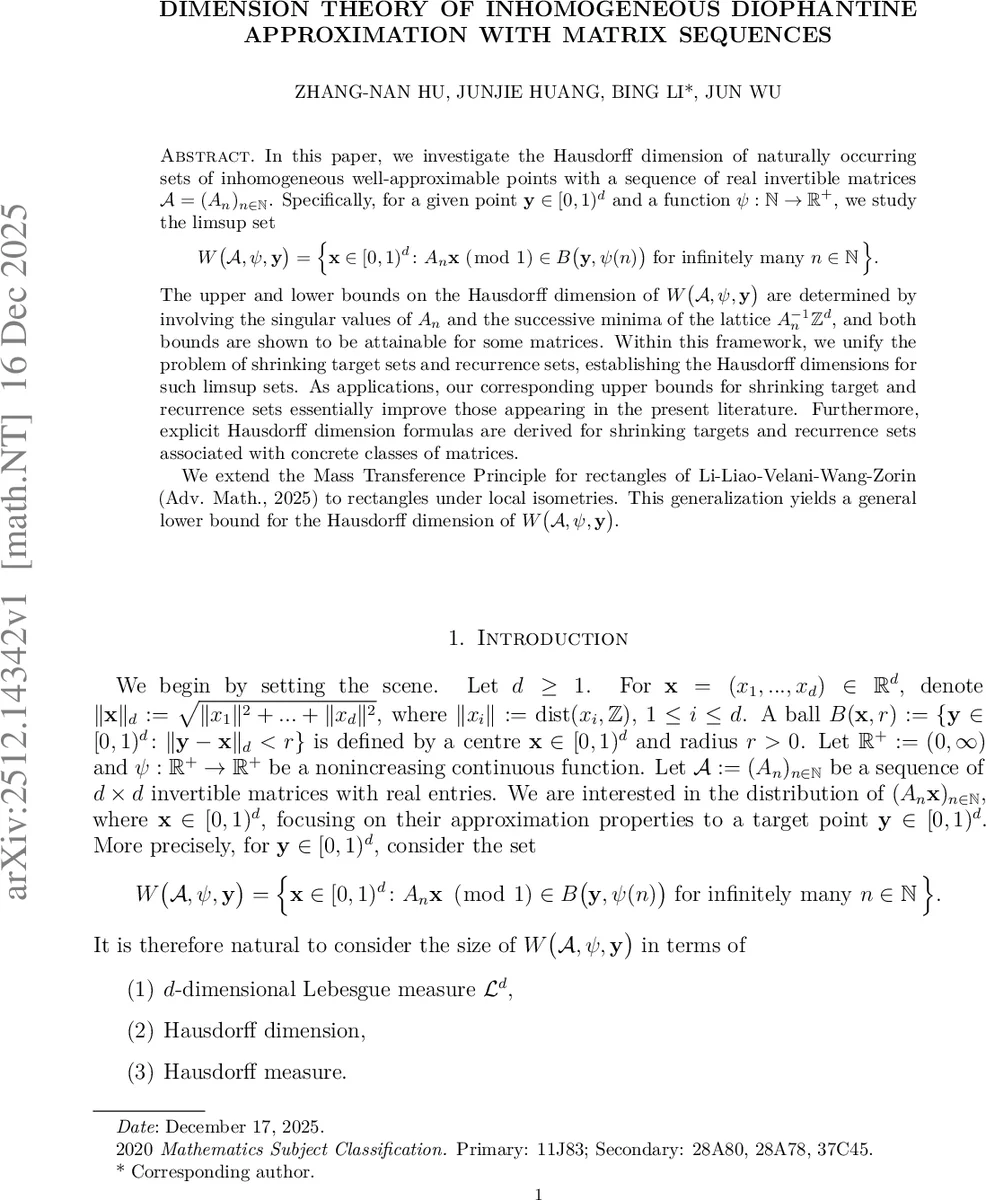
In this paper, we investigate the Hausdorff dimension of naturally occurring sets of inhomogeneous well-approximable points with a sequence of real invertible matrices $\mathcal{A}=(A_n)_{n\in\mathbb{N}}$. Specifically, for a given point $\mathbf{y}\in [0,1)^d$ and a function $ψ: \mathbb{N} \to \mathbb{R}^+$, we study the limsup set [ W\big(\mathcal{A},ψ,{\bf y}\big) =\Big{\mathbf{x}\in [0,1)^d\colon A_n\mathbf{x}(\bmod1)\in B\big(\mathbf{y}, ψ(n)\big) {\rm ~ for~ infinitely ~many}~n\in\mathbb{N}\Big}.] The upper and lower bounds on the Hausdorff dimension of $W\big(\mathcal{A},ψ,{\bf y}\big)$ are determined by involving the singular values of $A_n$ and the successive minima of the lattice $A_n^{-1}\mathbb{Z}^d$, and both bounds are shown to be attainable for some matrices. Within this framework, we unify the problem of shrinking target sets and recurrence sets, establishing the Hausdorff dimensions for such limsup sets. As applications, our corresponding upper bounds for shrinking target and recurrence sets essentially improve those appearing in the present literature. Furthermore, explicit Hausdorff dimension formulas are derived for shrinking targets and recurrence sets associated with concrete classes of matrices. We extend the Mass Transference Principle for rectangles of Li-Liao-Velani-Wang-Zorin (Adv. Math., 2025) to rectangles under local isometries. This generalization yields a general lower bound for the Hausdorff dimension of $W\big(\mathcal{A},ψ,{\bf y}\big)$.
💡 Research Summary
The paper studies the Hausdorff dimension of a family of lim‑sup sets that arise naturally in inhomogeneous Diophantine approximation when the approximating maps are given by a sequence of real invertible matrices (\mathcal A=(A_n)_{n\in\mathbb N}). For a fixed target point (\mathbf y\in
Comments & Academic Discussion
Loading comments...
Leave a Comment